
Loading...

Most paragraphs work best at 2 to 4 sentences for web writing and 4 to 8 sentences for academic essays, though journalism often runs just 1 to 3. There's no fixed rule because context, not word count, decides. The real test is whether every sentence in the paragraph serves one controlling idea. Get that right and the sentence count almost takes care of itself. The sections below break down the ranges by writing context, show you the structural template, and give you a revision checklist for spotting a paragraph that's grown too big for its job.
TL;DR:
- Paragraphs should contain a single controlling idea, with each sentence directly supporting or relating to that main point.
- Shorter paragraphs of two to four sentences work best for web content, while academic writing can extend to eight sentences if necessary.
- On mobile screens, break paragraphs over four or five lines or around 150 words to maintain readability and reader engagement.
- Remove or split paragraphs that cover multiple ideas, lack a clear topic sentence, or exceed 150 words for online content.
- The focus should always be on clarity of the main claim; sentence count is secondary to whether the paragraph effectively develops one idea.
Sentence count isn't arbitrary. It tracks how much a reader is willing to absorb before needing a visual break, and that tolerance shifts depending on where the writing lives.
Treat these as starting points, not laws. A dense academic argument might justify a ninth sentence; a punchy blog intro might work in one.
Every well-built paragraph revolves around one controlling idea, and every sentence inside it has to serve that idea. The moment a sentence introduces a new idea, UNC's Writing Center recommends starting a fresh paragraph rather than cramming it in.
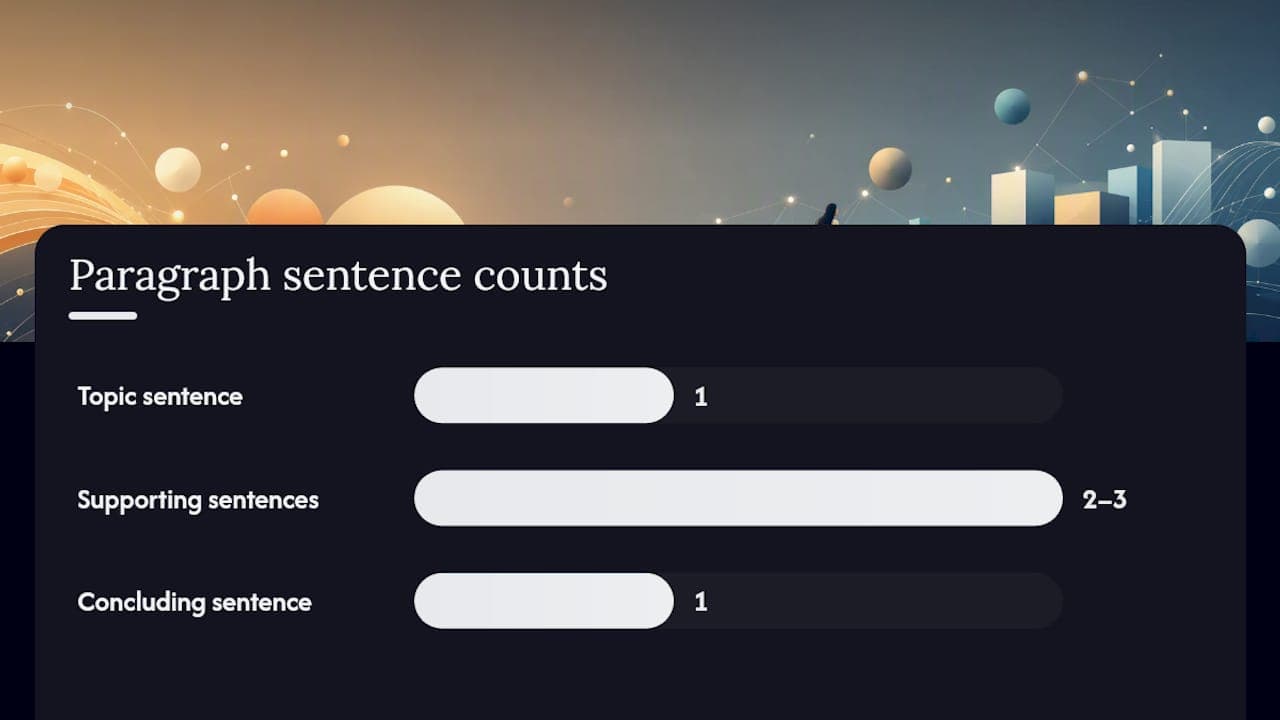
The classic structure students learn first still holds up because it forces discipline:
That's a 4 to 5 sentence paragraph, and it's the backbone of most academic writing. Extend it only when the evidence genuinely demands more room, like multi-step reasoning or a comparison that needs two data points instead of one. Padding a paragraph to hit a word count is the opposite of the goal.
Pro Tip: Read your topic sentence alone, then read your last sentence alone. If the second one doesn't clearly connect back to the first, your paragraph has probably wandered off its own idea.
If you're structuring a full essay rather than a single paragraph, this breakdown of paragraph counts by word total shows how the math scales across a whole paper.
Yes, and the shift matters more than most writers assume. A paragraph that reads fine on a laptop screen can look like a wall of text on a phone, and readers bail before they finish it.
Run any paragraph through these questions before you call it finished:
Red flags that mean it's time to split: two separate claims sharing one paragraph, a word count creeping past 150 on a web page, or an academic paragraph with no identifiable topic sentence at all. Purdue OWL notes that mixed evidence types or a claim tangled up with its counterclaim are structural tells that a split is overdue, even when the sentence count still looks reasonable on paper.
Pro Tip: When you find a paragraph doing too much, don't just chop it in half. Find the sentence where the idea actually shifts, and split there. A clean structural break beats an arbitrary one every time.
For a longer walk-through of revision habits beyond paragraph length, this academic writing checklist covers the surrounding steps.
Seeing the ranges in action makes them easier to copy. Here are three short samples, each tuned to its medium.
A reusable template: [Topic sentence stating the claim]. [Supporting evidence or example]. [Second supporting point]. [Sentence addressing a complication or counterpoint]. [Concluding sentence tying back to the main idea]. When you're working citations or direct quotes into that structure, treat the quote as one of your supporting sentences rather than an extra addition. If you need a deeper primer on structuring paragraphs inside a full essay, this guide on improving academic writing walks through it.
The most common mistake isn't paragraphs that are too long. It's paragraphs trying to do two jobs at once, usually because a student is rushing toward a word count instead of finishing a thought. Instructors notice immediately when a topic sentence is missing, because the paragraph reads like a list of facts with no argument holding it together.

Under deadline pressure, run the four-question checklist above on just your first and last paragraph of any essay. Those two carry the most weight with a grader, and they're where structural sloppiness shows up first.
The sentence-count ranges in this article are useful scaffolding, not scripture, and treating them as rigid rules is where a lot of writing advice goes wrong. A 12-sentence paragraph isn't automatically bad, and a 3-sentence paragraph isn't automatically good. What matters is whether the paragraph tracks one idea from start to finish.
Where conventional advice falls short is in treating word count as a proxy for quality. Editorial tools that flag anything over 150 words are solving a screen-readability problem, not a writing-quality problem, and conflating the two leads students to chop good paragraphs into fragments or, worse, pad thin ones to hit an assignment's page count.
If you take one thing from this, prioritize the topic sentence test before you count anything. Ask what single claim the paragraph is making. If you can't answer in one sentence, no amount of trimming or padding will fix it. Sentence count is a downstream symptom. Controlling idea is the actual diagnosis.
— Tilen
Counting sentences by hand works, but it's slow when you're revising a full draft against a deadline. A power editor tool can read a paragraph, flag where it drifts off its controlling idea, and suggest where to split or tighten it, so you're not guessing whether that 9-sentence block needs to become two.

Guided Essays builds outline structure before you draft a single paragraph, which cuts down on the sprawling, multi-idea blocks that show up when you write first and organize later. The Reference Builder handles citations inside those paragraphs so a quote or source doesn't throw off your sentence flow. Samwell's Free Plan lets you run these tools on a limited word count to see how the suggestions feel, and the Academic Plan unlocks extended limits for full papers. Try pasting one dense paragraph from your current draft into the essay editor and see what it flags.
Neither number is a fixed rule. Academic paragraphs often land around 4 to 8 sentences, per Purdue OWL, while a 5 to 7 sentence paragraph fits comfortably in that range as long as it sticks to one controlling idea.
Every sentence should connect to a single controlling idea, and the paragraph should open with a clear topic sentence. Beyond that, structure it with supporting evidence and close with a sentence that wraps the point or transitions to the next one, following the model UNC's Writing Center recommends.
It depends entirely on whether it's still developing one idea. A 12-sentence paragraph that mixes multiple claims needs splitting, but one that walks through a single complex argument step by step can hold together, even though it runs well past typical web-length ranges.
Technically yes, but it's rare that a very long paragraph serves a single controlling idea without drifting. In web writing especially, editorial tools commonly flag anything over roughly 150 words, as it almost always signals multiple ideas stacked into one block.
Split when the topic shifts, when you introduce a new type of evidence, or when the paragraph would fill most of a mobile screen. If you're revising and can't summarize the paragraph in one sentence, that's usually the clearest sign it needs to break into two.



