
Loading...

There is no fixed number of paragraphs an essay must have. Most academic essays need at minimum an introduction, one or more body paragraphs, and a conclusion, and short essays often follow the familiar five-paragraph model. Beyond that floor, the right count depends on word limit, assignment complexity, and academic level, which the rules of thumb below turn into an actual plan.
TL;DR:
- Essays between 200 and 400 words typically require three to four paragraphs, including an introduction, one or two body paragraphs, and a conclusion.
- Longer essays, such as those around 1,500 words, need about four to eight body paragraphs, with each about 150 to 250 words, plus a brief introduction and conclusion.
- Each paragraph must do three jobs: state a point, support it with evidence, and transition to the next idea, usually running 100 to 250 words.
- Different essay types and lengths depend on the purpose, with short responses favoring concision and research papers requiring multiple paragraphs for methodology and background.
- Structuring your essay based on the number of ideas and evidence, not a fixed paragraph count, yields a clear, balanced, and effective argument.
The honest answer scales with word count, not with a rule someone taught you in ninth grade. A 300-word response and a 3,000-word research paper obey completely different math.
Use this as a starting reference, not a script:
The five-paragraph model (intro, three body paragraphs, conclusion) works well for timed writing, standardized tests, and early high school assignments because it forces a clean thesis and three pieces of support. It falls apart once an argument needs more than three supporting points or a counterargument section, which is why Trent University's writing guide flags it as a teaching tool that gets too rigid for university-level work. College admissions essays, narrative pieces, and one-paragraph short-answer responses break the mold entirely. They're built around a moment or an idea, not a five-slot template.
A paragraph earns its place when it does three jobs: state a point, back it up, and connect to what comes next. Skip any one of those and the paragraph either wanders or feels disconnected from the essay around it.
Academic paragraphs typically run 100 to 250 words, with body paragraphs in longer essays landing closer to 150 to 250 words once you factor in evidence and analysis. Start a new paragraph whenever the idea shifts, a new piece of evidence enters, or you pivot to a counterargument. A paragraph analyzing one poem's imagery and then jumping to a different poet's technique needs a break between those two moves, even if the topic sentence never quite says so.
Oxford's guidance for essay writing is blunt about the priority order here: each paragraph should develop one self-contained point, and paragraph count should never be the goal you're writing toward.
Pro Tip: Pull every topic sentence out of your draft and read them in a row, ignoring the rest of the paragraph. If they don't form a logical chain that mirrors your thesis, your paragraph breaks are in the wrong places, even if the word counts look fine.
Yes, and this is where students get tripped up trying to force one structure onto every assignment. The purpose of the writing changes what "enough paragraphs" even means.
The common thread: paragraph count follows the number of distinct ideas the assignment requires you to develop, not the other way around.
This is the part most essay-writing advice skips, and it's the most useful one. You can convert almost any word count into a working paragraph plan in four steps.
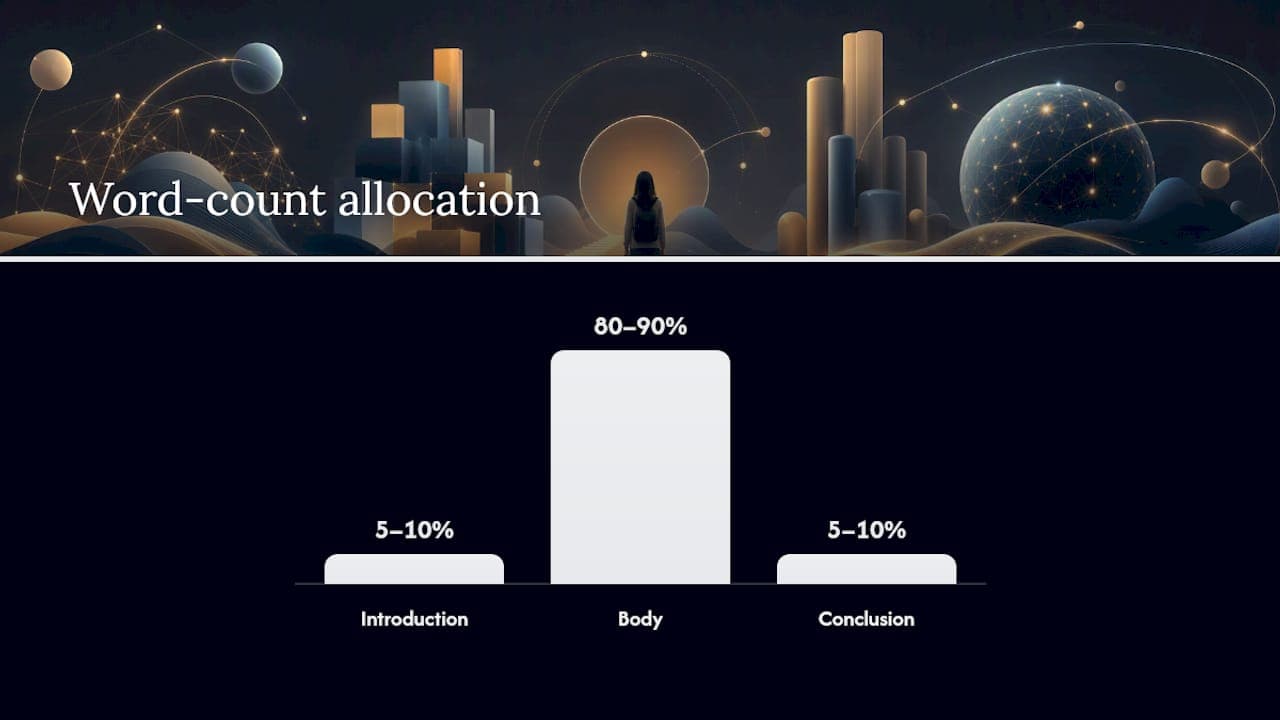
Worked example, 500 words: roughly 40 words for the intro, 40 for the conclusion, leaving 420 for the body. At 150 words per paragraph, that's about three body paragraphs, five total. Worked example, 1,500 words: about 100 to 150 words each for intro and conclusion, leaving 1,200 to 1,300 for the body. At 175 words per paragraph, that lands around seven body paragraphs, matching the four to eight range Canterbury's writing guide describes for essays this length.
Pro Tip: If your reverse outline produces ten thin subpoints, merge the weaker ones. Ten underdeveloped paragraphs read worse than six well-supported ones, even though the first draft looks longer. Samwell's Guided Essays can turn this outline into a structured draft if you want a head start on the paragraph breakdown before you write.
Chasing a specific paragraph count is the wrong question, and I'd argue it's actively counterproductive once you're past high school. The real test is whether each paragraph carries one clear point that moves your argument forward. Run the topic-sentence check, look at whether your paragraphs are roughly balanced in weight, and check your rubric or instructor's stated expectations before you check anything else. A five-paragraph essay that hits every rubric criterion beats a seven-paragraph one padded to look thorough.
— Tilen
Once you know how many paragraphs your essay needs, actually writing them at the right length is the next hurdle, and that's where Samwell earns its keep. Guided Essays builds a structured outline from your thesis before you write a single paragraph, and the Power Editor expands a thin topic sentence into a full, evidence-backed paragraph when your reverse outline leaves a gap. The citation editor keeps sources in MLA or APA format as you go, so paragraph-level evidence stays properly attributed.

None of this replaces your own argument or judgment. Samwell is built for drafting and editing within your school's academic integrity rules, not for skipping the thinking part. If you're staring at a word count and a blank outline right now, start by mapping your paragraph plan on the Samwell essay tool and build from there.
Both are valid depending on scope. Three paragraphs (intro, one body, conclusion) suit very short responses, while five paragraphs fit a standard short essay with three supporting points.
Three to four paragraphs work for shorter assignments, roughly 200 to 400 words, especially when the argument only needs one or two body paragraphs plus intro and conclusion.
Yes, for a mid-length essay of 800 to 1,000 words. Six paragraphs usually means intro, four body paragraphs covering distinct points, and a conclusion.
Not typically. Most academic definitions require at minimum an introduction, body content, and a conclusion, which usually means three paragraphs even in the shortest cases.
Check whether every distinct point in your thesis has its own paragraph and whether each paragraph passes the one-sentence-summary test; if points are crammed together or paragraphs run past 250 words, you likely need more.



