
Loading...

There is no fixed number of paragraphs an essay must have. Every essay needs a minimum of three parts: an introduction, at least one body paragraph, and a conclusion. Beyond that minimum, a short response might run three paragraphs, a standard assignment often lands around five, and many college-level papers need four to eight or more. The right count depends on how many distinct points your thesis requires, not on a rule someone taught you in ninth grade.
TL;DR:
- Essays should be structured around main points, with each point supporting the thesis and typically earning its own paragraph.
- Most paragraphs in academic writing range from 150 to 250 words, with the total number depending on the overall word count and complexity of the argument.
- For essays between 500 and 750 words, expecting 4 to 6 paragraphs is standard, while longer papers often require more, sometimes exceeding 10.
- Use the number of points or claims you need to make as a guide to paragraph count, rather than fixing on a rigid structure like the five-paragraph model.
- Effective paragraphs contain a clear topic sentence, supporting evidence, analysis, and a transition, and should be split if they become too long or cover multiple ideas.
The fastest way to estimate paragraph count is by word count, since most academic paragraphs run 100 to 200 words, with 150 being a reasonable average. Once you know your target length, you can back into a rough paragraph range instead of guessing.
These figures come from writing-guide estimates on essay length, which map word count to paragraph ranges as a planning tool, not a mandate.
Pro Tip: Use the five-paragraph model only for timed tests or short response assignments. The moment your assignment allows more than 500 to 750 words, that rigid five-slot structure usually can't hold your evidence without cramming.
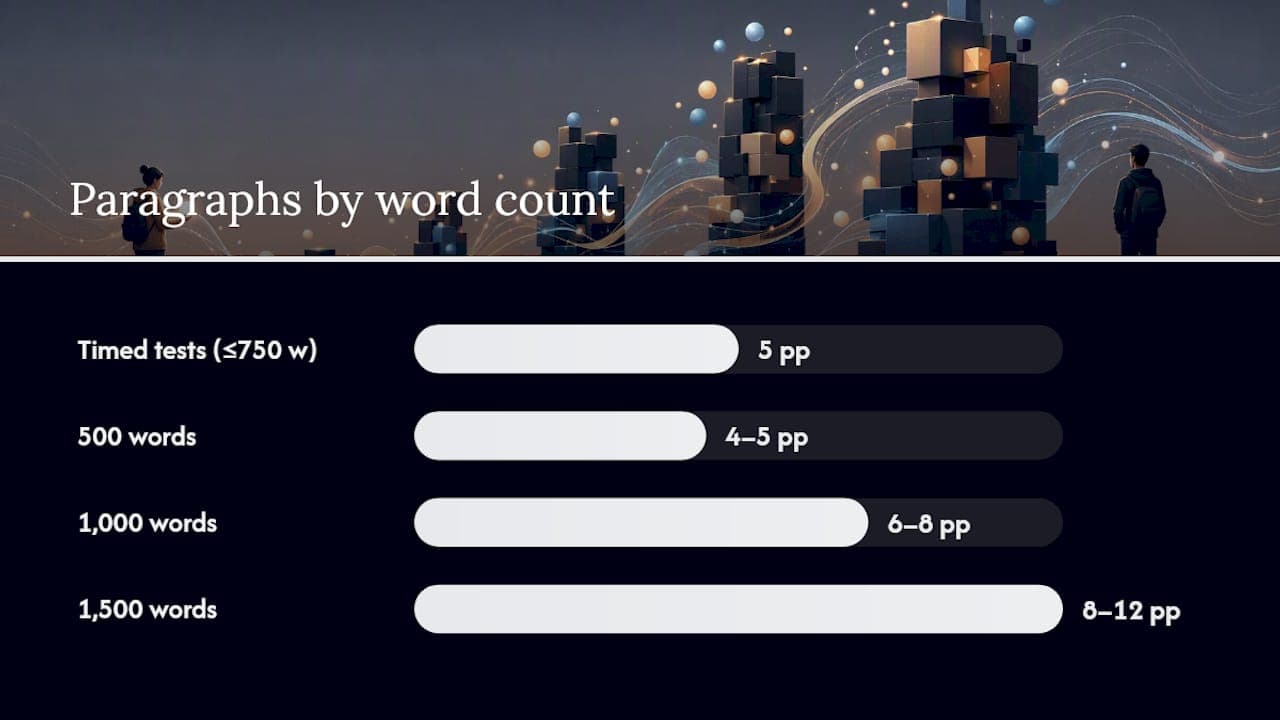
Matching paragraph count to word count gets easier once you see it laid out. The ranges below reflect standard academic expectations, where a well-built body paragraph runs 150 to 250 words and includes a topic sentence, evidence, and analysis.
| Word Count | Typical Paragraph Range | Notes |
|---|---|---|
| 300–500 | 3–4 | Introduction, one to two body paragraphs, conclusion |
| 500–750 | 4–6 | Common for short response essays |
| 1,000 | 6–8 | Standard undergraduate essay length |
| 1,500 | 8–12 | Room for counterarguments or added evidence |
| 2,500 | 13–18 | Multiple sub-arguments or sections |
| 30+ | 30+ | Dissertation chapters, long research papers |
Complex theses, methodology sections, and multi-part assignments push those numbers higher. A methods section in a research paper, for instance, often needs its own paragraph cluster regardless of overall word count, because it's doing a structurally different job than an argumentative body paragraph.
Counting paragraphs backward from a word target only gets you so far. The more reliable method starts with your argument, not your word processor.
Here's a worked example: a thesis arguing that remote work improves productivity might break into three points: focus time, commute elimination, and flexible scheduling. That's a minimum of three body paragraphs, plus one more if you address a counterargument like collaboration friction. Introduction and conclusion bring the total to five or six.
Paragraph count means little if the paragraphs themselves are weak. Each one needs to do four jobs in sequence.
Most well-built paragraphs run 150 to 250 words, or roughly five to eight sentences. Crafting that first line well matters more than people assume. A vague topic sentence forces the reader to guess where the paragraph is headed; a strong topic sentence tells them immediately.
Pro Tip: If a paragraph runs past 10 sentences or you notice it drifting into a second idea, split it. Long paragraphs are usually two paragraphs wearing one coat.

Different assignment types call for different scaffolds. Here's how three common formats break down in practice.
Run through this list before you turn in any draft, no matter the essay type.
On that last point: most rubrics never specify a paragraph count at all. Professors grade for clarity, argument development, and word count. If your syllabus is silent on structure, ask your instructor directly rather than guessing.
Pro Tip: Merge tiny paragraphs that lack development, especially one or two-sentence paragraphs that restate a point without adding evidence. A pre-submission structure check catches this kind of thin paragraphing fast.
The guidance above tracks what university writing centers actually teach, not internet folklore. Harvard's College Writing Center frames paragraph breaks around the steps needed to build an argument, with each paragraph focused on one main point. The University of Evansville's writing center backs the 150 to 250-word paragraph estimate used throughout this guide, and word-count-to-paragraph mapping draws on the same estimates found in established writing guides and reference resources like Thesaurus.com's breakdown of essay paragraphing.
For students who want help applying this in practice, Samwell.ai's relevant tools include:
Students fixate on hitting a specific number of paragraphs because it feels measurable. It's a false comfort. A five-paragraph essay with three thin, repetitive body paragraphs is weaker than a four-paragraph essay where each one earns its place. The number was never the point. The argument was.
Where conventional advice falls short is treating the five-paragraph model as a universal template instead of what it actually is: a training wheel for short, timed writing. Once you're past high school, or once an assignment crosses roughly 750 words, that rigid structure starts working against you. You end up padding a third body paragraph just to hit the shape, when the honest move is adding a fourth paragraph for a point that deserves its own space.
If you take one thing from this, take the ordering: figure out your points first, then let paragraph count fall out of that list. Word count and paragraph estimates are useful checkpoints, not starting points. Students who reverse that order tend to write essays that hit a target length while saying less than they should.
— Tilen
Figuring out where one paragraph should end and the next should begin is often harder than knowing your thesis. There are tools that provide a faster path from outline to finished draft by building paragraph-by-paragraph structure and allowing you to expand thin paragraphs or split overloaded ones without starting over. Citation formatting for APA, MLA, and other standards can run alongside your draft instead of as a separate scramble before the deadline.

If your paragraphs feel either too thin or too tangled, try the enhanced essay creator to build a structured draft and adjust paragraph length as you go.
Yes. Seven paragraphs fits comfortably in the 1,000 to 1,500-word range, typically as an introduction, five body paragraphs covering distinct points or a counterargument, and a conclusion.
Neither number is required. Five paragraphs is the common classroom default (intro, three body paragraphs, conclusion), while four paragraphs works fine for shorter assignments with two well-developed points instead of three.
Yes. Six paragraphs suits an introduction, four body paragraphs, and a conclusion, often used when a thesis has three main points plus a counterargument.
Yes, as long as it still has an introduction, at least two body paragraphs covering separate points, and a conclusion. Four paragraphs works well for essays around 500 words.
Most college essays run five to eight paragraphs for standard 750 to 1,000-word assignments, though research papers and longer analyses regularly exceed that range.



