Loading...

Many students ask how quickly they can finish a 2000 word essay, often underestimating the total time required. While typing 2000 words might seem straightforward, the complete process involving research, planning, drafting, and editing typically spans 6 to 10 hours total. This guide breaks down each writing phase and reveals practical strategies to manage your time efficiently while maintaining academic quality.
| Point | Details |
|---|---|
| Total time commitment | Writing 2000 words requires 6 to 10 hours including research, planning, drafting, and editing stages. |
| Average writing speed | Focused academic writing averages 200 to 300 words per hour, much slower than casual typing speeds. |
| AI writing assistance | Generative AI reduced writing time by 56.7% for graduate students while improving quality. |
| Planning saves time | Organizing research and creating outlines before writing prevents last minute stress and extensive rewriting. |
| Support systems matter | Writing groups and scheduled sessions reduce procrastination and isolation while improving completion rates. |
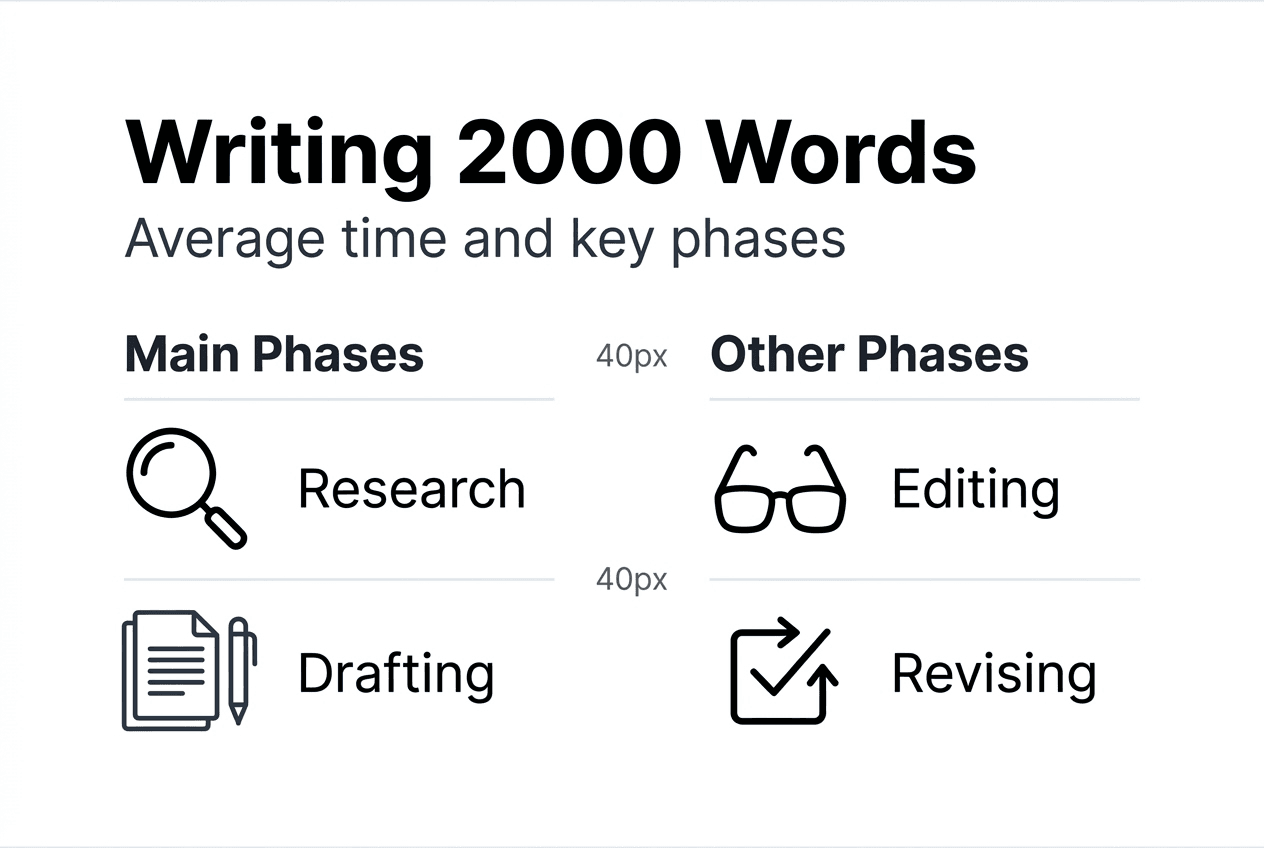
Most people focus only on the typing portion when estimating how long writing takes. The reality involves four distinct phases that each demand significant attention and time.
Research consumes 1.5 to 3 hours as you locate credible sources, read relevant materials, and extract key information. Planning adds another 30 to 60 minutes for outlining arguments and organizing ideas logically. The actual drafting phase takes 3 to 4 hours, while editing and refining your work requires 1 to 2 hours to polish structure, fix errors, and strengthen arguments.
Writing Phase Time Breakdown
| Phase | Time Required | Key Activities |
|---|---|---|
| Research | 1.5 to 3 hours | Finding sources, reading materials, note taking |
| Planning | 30 to 60 minutes | Creating outlines, organizing arguments |
| Drafting | 3 to 4 hours | Writing content, developing ideas |
| Editing | 1 to 2 hours | Revising structure, correcting errors |
Your focused writing speed averages 200 to 300 words per hour for academic tasks, far below your casual typing speed. This slower pace reflects the cognitive work of formulating coherent arguments, connecting ideas logically, and maintaining academic standards. Rushing through any phase typically means spending more time fixing problems later.
Proper preparation dramatically reduces stress and last minute scrambling. Students who allocate time for each stage produce higher quality work and experience less anxiety. Understanding these writing challenges and AI tools available can help you plan more realistically.
Pro Tip: Block specific time periods for each writing phase in your calendar. Treat these appointments as non negotiable commitments to avoid procrastination and maintain steady progress.
Common Time Management Mistakes
Your personal writing speed varies based on multiple individual and situational factors. Time requirements range from 2 to 8 hours depending on your specific circumstances and the complexity of your assignment.
Experience level plays a major role in determining speed. Graduate students familiar with academic writing conventions complete essays faster than undergraduates learning these skills for the first time. Your comfort with the subject matter also affects pace significantly. Writing about familiar topics allows quicker progress than exploring completely new territory.

Topic complexity adds substantial time through deeper research requirements and more nuanced argument development. Technical subjects demand precise terminology and careful explanation, while straightforward topics allow faster composition. The thinking speed and argument formulation represents the main bottleneck, more so than actual typing speed.
Available resources impact your efficiency considerably. Access to quality databases, previous coursework notes, or expert guidance speeds up research and reduces time spent verifying information. Limited resources force you to search longer and work harder to find credible support for your arguments.
Individual Factors Affecting Speed
Your mental state and environment matter too. Writing when well rested in a quiet space produces faster results than attempting work while exhausted or distracted. These AI tips for student writing can help you optimize conditions for better performance.
Pro Tip: Assess your strengths and weaknesses honestly before starting. If research takes you longer, allocate extra time there rather than assuming average timeframes apply to you.
Recent studies reveal significant time savings when students use AI writing assistants appropriately. Research found GenAI reduced writing time by 56.7% for graduate students working on academic assignments.
The quality improvements prove equally impressive. The same research showed GenAI improved essay quality from A minus to A average among graduate users. Non native English speakers benefit particularly from AI assistance with grammar, vocabulary selection, and sentence structure refinement.
Success with AI tools depends entirely on how you use them. Students who understand AI limitations and provide clear instructions achieve better results than those expecting automatic perfection. The technology works best for generating initial drafts, suggesting improvements, and reorganizing content rather than replacing your critical thinking.
"The key is treating AI as a collaborative tool that enhances your ideas rather than a shortcut that replaces original thinking."
Research indicates benefits vary due to understanding limitations and instruction quality for AI tools. Students who verify outputs, fact check claims, and add personal insights produce superior work compared to those who submit AI generated content directly.
A supportive writing environment combined with AI yields optimal results. This means using AI essay writing technology alongside proper time management, peer feedback, and instructor guidance rather than in isolation. The tools amplify good writing practices but cannot substitute for fundamental skills.
Best Practices for AI Writing Tools
When exploring AI writing tools, focus on platforms that emphasize academic integrity and plagiarism detection. Quality tools help you write faster while maintaining originality and proper citation standards.
Pro Tip: Use AI as your first draft generator, then spend saved time strengthening arguments, adding examples, and refining your unique perspective on the topic.
Implementing structured approaches transforms how quickly and effectively you complete writing assignments. Evidence based strategies help you avoid common pitfalls while maximizing productivity.
Step by Step Writing Schedule
Joining or forming writing groups provides accountability and motivation that solo work often lacks. Studies show writing groups and online writing sessions support timely completion and reduce the isolation many writers experience. Regular meetings with peers create external deadlines that combat procrastination effectively.
Scheduled online writing sessions build consistent habits through structured time blocks. These sessions work particularly well for students balancing multiple commitments who need designated writing periods. The social aspect keeps you engaged even during challenging sections.
Reflective practices enhance both quality and motivation throughout the writing process. Research indicates reflective workshops and faculty student writing groups boost progress and writing quality substantially. Taking time to analyze your approach helps identify what works and what needs adjustment.
Solo vs. Group Supported Writing
| Approach | Efficiency | Accountability | Motivation | Isolation Risk |
|---|---|---|---|---|
| Solo Writing | Moderate | Self imposed | Variable | High |
| Writing Groups | High | Peer driven | Consistent | Low |
| Online Sessions | High | Structured | Consistent | Low |
Breaking large assignments into smaller milestones prevents overwhelm and creates natural progress checkpoints. Instead of viewing 2000 words as one massive task, divide it into four 500 word sections with individual deadlines. This approach makes the work feel manageable and provides regular completion satisfaction.
These academic success strategies work best when combined with appropriate tools. Comparing top AI writing tools helps you select platforms matching your specific needs and writing style.
Avoiding Common Time Wasters
You have learned how research, planning, and editing extend writing time far beyond simple drafting. Now discover how the right tools accelerate your process while maintaining academic standards.
Samwell AI combines advanced technology with academic integrity to help you write faster without sacrificing quality. Our platform generates plagiarism free essays that meet rigorous academic standards while cutting your writing time substantially. The system works with your ideas rather than replacing them, ensuring authenticity and originality.
Our AI essay generator understands academic requirements and citation formats, producing structured content you can refine with your unique insights. Students report saving hours on initial drafts while producing clearer, better organized arguments. The platform supports various citation styles and provides real time plagiarism detection to protect your academic reputation.
Combining AI assistance with the time management strategies covered earlier creates optimal results. Visit Samwell AI to experience how technology and smart planning transform your writing efficiency.
Pro Tip: Use Samwell AI to generate your initial draft and outline, then invest saved time in deepening analysis, adding personal examples, and strengthening your unique perspective.
Writing 2000 words requires 6 to 10 hours total when you include all phases of the process. This timeframe accounts for research, planning, drafting, and editing rather than just typing. Your actual time depends on topic familiarity, research complexity, and individual writing speed.
Yes, research shows GenAI reduced writing time by over 50% while improving quality for graduate students. Success requires understanding AI limitations and always reviewing outputs for accuracy and originality. Non native English speakers benefit particularly from grammar and structure assistance. Learn more about AI writing academic applications to use these tools effectively.
Studies confirm writing groups, scheduled sessions, and reflective workshops reduce procrastination and enhance progress significantly. Breaking assignments into smaller sections with individual deadlines makes large projects feel manageable. Regular peer accountability through group meetings creates external motivation that combats delay tactics effectively.
Planning and editing together often consume as much or more time than drafting itself. Research shows ignoring research and editing time leads to rushed, lower quality essays. Allocating sufficient time for these phases improves argument clarity, strengthens evidence, and catches errors that undermine credibility. Quality essays require balanced attention across all stages.