Loading...

On a standard letter-size page with 12-point Times New Roman or Arial and 1-inch margins, 400 words runs about 0.8 pages single-spaced and 1.5 to 1.6 pages double-spaced. That's the number most word processors and style guides converge on, and it holds steady across Word Counter's and Grammarly's published estimates.
The baseline assumptions matter as much as the number itself:
Change any of those and the page count shifts. The quick-reference table below shows how 400 words stack up against other common word counts, so you can eyeball where your assignment lands.
Four hundred words fills about 0.8 pages single-spaced or 1.5 to 1.6 pages double-spaced under standard 12-point formatting, and the same math scales up for longer word counts.
| Point | Details |
|---|---|
| Page estimate | 400 words is about 0.8 pages single-spaced and 1.5 to 1.6 pages double-spaced in 12-point font with 1-inch margins. |
| Formatting shifts the count | Font size, margins, and line spacing can move the page count by several tenths of a page in either direction. |
| Reading takes under two minutes | At 200 to 300 words per minute, a 400-word piece reads in roughly 1.5 to 2 minutes. |
| Structure beats length | A brief introduction, two body paragraphs, and a short conclusion cover the standard blueprint. |
| Samwell.ai supports short drafts | Power Editor and Guided Essays help structure and tighten a 400-word assignment while flagging originality risks in real time. |
Here's how 400 words fits into the broader pattern of word-to-page conversions, using the same 12-point font and 1-inch margin baseline:
Small deviations happen because font metrics aren't identical. Times New Roman packs slightly more characters per line than Arial at the same point size, and paragraph spacing (that extra gap some writers add after each paragraph) eats into your page count faster than people expect. If you're writing a 500-word essay or scaling up to something longer, the same math applies proportionally.
Pro Tip: In Google Docs or Word, check the bottom status bar or the page counter under "Word Count" for a live, exact page estimate as you type, rather than doing the math by hand.
Font size has the biggest single effect. Drop from 12-point to 11-point and 400 words can shrink from 0.8 pages to roughly 0.7 pages single-spaced, since you're fitting more words per line and per page. Margins matter too: shrinking from 1-inch to 0.75-inch margins on all sides can pull an extra 5 to 8 percent more text onto each page.
A few side-by-side comparisons make this concrete:
Watch for elements that quietly inflate length beyond the raw word count: headings, bullet lists, tables, and embedded images all take up vertical space that a word-count calculator never sees.
At a typical adult reading pace of 200 to 300 words per minute, a 400-word piece takes about 1.5 to 2 minutes to read. That's the number worth memorizing if you're timing a presentation, an elevator pitch, or a short essay someone else needs to read quickly.
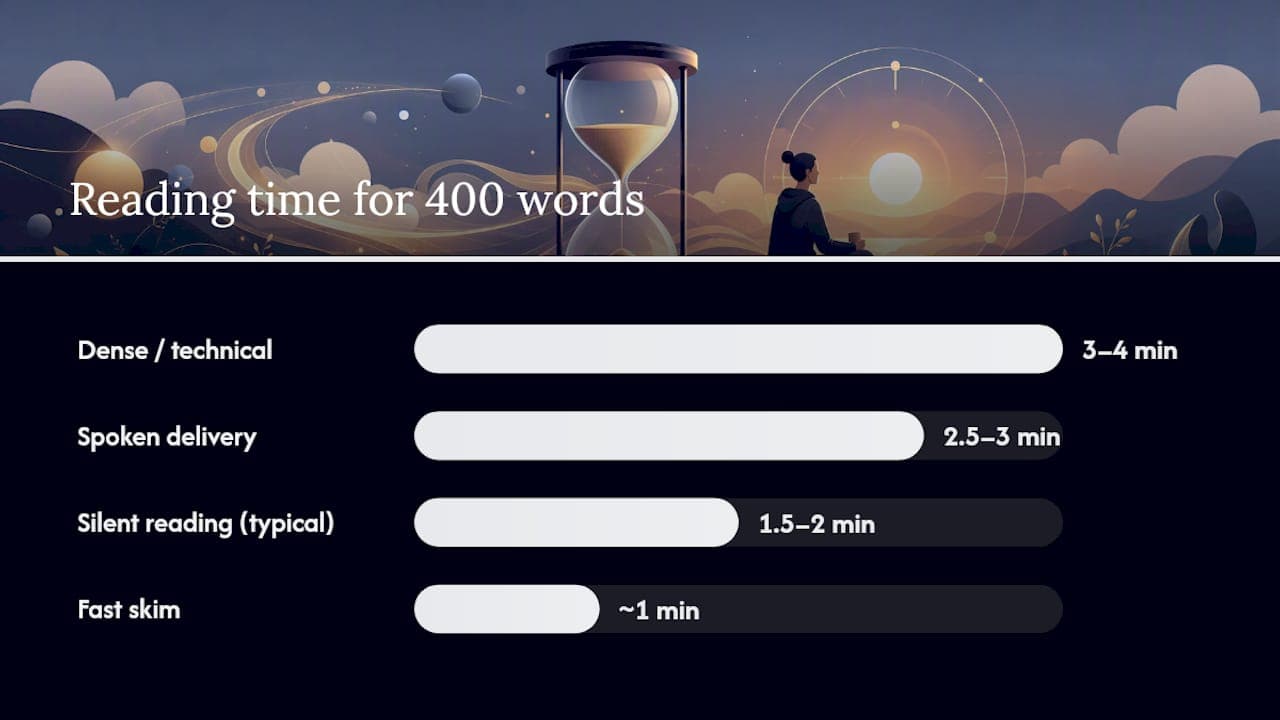
Reading Time at a Glance: Average silent reading of 400 words takes 1.5 to 2 minutes. Dense or technical material can stretch that to 3 to 4 minutes, while a fast skim clears it in about a minute.
If you're reading the piece out loud, the math changes. Spoken delivery runs slower than silent reading, typically 130 to 160 words per minute, which puts a 400-word speech or presentation script at roughly 2.5 to 3 minutes. That's a useful pacing check if you've been handed a strict time slot and a word-count target that doesn't quite match your instinct for how long it'll feel on stage.
A 400-word piece isn't long enough to wander. The most functional structure splits into three parts: an introduction that states your point, two body paragraphs carrying the evidence, and a brief conclusion that closes the loop. Each paragraph usually runs 4 to 8 sentences, depending on how much explanation each point needs.
Here's a simple blueprint that follows this pattern:
This structure works for a 400-word essay, a cover letter, or a short email pitch equally well.
Pro Tip: Write your thesis sentence last, even though it goes first. You'll often discover what you actually argued only after drafting the evidence paragraphs.
Realistic time budgets: 5 to 10 minutes for planning, 20 to 45 minutes for drafting, and another 10 to 30 minutes for revision, depending on how familiar you are with the topic. A practical writing workflow treats those minutes as a fixed plan rather than padding word count to fill time.

A few habits speed this up without sacrificing quality: outline before drafting, check topic sentences for clarity, cut filler phrases early, and favor active verbs over passive constructions.
Non-native writers benefit from reading the draft aloud once. Awkward phrasing tends to reveal itself audibly before it does visually on the page.
A tight word count leaves no room for a wandering paragraph or a shaky citation, which is exactly where a structured writing tool earns its keep. Samwell.ai's Power Editor targets specific paragraphs for tightening or expansion without forcing a full rewrite, while Guided Essays lays out a structural outline before you write a single sentence, useful when you're working within the intro-body-conclusion blueprint above.
Samwell.ai serves over 1,000,000 students and academic professionals, using its Semihuman.ai approach to keep AI-assisted drafts closer to a credible, individual voice.
Cutting a thought down to 400 words forces decisions that a 2,000-word paper lets you avoid. Every sentence has to justify its place, because there's no room for a throwaway line that "sounds nice." The common mistake isn't running long. It's writing a rough draft at 600 words and cutting it down mechanically, which usually leaves behind a paragraph that no longer connects to the one before it.
The fix isn't a stricter word count. It's writing with a function assigned to every sentence before you start, thesis, evidence, connection, example, close, so nothing needs to be there just to hit a target. Practice that structure enough times and the editing gets faster each round.
— Tilen
Formatting math tells you how much space 400 words takes up. It doesn't help you write those words well under a deadline. Samwell.ai handles both sides: Guided Essays sets up the intro-body-conclusion structure before you type a word, Power Editor tightens a paragraph that ran long without a full rewrite, and the real-time originality check flags AI-detection risk before you submit, not after.
For a short assignment where every sentence counts, that combination saves the back-and-forth of manual editing. You get a structured draft, a tightened version, and an originality check in the same workflow instead of three separate tools. Start a draft through the plagiarism-free essay tool and see how a 400-word piece comes together with the structure already in place.