Loading...

TL;DR:
- AI tools can significantly enhance essay revision quality, nearly doubling improvement compared to traditional feedback. They analyze structure, grammar, and argument flow, supporting students throughout the writing process with actionable suggestions. Combining AI with human insight yields the best results, emphasizing iterative, reflective engagement over passive acceptance.
AI tools can nearly double the quality of essay revisions compared to traditional feedback methods, and that single fact challenges everything most students assume about the writing process. A Hong Kong study found students receiving AI-driven feedback scored 8.314 revision marks on average versus just 4.474 for those using conventional approaches. Guided essay tools are AI-powered platforms that support every stage of writing, from outlining to final edits. This guide breaks down how they work, what the research actually proves, where they fall short, and how to use them strategically for stronger academic results.
| Point | Details |
|---|---|
| AI nearly doubles essay gains | AI-guided tools produce almost twice the improvement in essay revisions compared to traditional methods. |
| Hybrid feedback works best | Combining AI and human feedback leverages strengths from both for optimal essay quality. |
| Prompting matters | Techniques like chain-of-thought prompts make AI guidance significantly more effective. |
| Mindful use avoids pitfalls | Balancing AI help with personal effort prevents overreliance and boosts genuine skill growth. |
Guided essay tools are AI-powered writing assistants built specifically for academic contexts. They go far beyond basic spell-checkers by analyzing structure, argument flow, grammar, citation format, and topic relevance in real time. Unlike template-only tools that give you a blank outline and leave you to fill it in, AI-driven guided tools interact with your actual writing, responding to your content and offering specific, actionable suggestions at each revision stage.
The core functions typically include:
The users who benefit most are undergraduate and graduate students, academic researchers, and educators designing writing assignments. As AI's role in academic writing grows more sophisticated, these tools are increasingly capable of supporting complex tasks like literature synthesis and argumentative structuring. Research confirms that AI excels in structural feedback covering organization and grammar, while human instructors remain stronger at contextual, holistic guidance. Understanding that distinction matters when deciding how to use these tools effectively.
The short answer is yes. And not by a small margin. The evidence is now strong enough that dismissing these tools as novelties is genuinely hard to justify.
The Hong Kong study gains of 8.314 versus 4.474 marks represent nearly a doubling of revision quality. That is not a marginal improvement. It signals a structural shift in what students are able to accomplish when they have access to responsive, personalized AI feedback during the writing process. The same study reported increased engagement and motivation, meaning students were more likely to revise multiple times rather than submitting their first draft.
| Study | Setting | AI feedback score | Comparison score | Key outcome |
|---|---|---|---|---|
| Hong Kong University trial | Undergraduate essays | 8.314 marks | 4.474 marks | Nearly double revision quality |
| U Michigan randomized trial | 354 students | Higher quality revisions | Human-only feedback | Outpaced traditional methods |
A U Michigan trial with 354 students provided even more rigorous confirmation. Using a randomized design, researchers found that students receiving AI-assisted feedback produced consistently higher-quality revisions than peers who only received instructor feedback. The scale of the trial and its randomized structure make these findings hard to dismiss as coincidence.
"AI-assisted feedback not only improved the technical quality of essays, it also changed how students approached the revision process itself, making iterative improvement a habit rather than an exception."
For students who worry about the challenges in using AI writing tools, these results offer a reassuring foundation. The gains are real, measurable, and replicable. That said, understanding why they work requires looking at how AI and human feedback actually compare. For a deeper look at efficiency gains, using AI for writing efficiency covers additional practical benefits worth exploring.
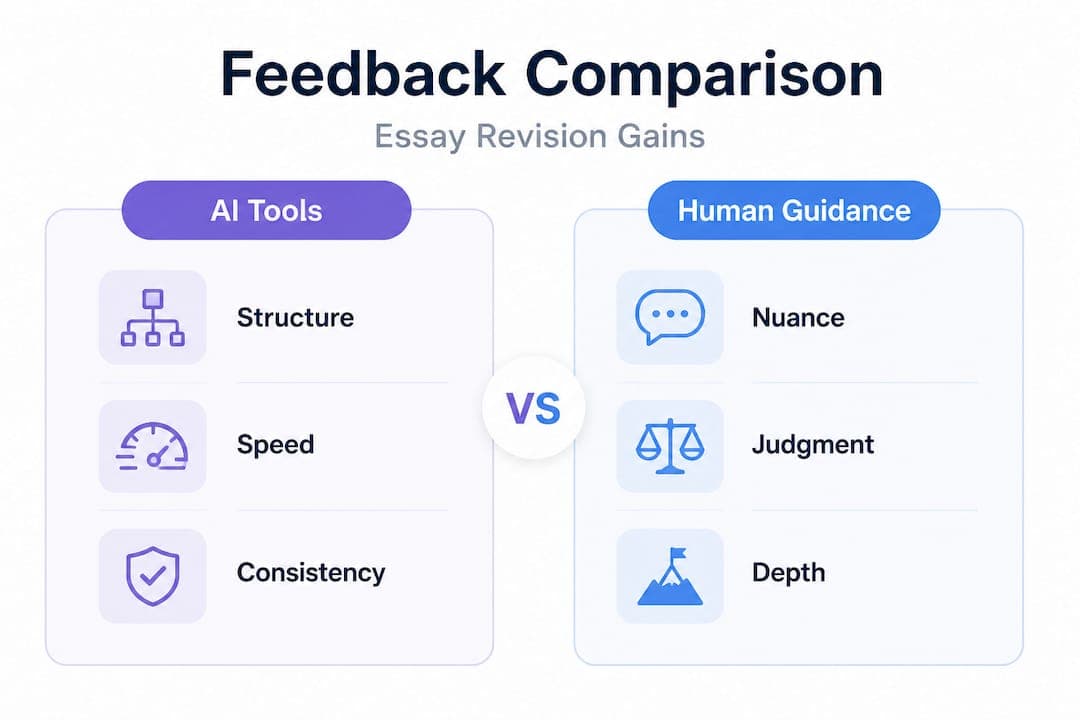
AI and human feedback are not competing alternatives. They are complementary tools with genuinely different strengths, and treating them as either-or is the single biggest mistake students make when integrating guided essay tools into their workflow.
| Feedback type | Strengths | Limitations |
|---|---|---|
| AI-driven | Speed, scalability, consistency, structural analysis | Limited contextual understanding, can miss nuanced arguments |
| Human (instructor/peer) | Deep context, critical thinking, holistic judgment | Slower, subjective, limited availability |
| Hybrid (AI + human) | Best of both worlds | Requires intentional coordination |
Research confirms that AI excels in structure and efficiency while human instructors provide judgment and nuanced critique that AI cannot replicate. A professor reading your argument about climate policy can assess whether your sources are credible, whether your framing is politically naive, and whether your conclusion contradicts your premise in ways that require domain expertise. AI can tell you that your paragraph lacks a topic sentence. Both insights are valuable, and neither is sufficient alone.

The most effective strategy draws from academic writing tools that support multi-source feedback loops. Studies show that multi-source feedback combining AI, peer review, and instructor input produces significantly better outcomes than any single source.
Key ways to make AI guidance more powerful:
Pro Tip: Before submitting a draft to your instructor for feedback, run it through an AI-guided tool first. Your instructor's time is limited and valuable. Use AI to clear up structural and mechanical issues so your professor can focus on the deeper argumentative and conceptual feedback that only they can provide.
The evidence for guided essay tools is compelling, but adoption without awareness creates predictable problems. Most students who struggle with these tools are not failing because the technology is flawed. They are failing because they are using it the wrong way.
Pro Tip: After receiving AI feedback, close the tool and write a one-paragraph summary in your own words of what the AI identified as your essay's main weaknesses. Then reopen the tool and revise. This simple reflection step dramatically reduces passive acceptance and builds your metacognitive awareness as a writer.
Knowing the pitfalls makes the path forward much clearer. These strategies are backed by research and designed specifically for academic writers who want genuine skill development alongside faster turnaround.
Pro Tip: Set a personal rule that you will not accept any AI suggestion without first being able to explain in your own words why that suggestion makes your essay stronger. This one habit separates writers who grow from those who merely produce polished-looking work.
Here is the perspective most writing advice misses entirely. For decades, academic writing has been treated as a product: the finished essay. Grades reward the artifact, not the thinking that created it. This framework made sense when revision was expensive, time-consuming, and largely dependent on scarce human feedback. But that constraint no longer exists.
When hybrid AI and human approaches become the norm, the essay stops being the end goal and becomes a record of an evolving thought process. AI enables you to cycle through five drafts in the time it previously took to complete one. Each cycle deepens your thinking, clarifies your argument, and reveals gaps you could not see before. Human oversight then steers that process toward genuine insight rather than mechanical refinement.
The most important mindset shift is this: stop asking whether your essay is good enough to submit. Start asking what your essay is helping you understand about your topic. When you use AI feedback as part of creating content with AI that genuinely reflects your intellectual development, the quality of the final product improves as a byproduct, not as the goal.
This is not idealism. The research backs it. Students who engage iteratively with AI feedback, who ask follow-up questions, who push back against suggestions they disagree with, produce better essays and demonstrate better writing growth than those who treat AI as a one-pass polishing tool. The process is the point.
The research is clear, and the strategies are practical. Now it is time to put them to work.
Samwell.ai gives you access to a complete suite of guided essay tools built specifically for academic writing. From structured outlines powered by the Guided Essays feature to the Power Editor for targeted expansion and refinement, everything is designed to support the iterative, feedback-driven process that the research identifies as the gold standard. With real-time AI detection checks, full citation standard support for MLA and APA, and Semihuman.ai technology that protects originality, Samwell.ai is the platform where serious academic writers do their best work. Over 1,000,000 students and researchers from leading universities already use it. You can start today.
They deliver instant, personalized feedback that improves structure, grammar, and engagement, and revision quality gains of nearly double compared to traditional methods have been documented in peer-reviewed research.
Some students report reduced ownership feelings after heavy AI revision, which is why using AI as a thinking partner rather than a ghostwriter protects both your voice and your skill development.
Neither is strictly better. AI and human feedback serve different functions, and a hybrid approach that combines both consistently produces the strongest academic outcomes.
Chain-of-thought prompting and conversational, specific questions consistently yield higher quality feedback than generic or zero-shot prompts.