
Loading...

A claim is an arguable, focused position your essay exists to prove, and it goes beyond a fact or observation because someone could reasonably disagree with it. To draft one now, turn your assignment prompt into a single contestable sentence and check whether a classmate could argue the opposite. That sentence usually lands at the end of your introduction, where it sets up the rest of the essay.
TL;DR:
- A strong claim must be specific, debatable, reveal new insights, and be limited enough to prove within the available evidence.
- Narrow the subject and clarify the cause or interpretation to avoid vague or overly broad arguments that cannot be supported.
- Use templates like causal, analytic, evaluative, or policy claims, and revise your working claim multiple times based on evidence and feedback.
- Support claims with clear point, evidence, and explanation at the paragraph level, and justify the logical connection with the Toulmin model.
- Regularly check alignment through reverse outlines, ensuring each paragraph advances your claim and that your evidence convincingly supports your position.
A fact is something you could look up and confirm, like a publication date. An opinion is a personal preference, like saying a book was boring. A claim sits between them: it is a position that requires evidence and reasoning to support, and a reader has to be able to imagine a counterargument. According to the Writing Center at the University of Virginia, a claim is a specific, arguable position that goes beyond observation, and it defines the essay's goals, scope, and direction.
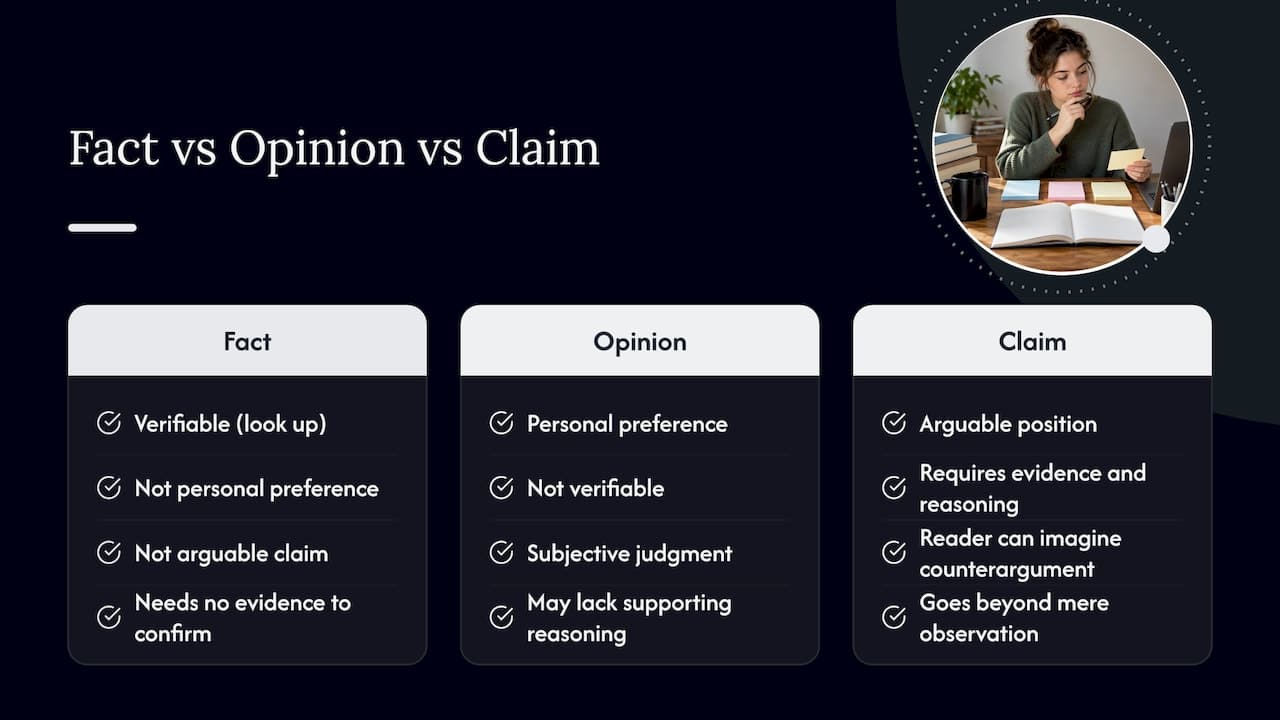
Claims also split into types. A descriptive or interpretive claim explains what something means or how it works, while a normative claim argues what should happen or what is right. Both kinds typically appear near the end of your introduction, often as the last sentence or two, so the reader knows exactly what you intend to prove before the body paragraphs begin.
A weak claim usually fails one of four tests. Before you commit to a working thesis, run it through this checklist:
Qualifiers help you narrow a claim without gutting it. Swapping "always" for "in most documented cases" or "society" for "urban school districts in the 2020s" keeps the argument honest and defensible. A fast revision rule: narrow the subject, then specify the cause, effect, or interpretation you're arguing for. If your sentence could apply to ten different essays, it needs another round of narrowing.
Different assignments call for different claim shapes. Pick the template that matches your task, then adjust the wording so it sounds like your own voice.
A few paired examples show the difference revision makes. Weak: "Social media affects teenagers." Revised: "Unstructured social media use before age 16 correlates with reduced attention span in classroom settings." Weak: "The novel is about loss." Revised: "The narrator's unreliable memory in the novel's final chapters reframes loss as a form of self-protection." Weak: "Schools should teach financial literacy." Revised: "High schools should require a one-semester financial literacy course because current graduates report low confidence managing basic budgeting."
For more worked examples matched to assignment type, see this guide to crafting strong claims.
Turning a prompt into a claim is a sequence, not a single flash of insight.
Accept your first version as a working claim, not a final one. It only becomes final after you've written enough of the body to know your evidence actually supports it, a point the Duke Writing Studio.pdf) makes directly: writers often mistake their first working thesis for the finished one, when it should evolve as they draft.
Pro Tip: Write your working claim on a sticky note or at the top of your draft so you notice the moment your evidence starts arguing for something slightly different.
For a full classroom-ready sequence, see 7 steps to an effective argumentative essay claim.
Once you have a claim, structure is what makes it persuasive rather than just asserted. At the paragraph level, PEEL works well: state your Point, give Evidence, add Explanation connecting the evidence to your claim, then Link back to the argument. Newcastle University notes that quality of analysis matters more than the number of citations you stack in, and that one well-chosen reference often carries more weight than three shallow ones.
At the whole-argument level, the Toulmin model adds precision:
Making the warrant explicit is one of the most reliable fixes for essays that have solid evidence but weak persuasion, according to Indeed's overview of the Toulmin model. Readers rarely infer the logical connection themselves, so spell it out rather than assuming it's obvious.
A reverse outline is the fastest way to check alignment. List each paragraph's main point in one line, then compare that list against your claim. If a paragraph's point doesn't clearly serve the claim, either the paragraph or the claim needs to change.
Run your draft against this checklist:
The decision rule is simple: if most paragraphs support the claim but one or two don't, cut or revise those paragraphs. If most of your evidence points somewhere else entirely, revise the claim instead of forcing the evidence to fit. For more on this alignment pass, see how to write a strong thesis.
Most weak claims fall into a handful of familiar traps.
Hidden assumptions are another quiet problem: if your warrant relies on something readers might not accept, state it directly instead of hoping they'll agree. Briefly acknowledging a counterargument, rather than ignoring it, also strengthens a claim; see how to write a counterargument for a short approach that fits inline without derailing your structure.
Guided Essays features walk you through the outline and claim-drafting stage with structure similar to the templates above, and editing tools help tighten a vague or overly broad sentence into a focused one. Reference checks assist with citation standards during revision, and AI detection tools flag sections that may need a more original voice. For deeper reading on any step, the Samwell.ai blog and this guide from Tilen cover the drafting process in more detail.
The claims that improve the most are the ones students are willing to rewrite twice. A first draft claim almost always narrows or sharpens once the writer sees what their evidence actually supports, which is exactly why peer review and instructor feedback matter more than getting it right the first time.
— Tilen
Turning a vague working thesis into a focused, defensible claim takes several rounds of rewriting, and Samwell.ai's Guided Essays feature was built to walk you through that process step by step, from prompt to structured outline. The Free Plan lets you try the workflow before committing to anything, and the Academic Plan and other options unlock longer word counts and the full Power Editor for deeper revision.

You can also upload an existing draft through the enhanced essay creator to get targeted feedback on a claim you've already written, or start fresh with the AI essay generator for template-driven drafting. Whichever route you take, the final check on citations and originality is still yours to make. Start with the free tools and see how far a sharper claim takes your next draft.
These sources shaped the guidance above and are worth reading directly for more depth.
An example is: "Requiring a personal statement in college applications disadvantages students with less access to writing support." It names a specific subject and takes a position someone could reasonably contest, which is what separates it from a plain fact.
Outside essay writing, a claim is any statement that asserts a position rather than states an observable fact, such as "remote work increases long-term employee retention in tech roles." It still needs evidence and reasoning to hold up, the same standard essay claims are held to.
Start with your topic, narrow it to one specific angle, and state a position that someone could disagree with, following a template like "[Subject] leads to [outcome] because [reason]." Test it by asking whether a classmate could argue the opposite side with real evidence.
Open the paragraph with your point in one clear sentence, then follow it with evidence and explanation using the PEEL structure described by Newcastle University. Ending the paragraph with a link back to your main claim keeps the argument connected rather than scattered.



