
Loading...

The best hook for an argumentative essay does two things in one to two sentences: it establishes stakes and connects directly to your thesis. The four types that work most reliably are a surprising statistic, a bold claim, a vivid scenario, and a provocative question. Whichever you choose, pair it immediately with a bridge sentence that walks the reader from the hook straight into your argument.
TL;DR:
- A strong argumentative hook should present a specific, sourced fact or vivid scenario that clearly demonstrates the issue's immediate relevance and stakes.
- Using a provocative question or bold claim works best when it sparks immediate reader interest and sets up a definitive position for the thesis.
- Ideally, the hook fits within one to three sentences, directly connects to the thesis, and is supported by fast-sourced evidence in subsequent sentences.
- Avoid vague generalizations or clichés; instead, craft hooks that answer "why should I care?" instantly, shaping first impressions and expectations.
- Testing multiple drafts aloud and ensuring your hook aligns with audience and assignment tone increases the likelihood of an engaging, effective opening.
An argumentative hook has one job that a narrative or personal-essay hook doesn't: it has to make the reader care about a claim, not a character. A personal essay hook can meander through a memory before revealing its point. An argumentative hook doesn't have that luxury. Readers need to know within a sentence or two why this issue matters right now, and writing centers consistently frame this as the whole purpose of the opening. ESU's Writing Studio describes strong hooks as ones that "reel in" the reader by showing stakes immediately, whether through a striking fact, a focused anecdote, or a pointed question.
"Establishing stakes" means answering an unspoken question before the reader asks it: so what? A hook about declining bee populations only works if it implies a consequence, fewer crops, higher food prices, ecosystem collapse, within the same breath. Stakes without specificity read as filler. Specificity without stakes reads as trivia.
This matters more than most students assume, because openings shape how people process everything that follows. Research on first-impression bias shows that an initial framing colors how readers interpret later information, even when that later information is more accurate or complete. The Decision Lab's overview of first-impression bias explains that early impressions act as a lens, not just a starting point. A weak, generic opening line doesn't just fail to grab attention. It primes the reader to skim the rest of your argument with lower expectations.
Here's how the three common hook categories differ in effect:
A hook succeeds when a reader unfamiliar with your topic can answer, after one sentence, "why should I keep reading?" without needing you to explain further. That's the bar. If your hook needs a follow-up sentence just to justify its own relevance, it's not doing its job yet.
Microsoft's writing guidance backs this up structurally: a strong introduction moves from hook to thesis to talking points, with the hook expected to land within the first sentence or two. There's no room for throat-clearing. You get one shot at the opening line, and it has to work immediately, not build slowly toward relevance.
Not every hook fits every topic. Matching the type to your subject, evidence, and audience is what separates a hook that lands from one that feels bolted on.
Pro Tip: Match the hook to your assignment's tone before you match it to your topic. A rhetorical question suits a persuasive op-ed style paper; a statistic suits a research-heavy argumentative essay with a works-cited page. Same topic, different hook, depending on what your instructor expects.
Every example below follows the same structure: a hook, a one-sentence bridge that connects it to the argument, and a sample thesis. Copy the pattern, then swap in your own evidence and topic specifics.
Education
For younger or introductory-level writers, a simpler statistic works better than a question that requires nuance to unpack. A broad trend in college admissions, for instance, most colleges admit most applicants, can anchor an argument about whether selectivity is overrated without needing advanced statistical literacy to follow.
Environment
Technology
Health
Social issues
Notice that each bridge does real work: it doesn't just transition, it explains why the hook matters to the specific claim that follows. That's the difference between a hook that feels attached and one that feels earned.
Picking the right hook isn't about finding the cleverest opening line. It's about matching a hook type to your audience, your evidence, and your assignment's constraints, then testing it fast.
Run your draft hook against this checklist before you commit to it:
Once you've checked those boxes, use this three-step workflow to finalize your choice:
Pro Tip: If your hook feels weak, don't rewrite the whole sentence, swap its type instead. A flat statistic ("Many students struggle with debt") becomes sharper as a scenario ("Picture graduating with a diploma and a bill you'll be paying off at forty"). Same content, different delivery.
Most weak hooks share the same handful of problems, and each one has a quick repair.
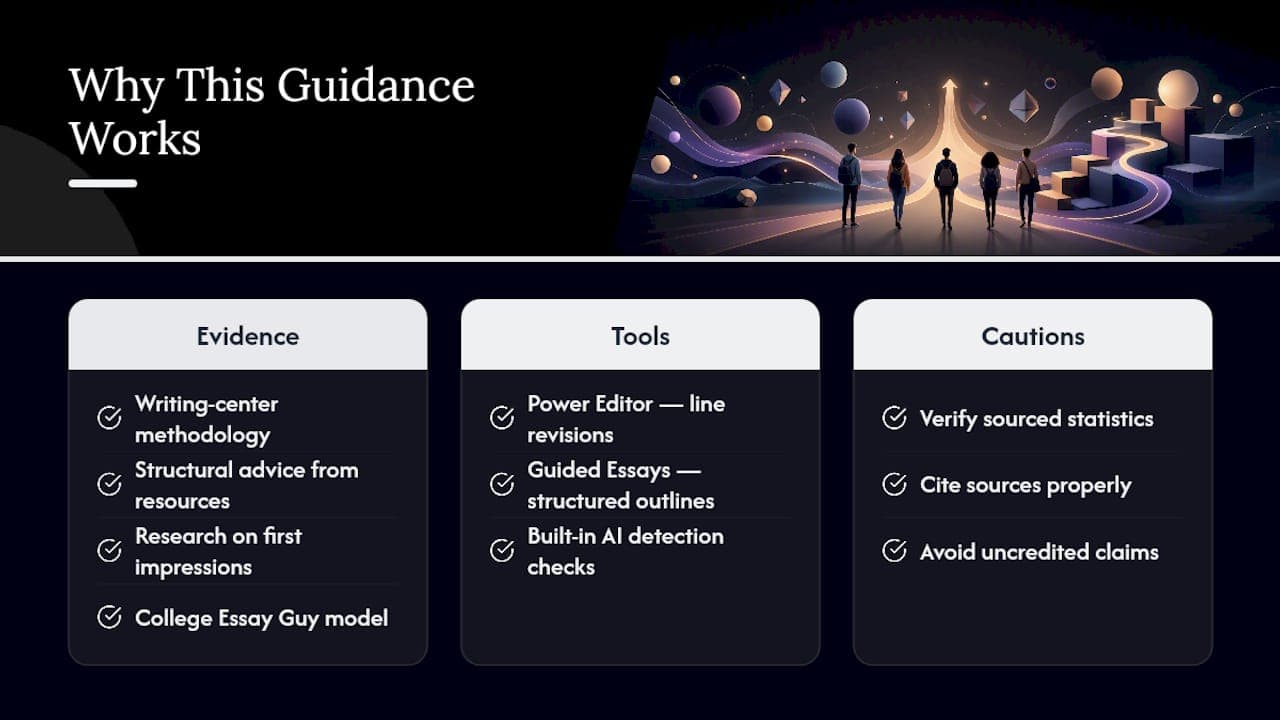
This guide draws on writing-center methodology, structural advice from established writing resources, and research on how first impressions shape reader engagement, not guesswork about what sounds catchy. The examples follow the same hook-bridge-thesis pattern that College Essay Guy highlights as the model worth copying.
If you're drafting on Samwell, tools like the Power Editor for line-level revisions, Guided Essays for structured outlines, and built-in AI detection checks can help you test whether a hook reads as sharp and original before you submit it. Always verify sourced statistics and cite them properly, no hook is worth an uncredited claim.
A student once opened an essay on food waste with "Food waste is a big problem in America." Flat, forgettable, no stakes. We rewrote it as a scenario: a family throwing out a week's groceries while a food bank down the street runs empty. Same thesis, completely different pull. Two habits made that fix possible: keeping three hook drafts instead of committing to the first idea, and writing the bridge sentence immediately, before momentum fades and the connection gets lost.
— Tilen
Testing three hook drafts by hand, reading each aloud, checking tone against your assignment, takes real time most students don't have the night before a deadline. Samwell's Guided Essays tool builds that structure in from the start, walking you from outline to introduction so your hook and thesis stay connected instead of drifting apart during revision.

The Power Editor lets you rewrite a single opening line multiple ways without touching the rest of your draft, useful when you're testing a statistic hook against a scenario hook on the same essay. Built-in AI detection checks and citation tools for APA and MLA formats mean the statistic you lead with can be sourced correctly the first time, not fixed in a panic later. If you're ready to see how a guided draft compares to writing cold, check the plans on Samwell's upgrade page and start your next essay with a hook that's already been stress-tested.
A good hook example states a specific, sourced fact or scenario tied directly to your thesis, not a vague statement. "A single plastic bottle can outlive the person who drank from it by four centuries" works because it's concrete and sets up an environmental argument in one sentence.
The strongest starting sentences use a statistic, bold claim, vivid scenario, or provocative question that immediately signals why the topic matters. Microsoft's writing guidance recommends the hook lead directly into your thesis within the same paragraph, with no throat-clearing in between.
A hook should run one to three sentences at most, according to common writing guidance. Longer openings delay the thesis and risk losing the reader before your argument even starts.
Start by picking one hook type, question, statistic, bold claim, or scenario, based on your topic and available evidence, then draft the sentence so it states stakes without needing further explanation. Tools like Samwell's Guided Essays can help you draft and compare a few versions quickly before you commit to one.



