
Loading...

Paying someone to write your essay from scratch is generally classed as contract cheating, and it carries real risk of suspension, expulsion, or a permanent mark on your academic record. Safer paid options exist: editors, tutors, and guided writing tools like Samwell.ai that help you improve your own work instead of replacing it. Below, we walk through how schools detect outsourced work, what things actually cost, and how to get legitimate help without crossing the line.
TL;DR:
- Outsourcing work can lead to disciplinary actions such as suspension or expulsion and damages your reputation for future academic and career opportunities.
- Detection relies on comparing your work's style and referencing to past submissions, with AI tools supporting human judgment rather than providing definitive proof.
- Prices for paid help vary widely depending on urgency, project complexity, and academic level, with suspiciously low offers and payment in untraceable methods raising red flags.
- Legitimate assistance includes editing and coaching, provided you document the process, clarify scope, and keep records to demonstrate your effort and understanding.
- Using AI tools to improve your work supports transparency and learning, while avoiding outright outsourcing helps maintain academic integrity and skill development.
Contract cheating is the term universities use for paying or arranging for someone else to complete academic work and submitting it as your own. UC Irvine's Student Conduct office classifies this as a formal violation of academic integrity, one that can lead to discipline up to suspension or expulsion.
The behavior covers more ground than most students expect. It includes:
None of these require getting caught to cause damage. Every outsourced assignment is a missed chance to practice the research, argument-building, and editing skills your degree is supposed to certify. Guidance from the University of Michigan's LSA frames this as the deeper cost: students who outsource lose the skill-building the work was meant to provide, which catches up with them later in internships, jobs, or graduate programs that assume those skills are there.
Reputational risk compounds the academic one. A conduct violation on your transcript can follow you into transfer applications, scholarship renewals, and professional licensing reviews that ask about academic discipline.
Instructors rarely rely on one signal alone. UC Irvine's guidance notes that faculty often compare a suspicious submission's voice, vocabulary, and referencing style against a student's earlier work, and an inability to explain your own paper in person is treated as a strong red flag.
Software plays a supporting role, not a deciding one. Turnitin's guidance on its AI Writing Report describes its AI indicators as investigative tools meant for instructor review, not definitive proof of misconduct. That distinction matters because detection software carries known limitations:
A paper that scores low on an AI or plagiarism check is not automatically "safe." Turnitin itself frames these reports as a starting point for human judgment, not a verdict. The practical lesson: don't try to beat the detector. Keep drafts, notes, and a research trail so you can explain your process if asked, which matters far more than any score.
Prices for paid academic writing vary widely based on a handful of factors, including urgency and timing of the order.
Because urgency and length move the price so much, a single "typical cost" figure is misleading. What matters more is recognizing when a quote is a warning sign rather than a bargain.
Paid help isn't automatically unethical. The difference comes down to what you're paying for: improving your own work versus having someone else produce it for you. Editors, tutors, writing center coaches, and research consultants can legitimately help you strengthen grammar, structure, and argument clarity without writing your content for you.
Here's a practical way to vet and document that kind of help:
UW-Madison's contract cheating guidance notes that students who document a transparent process, drafts, an annotated bibliography, tracked research notes, and substantially reduce the risk of disciplinary suspicion, even when they've used legitimate paid help along the way.
Pro Tip: When you're unsure whether a service crosses the line, ask your instructor or campus writing center before you pay. A five-minute question can save you a conduct hearing.
How you pay matters almost as much as who you pay. Credit cards and services like PayPal typically offer dispute and chargeback protections that let you recover funds if a service never delivers or delivers something unusable. Wire transfers, cryptocurrency, and informal peer-to-peer apps usually don't offer that protection, which puts the full risk on you if something goes wrong.
Avoid any service that insists on an unusual payment method, especially gift cards or crypto, since those are common signals in broader online payment scams and make a refund nearly impossible to pursue. A legitimate editing or tutoring service will accept standard, traceable payment methods and will provide a receipt or invoice.
Before paying, check for a clear refund and dispute policy in writing, not just a verbal promise. If a platform processes payments through a secure, well-known checkout system rather than a direct bank transfer to an individual, that's a modest but meaningful sign of legitimacy. None of this guarantees ethical service on its own, but it gives you recourse if the work or the behavior falls short of what was promised.
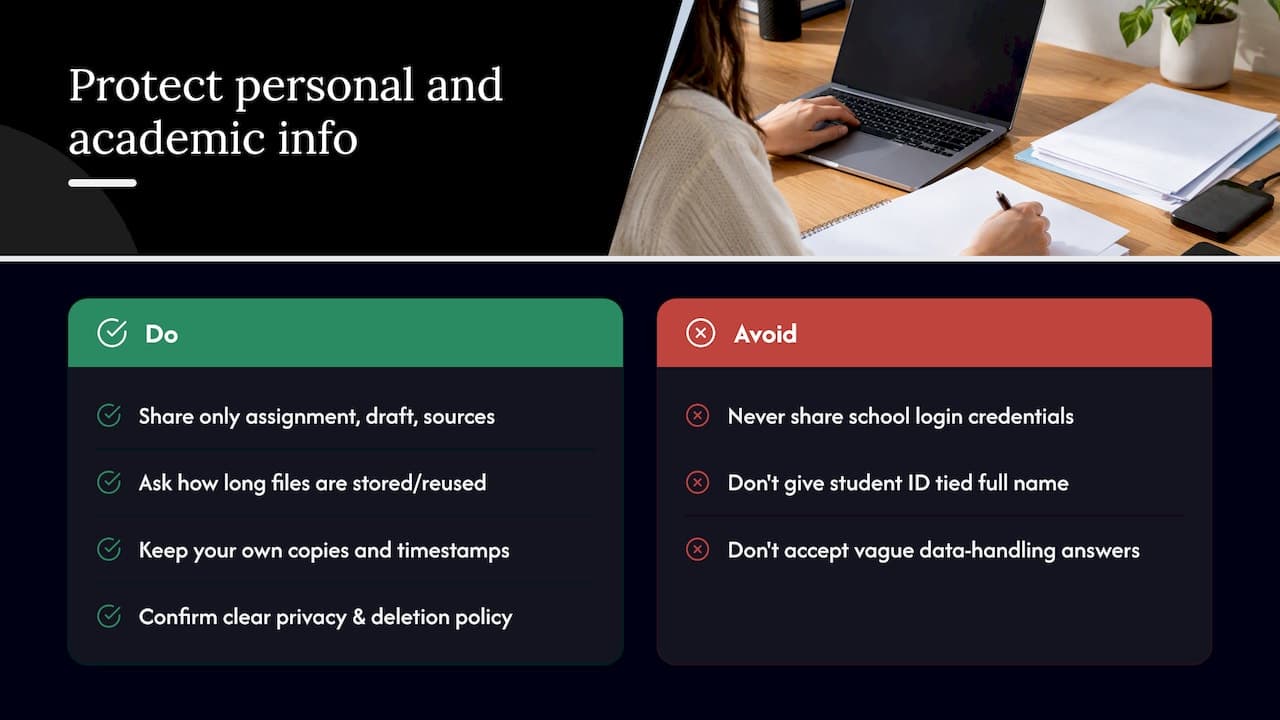
Any paid writing or editing service will ask for details about your assignment, and sometimes your school, course number, or even your login credentials for a learning portal. Treat that information carefully.
Never share your school's login credentials with a third-party service under any circumstance; legitimate editors and tutors never need them. Share only what's necessary for the task: the assignment prompt, your draft, and relevant source material, not your full name tied to your student ID unless the service has a clear, stated privacy policy covering data retention and deletion.
Ask directly how long your documents are stored and whether they're ever reused, resold, or added to a training dataset. A trustworthy service will have a clear answer. If a provider is vague or evasive about data handling, treat that as a reason to look elsewhere, not a detail to overlook because the price is attractive.
Keep your own copies of everything you send and receive, including timestamps of when files were shared. That record protects you if a dispute arises over scope, quality, or whether your information was handled appropriately.
A legitimate paid writing or editing engagement tends to follow a predictable sequence, and knowing the stages helps you spot a service that's cutting corners.
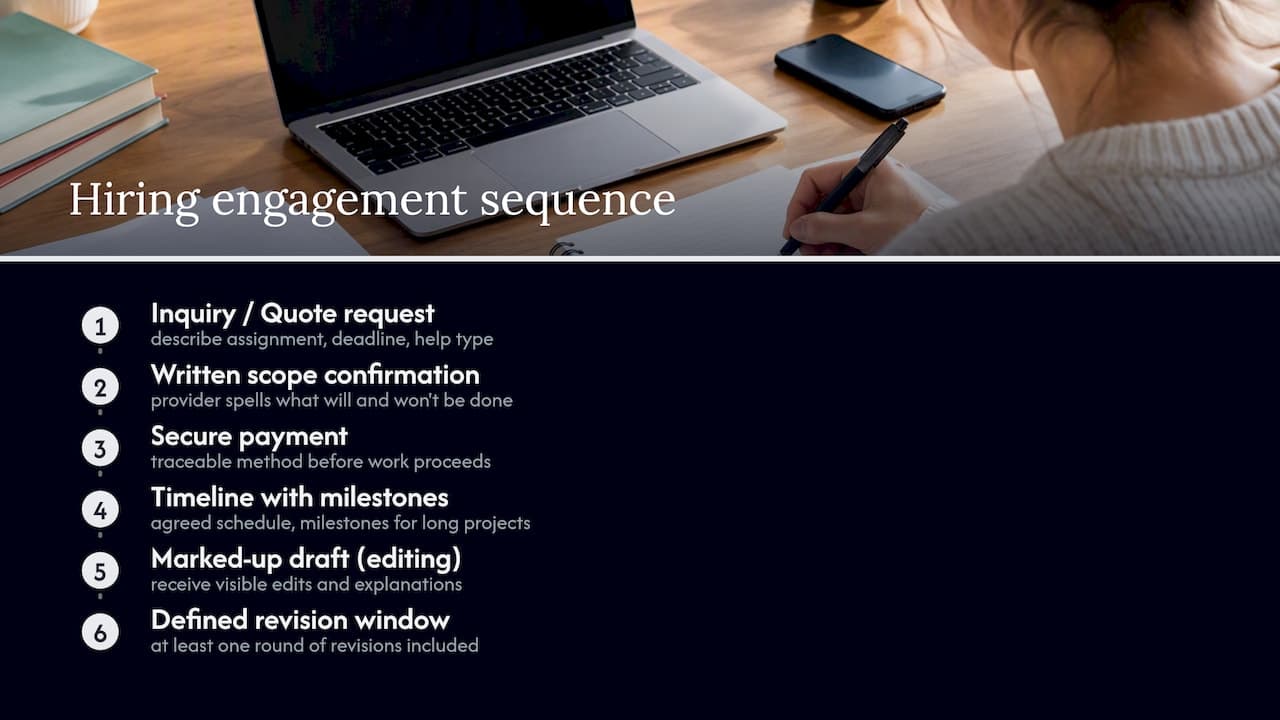
It typically starts with an inquiry or quote request, where you describe the assignment, deadline, and the type of help you want, editing versus tutoring versus something else. A credible provider responds with a scope confirmation in writing before any money changes hands, spelling out exactly what will and won't be done to your document.
Next comes payment, ideally through a secure, traceable method, followed by an agreed timeline with milestones for longer projects rather than a single all-or-nothing deadline. For editing work, you should receive a marked-up draft, not a silent rewrite, so you can see exactly what changed and why.
The final stage includes a defined revision window. A reasonable service builds in at least one round of revisions before calling the engagement complete. If any stage, quote, scope, milestones, or revisions, is missing or rushed, treat that as a signal to slow down and ask more questions before paying further.
The quoted price rarely reflects what you actually end up paying. Rush fees for tight deadlines can add a significant markup on top of the base rate, and many services charge extra for specific citation styles, additional source requirements, or formatting beyond a basic template.
Revision requests that go beyond a provider's included rounds often come with an added charge, and some services bill separately for plagiarism reports or certificates of originality that you might assume were included in the base price. Data visualization, specialized formatting like IEEE or Chicago style, and expedited delivery windows are other common add-ons.
Before paying anything, ask for a full breakdown of what's included in the quoted price and what would trigger an extra charge. A provider that can't give you a straight answer about potential add-on fees is one where the final bill is likely to surprise you. Get the full cost structure in writing before you commit, not after the first draft arrives.
Vague instructions produce vague results, whether you're working with a human editor or an AI-assisted tool. Give specific, written guidance upfront: the exact prompt, your thesis or argument if you have one, required citation style, word count, and any specific feedback your instructor has already given on earlier drafts.
When you receive work back, review it against that original brief point by point rather than reacting to the writing in general. If something doesn't match what you asked for, say exactly what's missing or wrong rather than offering a general complaint; "this paragraph doesn't address the second part of the prompt" gets a better fix than "this isn't quite right."
Set revision expectations before you start, not after you're unhappy: how many rounds are included, what counts as a minor versus major revision, and how quickly you need the turnaround. Clear expectations on both sides reduce the chance of a rushed, lower-quality result and give you a documented standard to point back to if the final product falls short.
Most students who look into paid help aren't trying to cheat. They're juggling deadlines, jobs, and coursework that all land at once, and they want a faster path to a paper they can actually stand behind. The honest answer is that speed and integrity aren't opposites if you choose the right kind of help.
That's the gap tools like Samwell.ai are built to close. Guided Essays provide structure before you write a word, the Power Editor targets specific weak sections instead of rewriting your voice, and a built-in citation and reference builder keeps sourcing honest. Real-time AI detection checks let you see how a draft reads before you submit it, which supports transparency instead of concealment.
— Tilen
When you need paid help without handing over authorship, the goal is a tool that strengthens your draft, not one that replaces it. That's the gap we built Samwell.ai to fill: Guided Essays that give you a structured outline before you write, a Power Editor for targeted edits to weak paragraphs, and a reference builder that keeps your citations accurate across styles like APA and MLA.

We designed the workflow around keeping you in control of your own paper. You upload your own sources and instructions, edit within the platform, and keep a revision history that shows your process from outline to final draft, the same kind of documentation that protects you if an instructor ever asks how you worked. Real-time AI detection checks let you see how your draft reads before you submit it, rather than finding out after.
A few ways students put this to work:
Start with the Free Plan to try the core tools, or compare the Academic Plan and Custom Professional Plans if you need higher word limits and extended features for ongoing coursework.
Costs vary widely based on deadline, academic level, and page count, with rush orders and graduate-level work commanding the highest rates. Because pricing swings so much by project, treat any flat "average price" claim with caution and ask for a full written quote before committing.
AI-generated text can avoid word-for-word plagiarism but still raises academic integrity concerns if submitted as your own original work without disclosure. UNESCO's guidance on generative AI in education recommends teaching students to use AI tools as co-creators under clear policies, not as an undisclosed substitute for their own writing.
You can find services willing to do this, but most institutions classify it as contract cheating, a conduct violation that can lead to suspension or expulsion. UC Irvine's Student Conduct office treats this as a serious, formal violation regardless of whether the work goes undetected.
There's no single standard rate, since legitimate editing and tutoring help costs far less than full ghostwriting and carries far less risk. A better question than "how much should I pay" is what kind of help you're actually buying: editing and coaching your own draft are safer and typically cheaper than commissioning new content outright.



