Loading...

TL;DR:
- Guided essay tools actively support every stage of writing, improving structure, coherence, and originality. They reduce cognitive load, especially for novice writers, by providing explicit scaffolding aligned with evidence-based practices. Using these tools fosters skill development and safeguards academic integrity through structured prompts and human oversight.
Writing is not a gift you either have or you don't. Research consistently shows that evidence-based writing instruction that includes structured prompts, rubrics, and process-based feedback produces measurably better writers across all skill levels. Guided essay tools sit squarely in that tradition. They don't replace your thinking. They organize it, challenge it, and sharpen it. This article walks through what guided tools actually are, why the science backs them so strongly, how they handle the mechanical headaches of academic writing, and why they matter for originality and integrity in ways most writers never consider.
| Point | Details |
|---|---|
| Guided tools boost quality | Structuring essay writing with explicit support improves clarity, coherence, and originality. |
| Best for developing writers | Novice and intermediate writers benefit most from checklists, prompts, and structured practice. |
| Supports academic integrity | Guided tools help you avoid plagiarism by keeping your work anchored to assignment requirements. |
| Human judgment still matters | The most effective approach combines guided tools with final review by students or instructors. |
Guided essay tools are not spellcheckers dressed up in fancier clothing. They actively move you through every stage of essay creation, from the first brainstorm to the final revision. Think of them as a knowledgeable writing coach who sits with you through the whole process instead of glancing at your paper only at the end.
The key distinction is structure. Basic editing software flags grammar errors and suggests word choices. Guided tools, by contrast, offer explicit support for the writing process across planning, prewriting, drafting, and revising. That difference sounds simple, but it changes everything about how a writer approaches a blank page.
The main types of guided tools include:
A typical workflow might look like this: A student opens a guided essay tools overview platform, enters the assignment prompt, and receives a structured outline with thesis guidance. They draft within that outline, check mechanics at the sentence level using embedded prompts, then move through a revision checklist before submitting. Every step is intentional. Nothing is left to chance.
| Feature | Guided approach | Unguided approach |
|---|---|---|
| Planning support | Structured outline and thesis prompts | Writer generates structure alone |
| Drafting support | Section-specific prompts and examples | Open blank page with no scaffolding |
| Revision support | Checklist targeting specific criteria | General re-read with no framework |
| Originality protection | Rubric anchors prevent surface-level responses | Higher risk of drifting off-topic |
| Outcome consistency | More consistent quality across drafts | Highly variable depending on experience |
The table above captures why popular guided platforms are gaining traction at universities. The unguided approach works well for writers who already carry a strong internal framework. For everyone else, it's like building a house without a blueprint and hoping the walls come out straight.
The evidence here is not anecdotal. Empirical research comparing guided versus holistic prompting demonstrates that guided prompting produces quality gains across multiple dimensions of text quality, including coherence, argumentation depth, and factual accuracy. These are not marginal improvements. Researchers see meaningful differences in draft quality when writers receive structured support versus when they're left to generate everything independently.
The reason is cognitive load. Writing is already one of the most cognitively demanding tasks a student faces. You're managing your argument, your evidence, your sentence structure, your audience, and your citation format all at once. When you remove any structured support, you force the brain to juggle all of those demands simultaneously. The result is that something drops, usually argument quality or coherence, because those are the hardest to monitor in real time.
Who benefits most? The research is clear that guidance is especially critical for novice writers, because learners without sufficient prior knowledge cannot self-guide effectively. Intermediate writers also benefit substantially. Advanced writers with deep prior knowledge may need less explicit scaffolding, but even they report that structured revision checklists catch blind spots that expertise alone misses.
| Outcome measure | Guided writing | Unguided writing |
|---|---|---|
| Text quality and coherence | Significantly higher | Variable, often lower |
| Revision success rate | Higher with checklist support | Lower without explicit criteria |
| Factual accuracy | Improved through structured review | More errors persist to final draft |
| Writer confidence | Increases steadily | Can plateau or decline |
Pro Tip: Integrate guided writing tools at the very beginning of your process, not after you've already drafted three pages. Starting with structure dramatically reduces the rework you'll need later. Writers who add guidance after drafting are essentially retrofitting a blueprint onto a building that's already up. It can be done, but it costs far more effort than starting right.
Understanding AI guidance efficiency also helps frame why these tools matter in 2026. AI-powered guided platforms can adapt to your specific assignment, your level, and even your past patterns of error in ways that static checklists cannot. That adaptability is where the next generation of guided tools is making the biggest difference.
Knowing that guided tools help in theory is one thing. Seeing exactly how they handle the granular work of writing is another. This is where the real value becomes tangible for most students, because mechanics and structure are where essays quietly fall apart.

Cognitive science research on writing instruction confirms that guided support at the right level of granularity reduces cognitive load and makes the writing task genuinely more manageable. The phrase "right level of granularity" matters enormously. Too broad, and guidance doesn't help with the specific sentence you're stuck on. Too narrow, and it becomes mechanical and stifling. Effective guided tools hit the sweet spot by addressing structure at the paragraph level while also flagging sentence-level clarity issues.
Here is a stepwise picture of how explicit guidance works from start to finish:
Prewriting. Guided prompts push you to clarify your thesis, identify your three to five strongest supporting arguments, and map out your evidence before you write a word. Using outlines effectively at this stage sets a foundation that holds through every later draft.
Drafting. Section-specific prompts remind you what each paragraph needs to accomplish. A body paragraph prompt, for example, might ask: "What is the single point this paragraph makes, and which piece of evidence directly supports it?" That question forces focus.
First review. After an initial draft, guided tools direct attention to transitions, logical gaps, and places where the argument loses momentum. This is where step-by-step outlining tools shine, because they let you compare your draft structure against your original plan instantly.
Sentence-level revision. Checklist items targeting clarity, active voice, and wordiness address mechanics without requiring the writer to hold the entire essay in mind simultaneously.
Final check. A rubric-aligned review confirms that every assignment criterion has been addressed before submission.
Pro Tip: Don't skip the sentence-level check-ins even when you feel confident about the larger argument. Small clarity problems compound. A vague sentence in the introduction plants confusion that follows the reader through the entire paper. Catching it early costs you two minutes. Catching it during grading costs you points and credibility.
The stepwise approach described above also teaches something important over time. Writers who consistently use guided structures eventually internalize them. The checklist becomes part of your own thinking rather than an external crutch. That's skill development in its truest form.
Originality is not just about avoiding copied text. It's about the quality of engagement with your sources, the specificity of your argument, and the depth of your own intellectual contribution. Guided tools support all three when they're used properly.
Rubrics and structured prompts keep writers anchored to assignment requirements. When you're working through a guided tool that consistently asks "Does this paragraph connect to your thesis?" and "Have you cited and engaged with your primary source here?", you're less likely to drift into surface-level summary or accidental paraphrase. That drift is actually one of the most common causes of unintentional plagiarism. Writers who lose track of their own argument start leaning too heavily on their sources to carry the essay.
Here's how guided tools specifically reduce plagiarism risks and foster deeper originality:
The importance of human oversight cannot be understated. Research from the University of Michigan found that AI-mediated feedback with instructor oversight led to meaningfully higher-quality revisions than AI feedback alone. Guided workflows work best when final judgment stays with the writer or the instructor, not the tool.
"Guided workflows that are coupled to revision and human judgment are preferred over treating AI tools as replacements for the writer's own critical thinking and ethical responsibility." — University of Michigan Engineering, AI and FeedbackWriter research, 2026
The essay integrity guide framework and the research paper workflow tips available through Samwell.ai both reinforce this principle. The goal is never to hand off your thinking. The goal is to structure your thinking so it's stronger, clearer, and genuinely your own.
Additionally, guided approaches anchored to assignment expectations on thesis, evidence, and rubric criteria reduce the most common failure modes in academic writing. Writers stay on topic, engage more deeply, and produce work that reflects their actual understanding of the material rather than a patchwork of borrowed ideas.
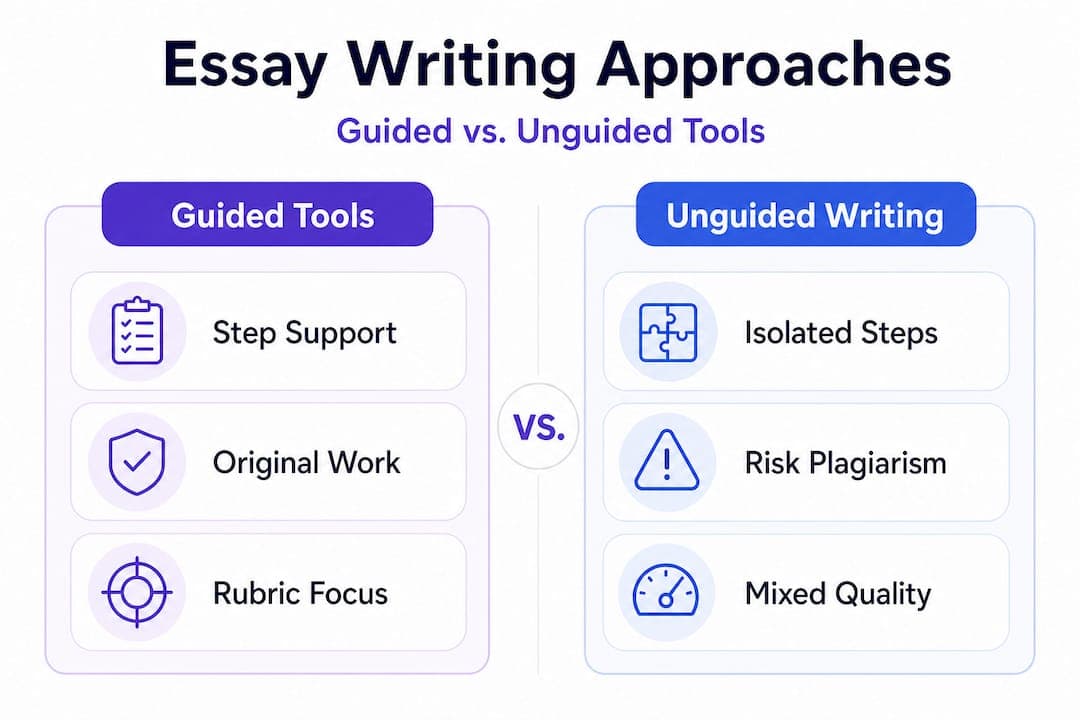
There's a durable piece of conventional wisdom in education that says struggle builds resilience. Let students wrestle with the blank page. Let them figure it out. The discomfort is the lesson. This view has real merit in some contexts, but in academic writing instruction, it often does more harm than good, and the evidence has been piling up for years.
Minimal guidance is generally less effective for most learners, particularly those who lack sufficient prior knowledge to self-direct their own learning. When a student stares at a blank page without any structural support and produces a disorganized, unfocused essay, they haven't learned to write better through that experience. They've learned that writing is hard and confusing, and they've produced evidence of that confusion as their submitted work.
The instructors and platforms who see the most growth in their students are those who pair structure with increasing autonomy. Early in the learning process, guidance is dense. Outlines are detailed. Rubric feedback is specific. Over time, as internalized skills develop, the scaffolding steps back. A student who has worked through twenty structured essays doesn't need a full outline prompt anymore because they've built that structure into their own process.
This is not coddling. Coddling would mean doing the thinking for the writer. Scaffolding does the opposite: it clears away the procedural noise so the writer can focus their cognitive energy on actual ideas. That's the distinction that gets lost in the "struggle builds strength" conversation.
It's also worth noting that even highly skilled writers benefit from guided essay tool transformation at key points. A researcher who has published dozens of papers still uses revision checklists and peer review rubrics. The form changes but the principle doesn't. Structure supports quality at every level. The idea that expertise means you no longer need frameworks is a myth that holds back a surprising number of advanced students who feel that using tools is somehow beneath them.
The bottom line: guidance is scaffolding for genuine independence. The goal is always a writer who doesn't need the tool anymore. But you don't get there by skipping the tool. You get there by using it so consistently that it becomes part of how you think.
If the research above resonates with you, the next step is putting guided support into practice on your own work rather than just reading about it. Samwell.ai offers a full suite of guided essay tools built specifically for students and academic professionals who need more than a grammar check.
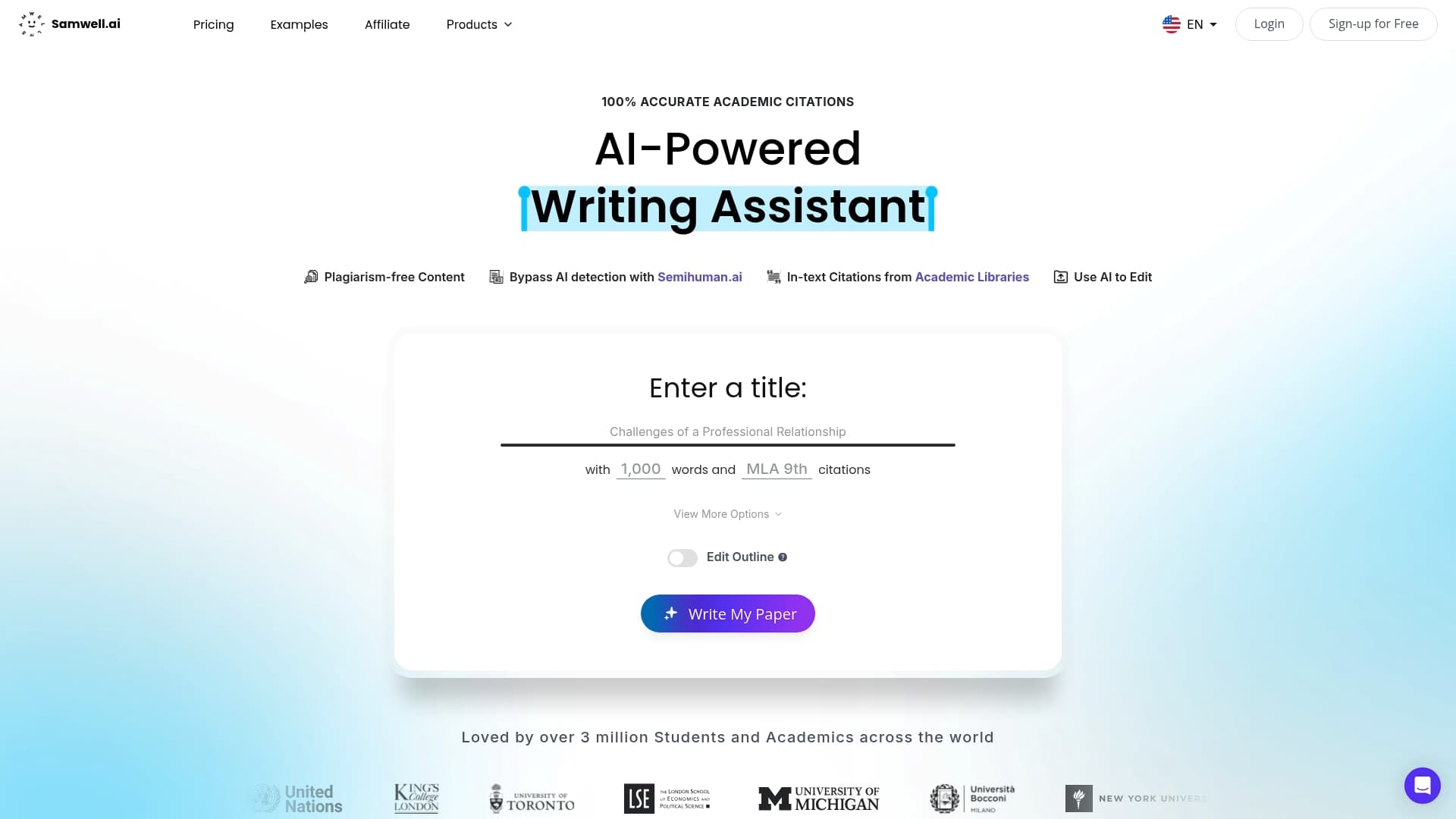
Samwell's Guided Essays feature provides structured outlines and thesis support tailored to your assignment requirements, while the Power Editor lets you expand, revise, and sharpen specific sections without losing the overall argument. Real-time AI detection checks and APA and MLA citation compliance are built into the workflow, not bolted on at the end. Over 1,000,000 students and researchers from leading universities already use Samwell.ai to produce credible, original academic work. If you're ready to move from struggling with structure to writing with genuine confidence, Samwell.ai is where that shift begins.
Guided tools provide step-by-step support throughout the entire writing process, not just grammar checks, by structuring planning, drafting, and revision for better outcomes. They are consistent with evidence-based writing instruction in ways that basic editing software simply isn't.
Yes, when used properly, these tools anchor writers to assignment requirements and push for original argument development, which directly reduces plagiarism risks. AI-guided workflows paired with revision and human judgment are the most integrity-protective approach available.
Beginners and intermediate writers see the greatest gains because guidance is especially important for novices who lack sufficient prior knowledge to self-direct effectively. Advanced writers still benefit from structured revision support, even if they need less scaffolding overall.
Most institutions permit AI tools when they're used for feedback and revision support, with final judgment remaining with the student or instructor. Research shows that AI-mediated feedback with instructor oversight consistently produces higher-quality revisions than either approach used alone.