Loading...

TL;DR:
- Structured academic research follows a sequential process from defining questions to final revisions.
- Evaluating credible sources and designing appropriate methodologies are key steps in producing reliable findings.
- Iteration, proper citation, and use of tools like AI support quality, integrity, and clarity in research.
Starting a research project can feel like standing at the edge of a forest with no map. You know the destination exists, but every direction looks equally overwhelming. Most students hit the same wall: too many sources, too little focus, and a deadline that keeps creeping closer. The good news is that structured academic research follows a reliable sequence that, once learned, turns that forest into a clearly marked trail. This guide walks you through every stage of the academic research process, giving you practical tools to move from confusion to confident, credible writing.
| Point | Details |
|---|---|
| Follow key stages | A structured approach ensures your research is focused and thorough. |
| Evaluate sources critically | Check for reliability, currency, and bias whenever you consult new academic material. |
| Document your work | Keep track of methods, findings, and citations to avoid errors and ensure integrity. |
| Embrace revision | Feedback and iteration are essential parts of producing excellent academic work. |
Before you open a single database or type a single sentence, it pays to understand the full picture. Research is not a single act. It is a sequence of decisions, each one building on the last. Skipping steps does not save time. It creates problems that surface later, usually when you have the least time to fix them.
The research process typically follows a structured sequence that professionals and novice researchers alike rely on. Understanding this sequence before you start is what separates papers that feel coherent from those that feel like a pile of information.
"A plan is not a luxury in academic research. It is the foundation that every credible finding stands on."
Here is a bird's-eye view of the main stages:
| Stage | Main deliverable |
|---|---|
| Define question | A clear, answerable research question |
| Background reading | A concept map or outline of existing knowledge |
| Literature review | Annotated source list |
| Methodology design | A written methods plan |
| Source evaluation | Filtered, credible source set |
| Data collection and analysis | Raw data plus interpreted findings |
| Writing and citing | Full draft with citations |
| Revision and reporting | Final polished manuscript |
Each stage produces something tangible. That is the point. Deliverables keep you accountable and make progress visible, which is critical when motivation dips.
Everything in academic research flows from one source: your question. A vague question produces vague research. A focused question tells you exactly what to look for, what to ignore, and where to stop.
Developing a research question is always the first step in structured academic research, and it is also where most students rush. They pick a broad topic, jump into searching, and end up buried under thousands of loosely related sources with no way to tie them together.
Here is a more effective approach:
Strong research questions are specific, arguable, and answerable within your available resources. They also connect to existing literature, meaning someone has studied something nearby, even if your exact angle is new.
Pro Tip: Run your draft question by a mentor or peer before you commit. An outside reader will spot ambiguities you have stopped noticing, and their feedback takes five minutes but can save hours of misdirected research.
With a clear question in hand, you are ready to find the evidence that will support or challenge your thinking. This is where reviewing and evaluating sources becomes an essential part of the process, not an afterthought.
Not all sources carry the same weight. Understanding the difference helps you build an argument that reviewers and readers will respect.

| Source type | Reliability indicator | Best uses |
|---|---|---|
| Peer-reviewed journal article | High (expert-reviewed) | Core evidence and data |
| Academic book or monograph | High (publisher-reviewed) | Theoretical frameworks |
| Government or institutional report | Medium to high | Statistics, policy data |
| Credible news outlet | Medium | Context and recent events |
| General website or blog | Low to medium | Background only, verify claims |
For locating sources, start with your university library's databases. JSTOR, PubMed, PsycINFO, and Google Scholar cover most disciplines. Use Boolean operators (AND, OR, NOT) to refine your searches and cut through irrelevant results fast. Understanding the types of academic sources available to you is worth mastering early in your career.
Once you find a source, evaluate it before you cite it:
Pro Tip: Do not lean too heavily on AI-generated summaries of sources. Research shows that AI tools introduce bias and struggle with complex expert-level tasks. Always read the original source yourself before citing it.
Once your sources are identified, you need to decide how you will generate or organize the evidence that answers your question. Choosing a methodology and collecting data are the steps that give your findings legitimacy.
There are three broad approaches:
Qualitative research focuses on meaning, experience, and context. Think interviews, case studies, and thematic analysis. It answers "how" and "why" questions.
Quantitative research focuses on numbers, patterns, and statistical relationships. Surveys, experiments, and secondary data analysis fall here. It answers "how much" and "how many" questions.
Mixed-method research combines both, giving you depth and breadth. It is more demanding but often produces richer insights.
When choosing, consider your research goals, the type of data available to you, your time frame, and your own skill set. A first-year student probably should not design a large randomized controlled trial. A well-executed small qualitative study can be just as valuable.
Once your method is set, structured planning during data collection is critical to avoiding errors that undermine your results. Common pitfalls include:
Document every decision you make during data collection. Write down why you excluded certain sources, how you coded responses, and where you found your data. This documentation is not busywork. It is what allows others (and you, months later) to trust and reproduce your findings.
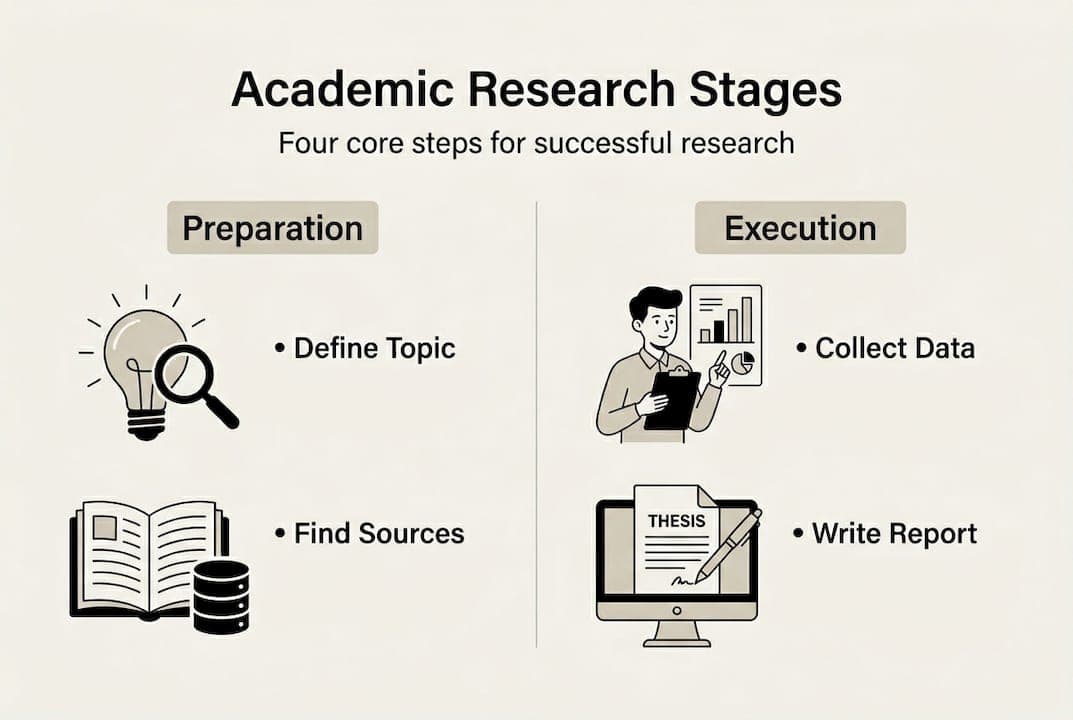
You have your data. Now comes the part most students dread: translating everything into a coherent, well-argued paper. The final stage of academic research involves writing, revising, citing, and sharing your findings in a way that earns credibility.
Follow this sequence:
Citation is not a formality. It is the mechanism that keeps academic knowledge honest. Skipping or mishandling citations leads to plagiarism, even when it is unintentional. Learning how to cite sources correctly is one of the highest-leverage skills you can build early in your academic career.
Common citation mistakes to avoid:
Pro Tip: Before you submit anything, run through a citation checklist. Verify that every in-text citation has a corresponding reference list entry and that every reference in your list appears in your text. It takes 15 minutes and prevents avoidable point deductions.
Here is something most research guides will not tell you: research is not linear. The tidy sequence described above is a framework, not a one-way street. You will define your question, find sources that force you to redefine it, collect data that raises new questions, and revise your argument multiple times. That is not failure. That is the process working as it should.
The most common mistake we see students make is treating their first draft as nearly final. They write, they submit, and they are surprised when feedback asks for deeper analysis. Iteration is not a sign that your research is weak. It is the mechanism by which research gets stronger.
A second trap is over-reliance on shortcuts. AI tools can struggle with expert-level tasks and may produce confident-sounding claims that are factually wrong or subtly biased. Tools like these are useful for brainstorming and formatting, but they cannot replace your original analysis or your voice. If you let a tool do your thinking, your paper loses the quality that makes it yours. Learn more about navigating this balance in our citation in essays guide.
Finally, keep a research journal. It sounds old-fashioned, but a simple running document where you track decisions, dead ends, and sudden insights is one of the most useful tools you can use. When you sit down to write your methods section or your discussion, that journal is your memory.
Following a structured research process gets you most of the way there. The final stretch, turning solid research into a polished, properly cited paper, is where many students get stuck. That is exactly where Samwell AI steps in.
Samwell AI gives you a platform built for academic writing at every stage. From structured outlines and guided drafts to real-time AI detection checks, every feature is designed to support your process without replacing your thinking. You can generate plagiarism-free essays that meet your citation requirements, whether APA, MLA, or Chicago. Over one million students already use Samwell AI to write with more confidence and integrity. Make your next paper your best one.
The research process usually includes developing your question, reviewing literature, choosing a method, evaluating sources, collecting data, writing, and revising. Each stage builds directly on the one before it.
Check the author's credentials, publication type, citation record, and whether the information is current and balanced. Evaluating sources rigorously at the start saves significant time and errors later.
Common mistakes include poorly defined questions, unreliable sources, and skipping citation checks. AI tools can also introduce bias and should support rather than replace your own analysis and judgment.
Citation gives credit to original authors and protects you from plagiarism. The writing and citing phase is where your research earns credibility and your integrity as a scholar becomes visible.