Loading...

A great conclusion restates your thesis in fresh language, synthesizes how your evidence built that claim, and closes with a clincher that tells the reader why any of it matters. Skip any one of those three moves and the ending feels either repetitive or hollow. The examples below show what that looks like across essay types, disciplines, and even non-academic writing.
TL;DR:
- Conclusions should connect your evidence to a broader implication or pattern, rather than just restating points or listing data.
- Effective endings often include a call for further research, policy, or action, tailored to your discipline's conventions.
- Avoid introducing new facts or thesis statements in the conclusion, and focus on synthesizing your main points through explicit connections.
- The clincher should answer an unspoken question or echo your introduction to leave a memorable, purposeful impression.
- Tailor your conclusion to your audience, whether academic, general readers, or speakers, emphasizing clarity, relevance, and action.
Every conclusion that actually works does three jobs, in this order, according to Purdue OWL's guide to conclusions. It reframes the thesis without copying it word for word. It synthesizes, meaning it shows how your points reinforce each other rather than just listing them again. Then it lands on a clincher, a final line that states significance, implication, or a next step.
The synthesis step trips up most writers. A simple recap ("First I discussed X, then Y, then Z") is not synthesis, it's a table of contents. Real synthesis draws a connection your reader hasn't explicitly seen yet: showing how the historical evidence and the economic data in your paper actually explain the same underlying pattern.
Word choice matters more than most writers assume. Harvard's Writing Center recommends transitions like "ultimately," "on balance," and "taken together" over checklist phrases like "in conclusion," which signal that summary is coming rather than insight.
A few reliable moves for each component:
Pro Tip: Draft your clincher before you finish your body paragraphs. Writers who know their landing point tend to build stronger evidence chains toward it.
Each example below is short enough to adapt directly. Read the annotation, then swap in your own thesis and evidence.
Argumentative essay (social policy): "Universal pre-K doesn't just prepare children for kindergarten, it reshapes the economic trajectory of the households they come from. Taken together, the wage data and enrollment trends suggest that expanding access is less a budget question than an investment question." Why it works: synthesizes two data threads into one causal claim, then reframes the debate itself.
Literary analysis (a novel): "Read this way, the house in the novel stops being a setting and becomes a character in its own decline. Once you see the parallel, you can't unsee it in the final chapter." Why it works: reframes the central symbol rather than summarizing plot.
STEM lab report: "These results support a moderate but consistent correlation between soil pH and germination rate, though the sample size limits generalizability. Future trials should test across a wider pH range before drawing agricultural recommendations." Why it works: states a limitation and a precise next step, avoiding overreach.
Historical research paper: "The treaty's failure wasn't a diplomatic accident, it was the predictable outcome of excluding the one party with enforcement power. That pattern recurs in every subsequent agreement this paper examined." Why it works: connects a specific finding to a broader recurring pattern.
Compare and contrast essay: "Both systems solve for efficiency, but only one accounts for the human cost of getting there. On balance, that difference should carry more weight in policy decisions than either system's raw output numbers." Why it works: uses the comparison to make a value judgment, not just a summary.
Persuasive essay: "The evidence doesn't just favor stricter emissions standards, it makes the current timeline look reckless by comparison. Waiting another decade isn't caution, it's a bet against the data." Why it works: escalates the stakes rather than restating the argument.
Narrative/personal essay: "I didn't learn patience that summer. I learned the difference between waiting and paying attention, and I've been applying that distinction ever since." Why it works: full circle image that ties back to the opening anecdote.
Social science research paper: "The interview data suggests that trust in local institutions predicts civic participation more reliably than income does, though this sample was limited to one region. Practitioners designing outreach programs should weigh relationship building over incentive structures." Why it works: cautious policy implication scoped to the study's limits.
Rhetorical analysis: "The speech succeeds not through its logic but through its timing, arriving exactly when the audience needed permission to feel angry. That's a lesson in rhetoric textbooks tend to underrate." Why it works: clincher offers a broader claim about the field, not just the text.
Business/case study report: "The company's pivot worked because it solved a problem customers hadn't articulated yet. Any team facing a similar plateau should start by asking what their customers aren't saying, not what they are." Why it works: converts a specific case into a transferable takeaway.
Rewrite note for all ten: keep your version to one or two sentences per beat, restatement, synthesis, clincher, and resist the urge to add a third supporting example. That's what the body paragraphs already did.
Conclusion conventions aren't universal. Harvard's Writing Center points out that STEM and humanities papers ask for genuinely different endings, and treating them the same way costs you credibility with a reader who knows the field.
STEM writing in particular rewards restraint. Claiming broad societal impact from a limited data set reads as overreach to reviewers, so stick to what the numbers actually support and let the "so what" stay modest.
Pro Tip: When in doubt, check three published papers or essays from your specific course or journal. Discipline conventions shift enough between fields, and even between professors, that a quick scan beats guessing.
The UNC Writing Center calls one frequent error the "grab bag," tossing in a stray fact or statistic that never appeared earlier in the paper because it seemed interesting. It doesn't strengthen your ending, it confuses a reader who's trying to see how everything connects.
A second common error: revealing your actual thesis for the first time in the final paragraph, sometimes called the "Sherlock Holmes" move. If your reader learns your real argument only at the end, your body paragraphs weren't doing their job.
Quick fixes:
A weak clincher restates the obvious. A strong one answers a question the reader didn't know they were asking. Here's how to get there in four moves.
Pro Tip: Write your clincher, then delete the first half of it. Writers often bury the sharpest line under three sentences of throat clearing. The good line is usually already there, just later than it should be.
For a deeper walkthrough of these techniques, Samwell's guide on 7 expert tips for concluding sentences breaks down more templates by essay type.
Spoken conclusions carry more pressure than written ones because there's no rereading. Your audience's last impression is whatever they hear in the final thirty seconds, so that stretch has to do more work per word than any paragraph in an essay.
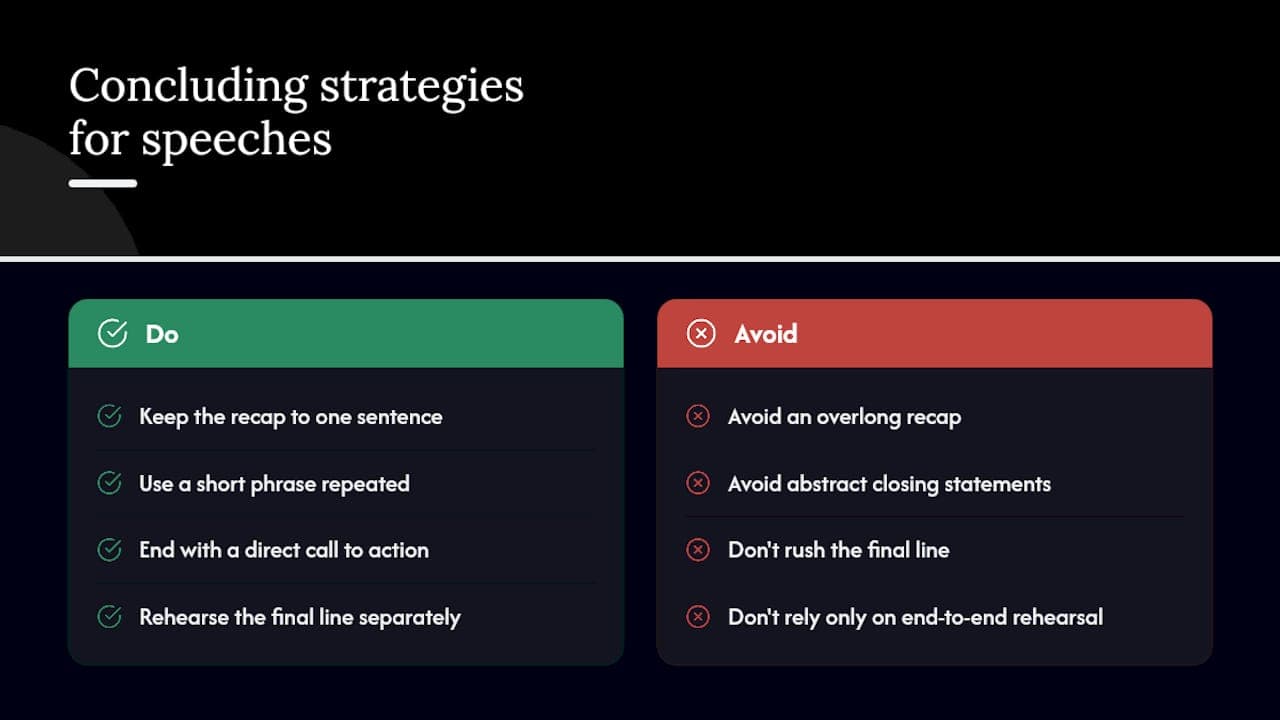
Start by cutting the summary shorter than you think you should. In writing, a brief recap orients the reader. Spoken aloud, the same recap feels like stalling, since the audience just heard those points minutes ago. One sentence of synthesis is usually enough before you move to the close.
Repetition works differently on stage than on the page. A short phrase repeated two or three times, sometimes called a rhetorical triple, gives a spoken ending rhythm that written prose doesn't need. It also gives your audience something to remember without needing notes.
End on a direct address or a call to action rather than an abstract statement. "This matters because..." lands flatter out loud than "Here's what I'd ask you to do next." Presentations, unlike most essays, usually want the audience to act, decide, or reconsider something specific, so name that action plainly instead of trailing off on a general observation.
Practice the final line separately from the rest of the talk. Speakers who rehearse their whole speech end to end often rush the closing because they're relieved to be near the finish. The last line deserves its own rehearsal, delivered at the pace you'd use if you had all the time in the world.
The same paper needs a different ending depending on who's grading, reading, or citing it, and matching that expectation is part of writing well, not a compromise.
For an instructor grading against a rubric, your conclusion should explicitly demonstrate that you met the assignment's stated goals. If the prompt asked you to evaluate a policy, your clincher should contain an evaluation, not just an observation. Rubric-driven readers are scanning for proof, so make it easy to find.
For a journal audience or discipline-specific reader, restraint reads as credibility. Overstating your findings to a specialist reader backfires immediately, since they know the field's actual limits better than you do. A social science paper aimed at practitioners can afford a practical recommendation; the same paper aimed at fellow researchers should stick closer to the data.
For a general audience, whether that's a blog readership or a public-facing report, translate implications into terms that connect to daily experience. Purdue OWL notes that bridging your paper's findings to a reader's broader context increases how relevant and memorable the ending feels, which matters even more when your reader isn't required to care.
For peers in a workshop or discussion setting, an open question can work better than a firm statement. Ending with "What would change if..." invites the kind of engagement a closed statement shuts down.
Articles, blog posts, and business reports follow looser rules than academic papers, but the same three components, restatement, synthesis, clincher, still show up in whatever holds a reader's attention past the last paragraph.
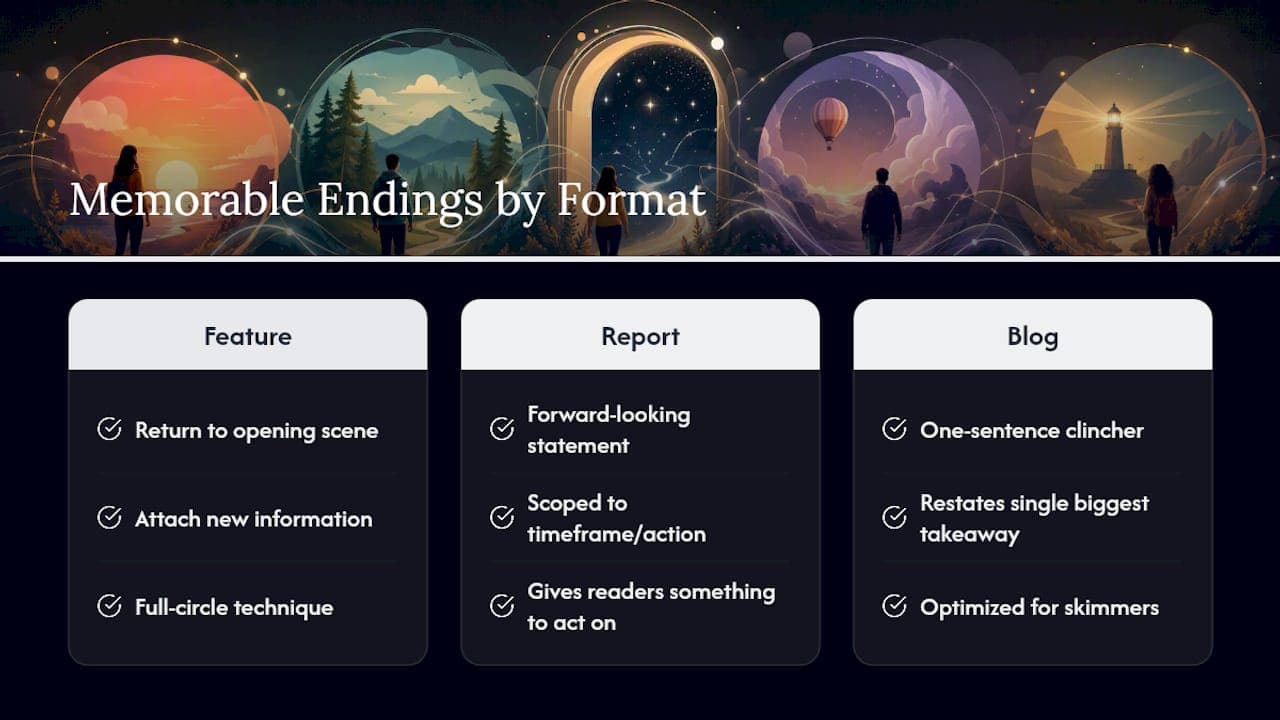
A strong feature article often closes by returning to its opening scene with new information attached. If the piece opened on a specific person or moment, the ending revisits that same image, now colored by everything the reader learned in between. That's the full circle technique doing the same job it does in a personal essay, just with journalistic distance.
Business and industry reports tend to close with a forward-looking statement scoped to a specific timeframe or action, rather than a broad claim about "the future of the industry." A report that ends with "companies that adapt their supply chains in the next two years will hold a structural advantage" gives readers something to act on. A report that ends with "the industry is changing fast" gives them nothing.
Blog posts written for search and skimming often benefit from a clincher that restates the single biggest takeaway in one sentence, since many readers scroll straight to the end before deciding whether to read the middle. That's a different reader behavior than an essay grader works with, but the underlying discipline, one clear final claim instead of a vague wrap-up, holds across every format.
The common thread: whatever the format, endings that just trail off with "overall, this was an interesting topic" lose readers immediately, while endings that commit to one specific, well-earned claim tend to be the line people actually remember or quote.
Most conclusion advice treats the ending as a formatting problem: hit three beats, use the right transition word, and you're done. That's not wrong, but it skips the actual reason so many conclusions fail. Writers usually don't know their real point until they've finished writing the body, which means the conclusion becomes the first place they're forced to articulate what the paper was actually for.
That's not a failure of technique. It's a sequencing problem, and it's why the "So What" exercise works better than any transition-word list: it forces the writer to locate significance rather than perform it. A clincher borrowed from a template sounds hollow precisely when the writer hasn't done that work yet.
Samwell's Guided Essays feature exists partly because of this gap. It structures the outline before drafting begins, so writers reach the conclusion already knowing their argument's shape instead of discovering it in the final paragraph. The Power Editor then lets you tighten or expand that closing section once the rest of the draft is settled, and Samwell's real-time AI detection checks help keep the final product aligned with academic integrity standards as those standards keep evolving. Used this way, AI assistance supports the thinking rather than replacing it, which is the only version of "help" worth trusting in academic work.
— Tilen
Staring at a blank final paragraph after finishing the rest of your paper is its own specific kind of stuck, and generic advice about "restating your thesis" rarely breaks that block. Samwell's Guided Essays tool builds your outline before you draft, so by the time you reach the conclusion, you already know what you're synthesizing instead of scrambling to figure it out.
If you've already got a draft and the ending just isn't landing, the Power Editor lets you target that one paragraph specifically, tightening a vague clincher or expanding a synthesis that feels thin, without touching the rest of your paper. Pair that with Samwell's citation support for APA, MLA, and other formats, and the mechanical parts of finishing a paper stop competing for attention with the actual argument. Start a draft or refine an existing conclusion at Samwell.