Loading...

Grammarly-style AI detectors return a percentage estimate of how much text looks AI-generated. That number is a guide, not a verdict. The score comes from a probabilistic model comparing your writing against patterns common in AI output, and even Grammarly's own AI detector frames the result as one signal among several, not proof of anything.
If you're staring at a flagged paragraph right now, here's what to do before you panic or argue with the report:
The rest of this guide walks through why the score behaves the way it does and how to act on it without overreacting.
Grammarly-style AI detectors estimate likelihood through pattern matching, not proof, so a flagged score should trigger review and revision rather than automatic resubmission or panic.
| Point | Details |
|---|---|
| Score is probabilistic | A percentage reflects pattern matching against training data, not confirmed authorship of the text. |
| Middle-range scores need inspection | Anything from 15 to 50 percent is ambiguous and requires reading the flagged passage, not just the number. |
| Bias hits non-native writers | Detectors can flag careful, correct non-native English writing more often due to predictable vocabulary patterns. |
| Fix with detail or citation | Add personal reasoning and examples to rewrite flagged text, or cite the source if it's paraphrased research. |
| Samwell.ai unifies the workflow | Detection, the Power Editor, Guided Essays, and citation tools sit in one platform used by over 1,000,000 students and academics. |
An AI grammar correction tool like Grammarly doesn't read your whole essay and spit out one number from a gut check. It breaks the document into smaller chunks, usually a few sentences at a time, and scores each chunk separately before averaging the results.
Here's the basic sequence:
ai_generated_percentage and an average_confidence value, then surfaces both to the user.That confidence score matters as much as the percentage itself. A 40% AI-likelihood score with low confidence means the model is guessing. The same score with high confidence means the pattern match was strong across most segments.
Grammarly also exposes this functionality through an API for institutions that want to build detection into their own grading or submission systems, not just the browser extension or desktop app. That's a meaningful detail for teachers or departments running checks at scale instead of one paper at a time. The underlying math doesn't change. Only the delivery method does.
Score ranges are heuristics, not rules carved in stone. Treat them as a rough map, not a legal threshold.
A workable way to read the number:
When you land in that middle or high zone, don't just stare at the percentage. Open the flagged passage and check for specific tells: overly uniform sentence length, a total absence of personal detail or opinion, and repeated sentence structures that read like they came from a formula rather than a person thinking through an idea.
Pro Tip: If a flagged paragraph reads smoothly but says nothing specific, that's usually the giveaway. AI-generated filler tends to be grammatically perfect and factually empty at the same time.
Once you've identified the problem sentences, you have three real options: rewrite them with a concrete example or personal reasoning, add a citation if the content is paraphrased from a source, or leave it if a second read confirms it's genuinely your own analysis that just happens to sound polished.
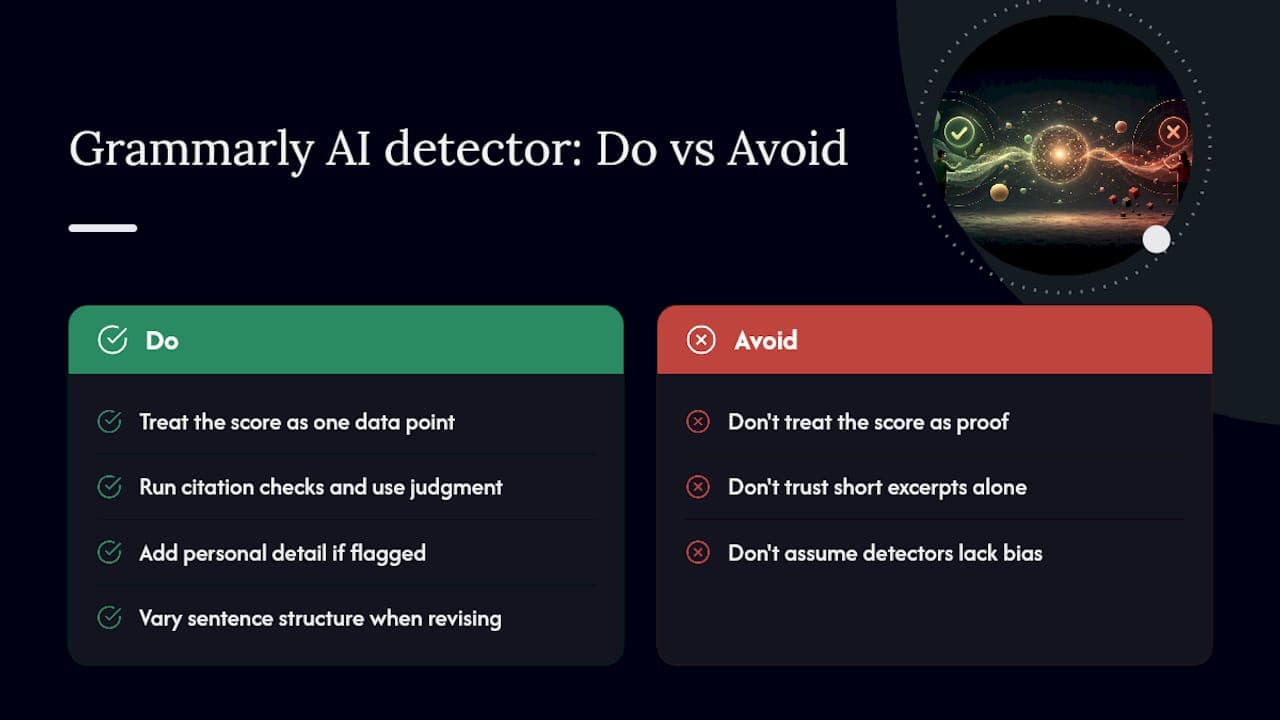
No detector proves authorship. It estimates likelihood based on statistical patterns, and Grammarly's own materials are candid that the tool isn't 100% accurate and should be used alongside citation checks and human judgment, not as a final ruling.
The bias problem deserves specific attention here.
Research from Stanford HAI found that AI detectors can disproportionately flag writing from non-native English speakers as AI-generated, likely because those writers tend to use more predictable vocabulary and simpler sentence structures, the same patterns detectors associate with machine output.
That's a serious equity issue in classrooms and workplaces with international students or multilingual staff. A detector trained mostly on native-English patterns will read careful, correct, slightly formal writing as suspicious, even when a human wrote every word of it.
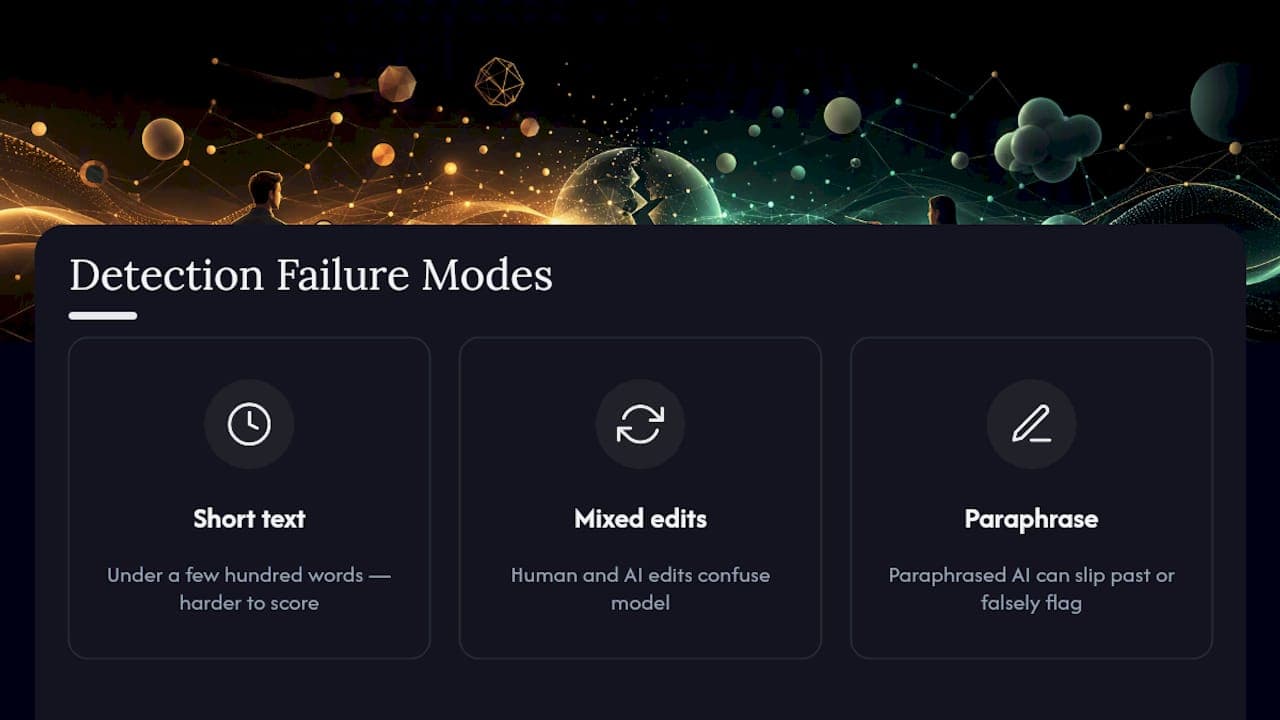
Three practical failure modes show up constantly: short passages under a few hundred words are statistically harder to score accurately, according to Grammarly's own support documentation; text that mixes human writing with AI-assisted edits often confuses the model; and paraphrased AI content, run through a rewriter, can slip past detection or trigger a false flag depending on how aggressively it was reworded.
Getting a score is the easy part. Acting on it correctly is where most people either overcorrect or ignore a real problem. Here's the sequence that actually works.
Pro Tip: Read your revised paragraph out loud. If it sounds like something you'd actually say to a classmate explaining your argument, it's probably fine. If it sounds like a brochure, keep editing.
This loop, scan, inspect, rewrite or cite, is the same workflow every responsible AI proofreading service recommends, and it takes minutes once you know what to look for.
Running a detector, then jumping to a separate editor, then a third tool for citations wastes time and increases the odds you'll skip a step. Samwell.ai builds the whole loop into one place.
Samwell.ai's Semihuman.ai technology is designed to minimize plagiarism risk while keeping your voice intact, and the platform now serves more than 1,000,000 students and academic professionals who need that scan-edit-cite loop to actually work under deadline pressure.
Grammarly offers its AI detector as part of a tiered structure rather than a standalone purchase. The free tier includes basic AI detection alongside grammar and clarity suggestions, which covers casual use, quick checks on a single essay, or a first pass before deeper editing.
Premium and Business plans unlock more frequent checks, additional writing style controls, and, depending on the plan, access to the newer Authorship features that pair detection with citation and originality tracking. Grammarly publicly introduced Authorship in 2024 specifically to give students and institutions a transparent record of how a document was written, human draft, AI assistance, and edits, layered together.
Institutional and education-tier pricing typically differs from individual consumer pricing, and exact rates shift based on seat count and contract length, so check current listings directly rather than relying on a fixed number here. The practical takeaway: casual users can run detection checks without paying anything, but anyone who needs the full transparency and citation workflow at scale will likely land on a paid tier eventually.
A single essay-length document, somewhere in the 1,000 to 2,000 word range, typically scans in well under a minute once it's pasted or uploaded. The segmentation and scoring process is automated and fast by design, since the tool needs to handle high volumes of student and professional submissions without becoming a bottleneck.
The time sink isn't the scan. It's what comes after.
Reviewing flagged passages, deciding which ones genuinely need rework, and rewriting or citing them properly can take anywhere from ten minutes for a short paper with one or two flags to well over an hour for a longer research document with multiple ambiguous sections. Students who skip the review step and just glance at the top-line percentage are the ones who end up resubmitting work later. The scan is instant. The judgment call afterward is where the real time goes, and it's worth budgeting for.
The biggest mistake I see people make with any AI grammar correction tool is treating the percentage like a grade. It isn't one. It's a probability estimate built from pattern matching, and pattern matching gets things wrong in predictable ways, especially for non-native English writers whose careful, correct prose can read as suspiciously uniform to a model trained mostly on other patterns.
My honest recommendation: mark AI assistance transparently when you've used it, cite sources rather than trying to disguise paraphrased research as original insight, and never let a single percentage override your own judgment about whether a passage actually reflects your thinking. Combine the detector's output with an actual human read of the flagged text every time. The tool is a flashlight, not a jury.
Scanning your draft is only step one. The harder part is fixing what gets flagged, and doing it fast enough to still hit your deadline. Samwell.ai handles the entire loop in one place: run the detection check, open the Power Editor to rewrite thin or uniform passages with real reasoning and detail, then generate a properly formatted citation the moment a paragraph needs attribution instead of a rewrite.
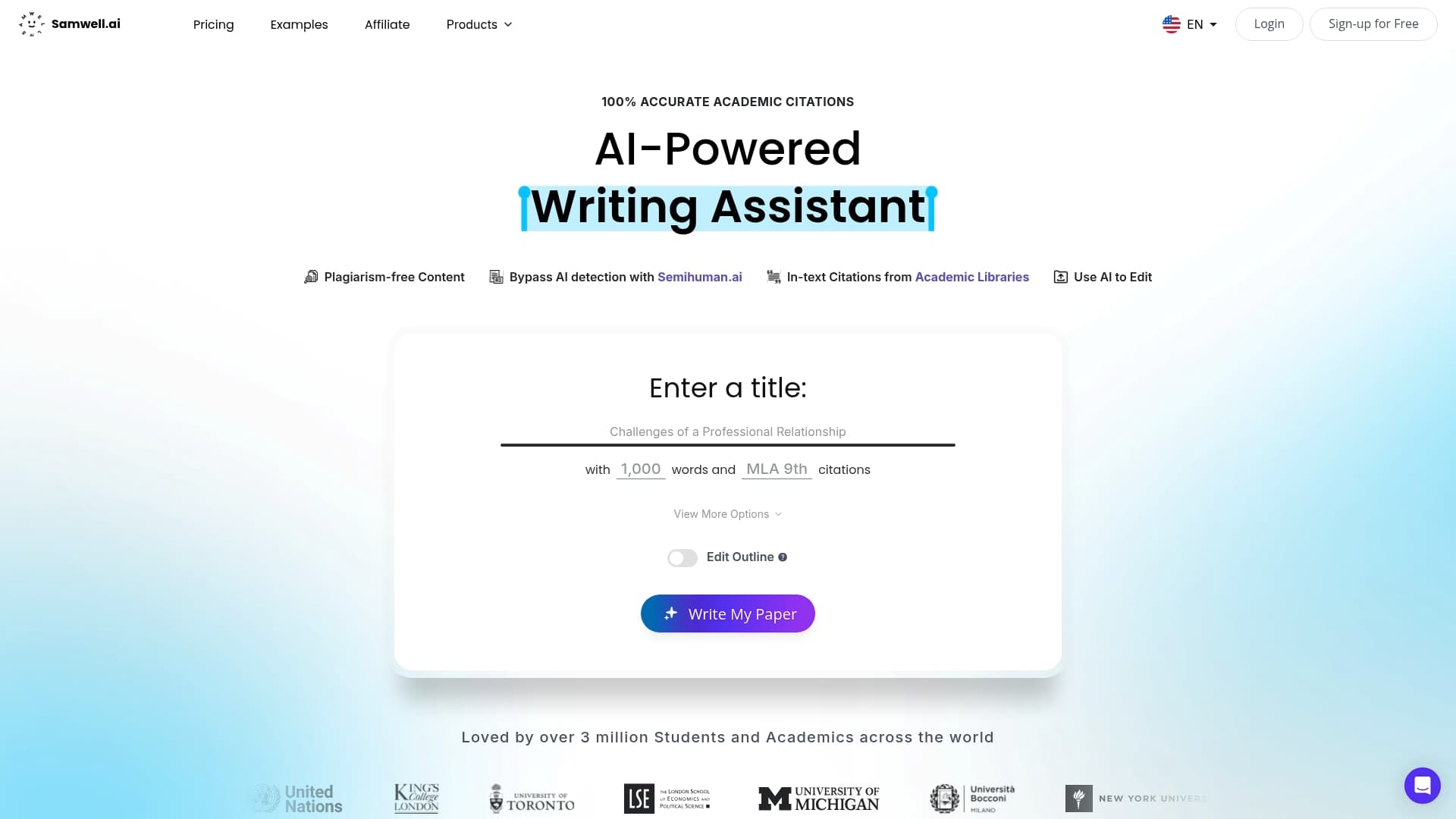
That integration matters because switching between three separate tools, a detector, a grammar editor, and a citation generator, is exactly where mistakes slip through. Samwell.ai's Guided Essays also help you avoid the templated structure that trips up detectors in the first place, since a well-reasoned outline produces writing that sounds like an actual argument instead of a pattern match. If you're staring at a flagged research paper right now, start with the research paper generator to rebuild the weak sections properly, or use the essay enhancement tool to strengthen an existing draft before you resubmit it.
Can Grammarly's AI check tell me for certain if text was written by AI? No. It returns a probability estimate based on pattern matching, and Grammarly itself notes the tool isn't fully accurate. Treat the score as a data point alongside citation checks and your own judgment, not as proof.
Does Grammarly's AI detector work on short paragraphs? Less reliably. Grammarly's support documentation notes that shorter passages give the model less material to analyze, so percentages on brief excerpts carry more uncertainty than results on full-length documents.
Is there a free version of Grammarly's AI checker? Yes, a free tier covers basic AI detection for casual or single-document use. Deeper features, including the Authorship transparency tools, typically require a paid plan.
What should I do if my own writing gets flagged as AI-generated? Read the flagged passage closely, add specific personal detail or reasoning that only you would know, and vary your sentence structure. If the content came from a real source, add a proper citation instead of rewriting from scratch.
Are AI detectors biased against certain writers? Yes. Research from Stanford HAI found detectors can disproportionately flag non-native English writing as AI-generated, largely because simpler, more predictable sentence patterns overlap with what the models associate with machine-generated text.