Loading...

An informative essay follows a three-part structure: an introduction with a hook and a focused thesis, body paragraphs that each cover one subtopic with evidence and explanation, and a conclusion that restates the thesis and closes with a final thought. Before you submit, check three formatting basics:
Resources like Purdue OWL and tools like Samwell cover both structure and citation in detail. The rest of this guide walks you through every step, from understanding what an informative essay actually is to the final pre-submission checklist.
An informative essay, sometimes called an expository essay, has one job: to explain or report on a topic using facts, without trying to persuade the reader or share the writer's personal opinion. The UMGC Effective Writing Center describes good informative writing as a "window of clear glass" — the reader sees the subject clearly, not the writer's feelings about it.
That distinction matters in practice. A persuasive essay argues a position and uses evidence to change the reader's mind. A narrative essay tells a story, often from personal experience. A reflective essay explores the writer's own thoughts and growth. An informative essay does none of those things. It presents, explains, and clarifies.
Three common types give you a sense of the range:
You can read more about what informative essays are and how they're structured across different assignment types.
The informative essay structure has three levels: the overall essay shape, the section-level formula, and the paragraph-level formula. Get all three right and your essay practically grades itself.

Think of your introduction as a funnel. You start broad, narrow toward your topic, and land on a precise thesis. Natural Write describes this as moving from a wide hook to a direct, one-sentence thesis statement.
A strong informative thesis sounds like: "This essay examines the three main causes of the 2008 financial crisis: deregulation of mortgage lending, the rise of mortgage-backed securities, and failures in credit rating." Notice it tells the reader what's coming without taking a side.
For more on writing effective introductions, including hook options and common opening mistakes, that guide covers the full range.
Each body paragraph follows a three-part rhythm: introduce, present, explain. Natural Write frames it as topic sentence → evidence → explanation of why it matters.
One practical note from Purdue University Global's Writing Center: the classic five-paragraph (1-3-1) format is a useful default, but the number of body paragraphs should follow the logical subpoints of your thesis, not an arbitrary count. If your thesis has four subtopics, write four body paragraphs.

Your conclusion restates the thesis in new words, briefly synthesizes the main points, and ends with a closing thought that gives the reader something to take away. No new information goes here. Think of it as the essay's landing, not its launch pad.
The outline below is a fill-in-the-blanks template. Copy it, replace the bracketed text, and you have a working skeleton for any standard informative assignment.
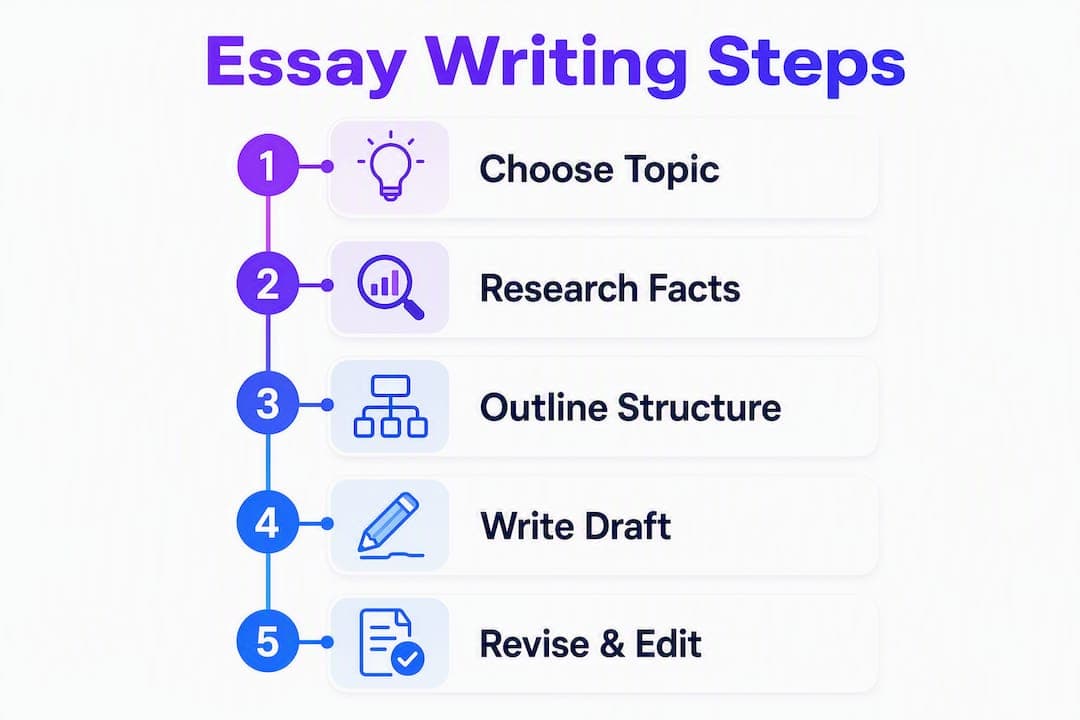
Five-Paragraph Informative Essay Outline
I. Introduction
II. Body Paragraph 1
III. Body Paragraph 2
IV. Body Paragraph 3
V. Conclusion
Here is what a completed body paragraph looks like in practice, following the introduce-present-explain formula:
Notice the topic sentence names the subtopic clearly, the evidence is specific and factual, and the explanation connects the evidence back to the thesis without editorializing.
Adobe Acrobat's writing guide reinforces that pre-writing and outlining are critical: experienced writers treat an outline as a skeleton they can reorganize before a single full sentence is written.
A five-paragraph essay covers one thesis with three subtopics. For a 10-page research paper, the same logic applies at a larger scale. Split each subtopic into its own section with multiple paragraphs. Add an evidence subsection under each heading. Narrow your thesis so it is genuinely doable within the page count. The informative essay format guide on Samwell's blog walks through how to expand this structure for multi-page assignments.
Pro Tip: Draft your topic sentences last, not first. Write the evidence for each paragraph, then write a topic sentence that honestly reflects what the evidence actually says. This prevents the common problem of a topic sentence that promises something the paragraph never delivers.
Most U.S. instructors expect these defaults unless they specify otherwise:
When in doubt, ask your instructor about title page requirements, whether an abstract is needed, and whether section headers are allowed.
APA, MLA, and Chicago are the three citation styles most commonly required in U.S. academic essays. Instructors typically specify which one to use.
| Style | In-text example | End-of-paper list | Best authoritative guide |
|---|---|---|---|
| MLA | (Smith) | Works Cited page | Purdue OWL MLA Guide |
| APA | (Smith) | References page | APA Publication Manual (7th ed.) |
| Chicago | Footnote: Smith, Title. | Bibliography | Chicago Manual of Style |
For Chicago in-text citation examples and footnote formatting, the Chicago in-text citation guide on Samwell's blog covers the most common patterns students encounter.
Purdue OWL remains the most widely used free reference for all three styles. Bookmark it.
Pro Tip: Read your essay backward, paragraph by paragraph. Starting from the conclusion forces you to evaluate each paragraph on its own merits rather than riding the momentum of the narrative. Weak paragraphs become obvious immediately.
Run through this before you upload or email your essay:
Samwell is built specifically for students working through exactly this kind of assignment. Its features map directly onto the seven-step process above.
In the workflow: use Guided Essays during the outline step, the citation manager throughout drafting, the Power Editor during revision, and the plagiarism minimizer before the final proofread.
Samwell serves over 1,000,000 students and academic professionals from universities across the country. [brand_signal] [author_bio]
A well-formatted informative essay uses a focused thesis, a three-part paragraph formula, and the correct citation style to present facts clearly and objectively.
| Point | Details |
|---|---|
| Core structure | Introduction (hook + thesis), body paragraphs (topic sentence + evidence + explanation), conclusion (restate + synthesize). |
| Paragraph formula | Every body paragraph follows: topic sentence → evidence → explanation → transition. |
| Thesis test | A strong informative thesis maps coverage, not an argument; check it is narrow, significant, and doable. |
| Citation style | APA, MLA, and Chicago are the three standard U.S. styles; always confirm which one your instructor requires. |
| Samwell for drafting | Samwell's Guided Essays, Power Editor, and citation manager support every step from outline to final submission. |
Most students treat the thesis as a formality, something to write first and never revisit. That's the single habit that produces mediocre informative essays. The thesis is a contract with the reader: it promises exactly what the essay will cover. When the body paragraphs drift, it's almost always because the thesis was written before the research was done.
The smarter approach is to write a working thesis early, draft the body with evidence first, then revise the thesis to match what the evidence actually supports. This isn't cheating or going backward. It's how experienced writers work. The outline is a living document, not a locked plan.
There's also a tone problem that doesn't get enough attention. Students who write persuasive essays well sometimes struggle with informative essays because they keep reaching for evaluative language. "This policy is clearly harmful" sounds confident, but it's an opinion. "Studies show this policy correlates with a 12% increase in X" is informative. The discipline of staying on the factual side of that line is what separates a B paper from an A paper on most informative assignments.
One last thing: don't underestimate the closing thought in your conclusion. It's not a summary. It's the one moment where you can gesture at the broader significance of what you've explained, without arguing for anything. A well-written closing thought is what readers remember.
Writing a strong informative essay from scratch takes time. Samwell cuts the friction at every stage where students typically lose hours: building the outline, formatting citations mid-draft, and catching originality issues before submission.
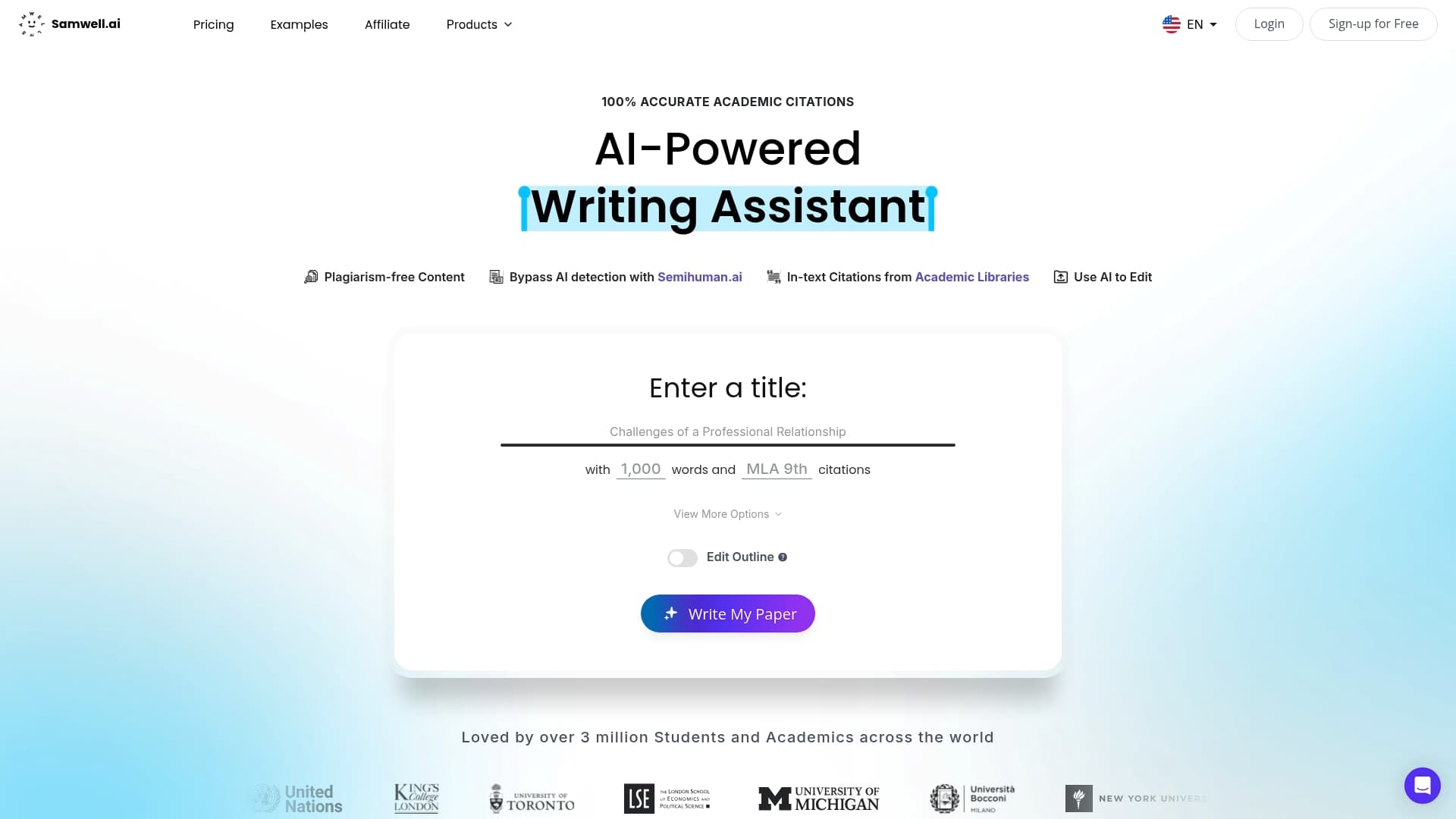
With Guided Essays, you get a structured outline the moment you enter your topic and thesis. The Power Editor handles targeted revisions so you're not rewriting whole sections to fix one weak paragraph. The citation manager keeps APA, MLA, and Chicago formatting correct as you write, not as an afterthought. And the Semihuman.ai plagiarism minimizer runs in real time, so you submit with confidence rather than guessing.
Over 1,000,000 students have used Samwell for exactly this kind of assignment. Use it to draft and check sources, then verify any quotes and confirm your instructor's specific requirements before submitting.
Start your informative essay with Samwell's research paper generator and have a formatted, cited draft ready faster than you'd expect.
These are the most reliable free resources for informative essay structure, citation rules, and writing guidance: