Loading...

Searching for credible sources for an essay in a North American university can feel like a maze of rules and expectations. With professors demanding transparent research, every citation counts toward your academic integrity. References serve three critical functions in scholarly writing: they help readers track down sources, credit original authors, and ensure fact-checking is possible. This guide clarifies how to define academic references, choose the right types, and use tools that simplify citation without risking plagiarism.
| Point | Details |
|---|---|
| Importance of References | Academic references are crucial for maintaining credibility and integrity in research, allowing readers to verify claims. |
| Citations vs. References | Citations indicate sources within the text, while references provide full source details at the end of the paper. |
| Types of References | Familiarize yourself with various reference types, such as journal articles and books, to enhance the quality of your writing. |
| Avoiding Improper Referencing | Proper citation practices prevent unintentional plagiarism and uphold academic integrity throughout your work. |
Academic references are the backbone of credible research. They're the citations and source information you provide so readers can trace your claims back to original sources and verify your work.
At their core, references serve three critical functions in your academic writing:
When you cite a source properly, you establish yourself as a careful researcher who values accuracy. Readers can focus on the actual content of your work instead of wondering where information came from or whether you did your homework.
References aren't just bureaucratic requirements. They're essential to maintaining academic honesty. When you reference someone else's work, you're explicitly saying, "This idea comes from this person, not from me." This distinction separates original thinking from borrowed ideas.
References also act as a fact-checking mechanism. If a professor wants to verify a claim you made, they can look up your source and check it themselves. This transparency builds trust in your research and demonstrates that you've done legitimate scholarly work.
Properly formatted references establish your credibility as a thorough researcher and ensure readers can locate the original sources that support your arguments.
Every academic field has expectations about what sources count as credible. You might include journal articles, books, government reports, or reputable websites. Understanding what types of sources work for your specific assignment matters just as much as formatting them correctly.
These terms get mixed up constantly. Citations are the in-text markers that show a source exists (like a superscript number or author-date notation). References are the full list at the end of your paper with complete publication details.
You need both to show readers exactly where your information came from. One without the other leaves readers confused about which sources you actually used or unable to find them.
Your citation style determines how both citations and references look. APA, MLA, and Chicago styles all format references differently, so knowing your assignment's requirements is critical before you start researching.
Pro tip: Set up your reference list from day one of your research project rather than trying to compile it at the end. Tools like citation managers save you hours and catch formatting errors before you submit your work.
Not all sources are created equal in academic writing. You'll encounter different types of references throughout your research, and each one follows its own formatting rules. Understanding what counts as what helps you cite correctly and find sources faster.
The most common academic references fall into these categories:
Each type serves a different purpose in your paper. Journal articles typically contain the latest research findings. Books provide comprehensive overviews and historical context. Government reports offer official data and statistics. Knowing which type works best for your argument matters as much as finding the source itself.
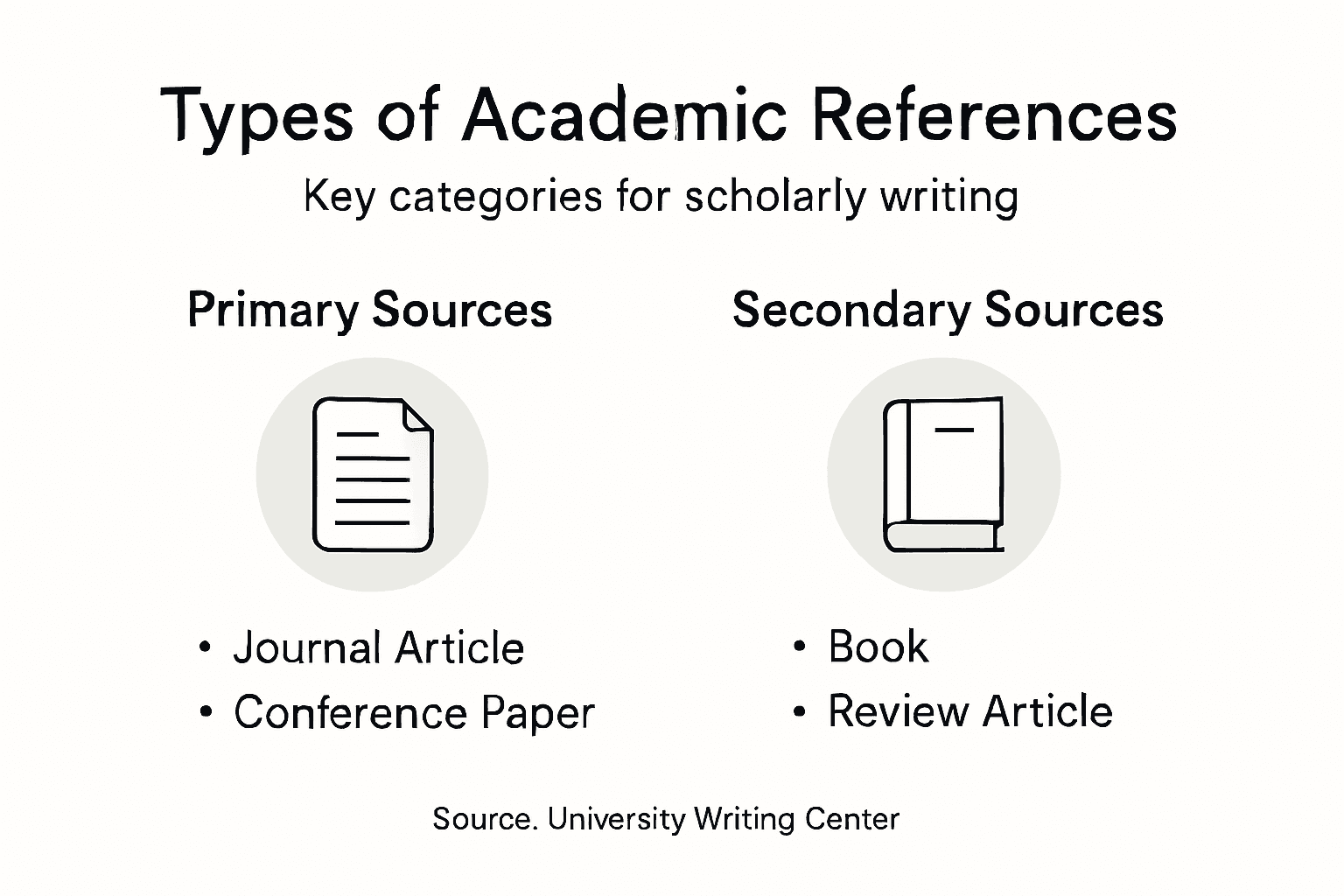
Academic references split into two main categories based on how directly they relate to your topic. Primary sources are original documents or data—think original research studies, historical records, or firsthand accounts. Secondary sources analyze or discuss primary sources, like review articles or books about historical events.
Your professor likely wants a mix of both. Primary sources show you've engaged with original research. Secondary sources help you understand context and what experts think about the topic.
Different academic fields emphasize different source types, so understanding your discipline's preferences is critical before you start researching.
Here is a quick comparison of primary and secondary sources to guide your research:
| Source Type | Direct Evidence | Common Examples | Academic Use |
|---|---|---|---|
| Primary Source | Yes | Original studies, firsthand accounts | Supports original arguments |
| Secondary Source | No | Reviews, textbooks, commentaries | Provides context, analysis |
The reason reference types matter comes down to formatting. A journal article citation looks completely different from a book citation. An online source needs different information than a government report. Proper citation formatting ensures readers can actually find what you cited.

Your citation style (APA, MLA, Chicago, Harvard) determines exactly what information you include and how you arrange it. Some styles prioritize the author's name first. Others lead with the publication date. Some require URLs for online sources; others don't.
The good news: once you know your source type and your required citation style, the formatting becomes straightforward. Most citation tools handle this automatically, catching errors before you submit.
Pro tip: Create a reference list template that matches your citation style before you start researching, then plug in source information as you go rather than scrambling at the deadline.
To clarify how citation styles differ, here is a summary of major academic reference formats:
| Citation Style | Author Emphasis | Date Placement | Typical Use |
|---|---|---|---|
| APA | Author first | Date after author | Social sciences, psychology |
| MLA | Author first | Date at end | Humanities, literature |
| Chicago | Author or title | Date varies | History, business |
| Harvard | Author first | Date after author | Science, general research |
Finding good sources matters more than finding lots of sources. You could spend hours scrolling through search results, but if your sources aren't credible, your entire paper suffers. Learning where to look and how to evaluate what you find saves time and protects your academic integrity.
Start your research in places designed for academic work:
These sources filter out low-quality material before you even see it. Your university library gives you access to premium databases that cost thousands of dollars. Use them—your tuition already paid for this.
Once you find a source, don't assume it's credible just because it appeared in your search results. You need to dig deeper. Check who wrote it and whether they have real expertise in the topic. An article about climate science should be written by someone with scientific credentials, not a blogger without background knowledge.
Look at who published the source. Peer-reviewed journals are gold standard—experts in the field reviewed the work before publication. University presses and established academic publishers also maintain quality standards. Be skeptical of sources with unclear authorship or no publication information.
Evaluating author credentials and institutional affiliations helps you determine whether a source is appropriate for academic work.
Check when the source was published. Recent sources show current thinking, though older sources matter too for historical context. Watch for bias. A study funded by a pharmaceutical company about that company's drug might present results differently than an independent study would.
If a source makes an important claim, check whether other credible sources agree. This takes extra time, but it's how you catch misinformation. If multiple peer-reviewed sources support the same finding, you've got something solid to cite.
Never rely on a single source for critical information. Real research uses multiple sources to build credibility and show you've done thorough work.
Pro tip: Save sources as you research by adding them to a citation manager like Zotero or Mendeley, which automatically formats them in any style and prevents you from losing track of where information came from.
AI citation tools can speed up your research workflow dramatically. They generate formatted citations, suggest reference formats, and catch inconsistencies in seconds instead of hours. But here's the critical part: AI isn't perfect, and you need to verify everything before submitting your work.
AI tools excel at specific tasks in the citation process:
These features save time on tedious formatting work. Instead of manually typing citations or hunting through publication details, you input basic information and let the tool handle the rest.
Here's where caution kicks in. AI tools can generate plausible but completely fabricated references. The tool might create a citation that looks perfect but doesn't match any real source. A study title might be slightly wrong. An author's name might be misspelled. These errors are hard to catch unless you verify each citation against the original source.
This matters because citing a source that doesn't exist is academic dishonesty, even if the mistake came from an AI tool. You're responsible for accuracy, not the tool.
AI-generated citations must be verified for accuracy before submission, as AI may produce plausible but incorrect references.
Use AI citation tools as assistants, not replacements for your judgment. Here's the right approach:
Never assume an AI-generated citation is correct just because it looks professional. Take 30 seconds to verify the author name, publication title, and date match your actual source. This prevents embarrassing errors from derailing your grade.
Also check your institution's or professor's policy on AI use in academic work. Some schools require transparency about which tools you used. Following these guidelines protects you academically and demonstrates integrity.
Pro tip: Use AI tools to generate a draft citation, then manually verify it against your actual source before adding it to your reference list—this catches errors and ensures accuracy without losing the time-saving benefits.
Improper referencing isn't just a formatting mistake. It can destroy your academic reputation, tank your grade, and create serious consequences you didn't anticipate. Understanding these risks helps you take referencing seriously and protect your future.
The most significant risks include:
These consequences are real and documented. Universities take plagiarism seriously because academic integrity is the foundation of scholarship. One careless citation mistake can unravel months of work.
Here's what trips up most students: you can plagiarize accidentally. You might paraphrase without citing, use someone else's phrasing without quotation marks, or forget to add citations when you promised you would. The intent doesn't matter. Your professor only sees the uncited material and assumes dishonesty.
Unintentional plagiarism happens when you lose track of which ideas came from sources and which are original thoughts. Maintaining detailed notes with proper citations from the start prevents this confusion before it starts.
The solution is simpler than you think: cite as you research, not after. Write down the source information immediately when you find something useful. Include the author, publication date, and page number. This takes 10 seconds now and saves hours of scrambling later.
Plagiarism gets the attention, but other referencing mistakes can be equally serious. Submitting the same paper for multiple classes, listing authors who didn't contribute, or presenting someone else's work as your own all damage academic integrity and can trigger investigations.
These behaviors might seem invisible in a large class, but institutions have sophisticated plagiarism detection software and faculty who remember student work. Getting caught costs far more than doing the work correctly.
Adhering to ethical guidelines for authorship ensures accurate attribution and maintains research integrity and credibility.
Prevent these issues with straightforward habits:
These steps take minimal time but create massive protection. You'll never stress about whether you cited something correctly because you know you did it thoroughly.
Pro tip: Set up a citation spreadsheet or file before researching, recording sources immediately with author, date, and page number—this prevents citation scrambles and protects you from accidental plagiarism.
Struggling to keep your academic references accurate and properly formatted while avoiding the pitfalls of unintentional plagiarism is a common challenge. This article highlights how critical it is to manage citations responsibly, verify AI-generated references, and maintain academic integrity throughout your research. If you want to streamline your referencing process, reduce errors, and uphold scholarly honesty without losing precious time, the advanced tools offered by Samwell.ai are exactly what you need.
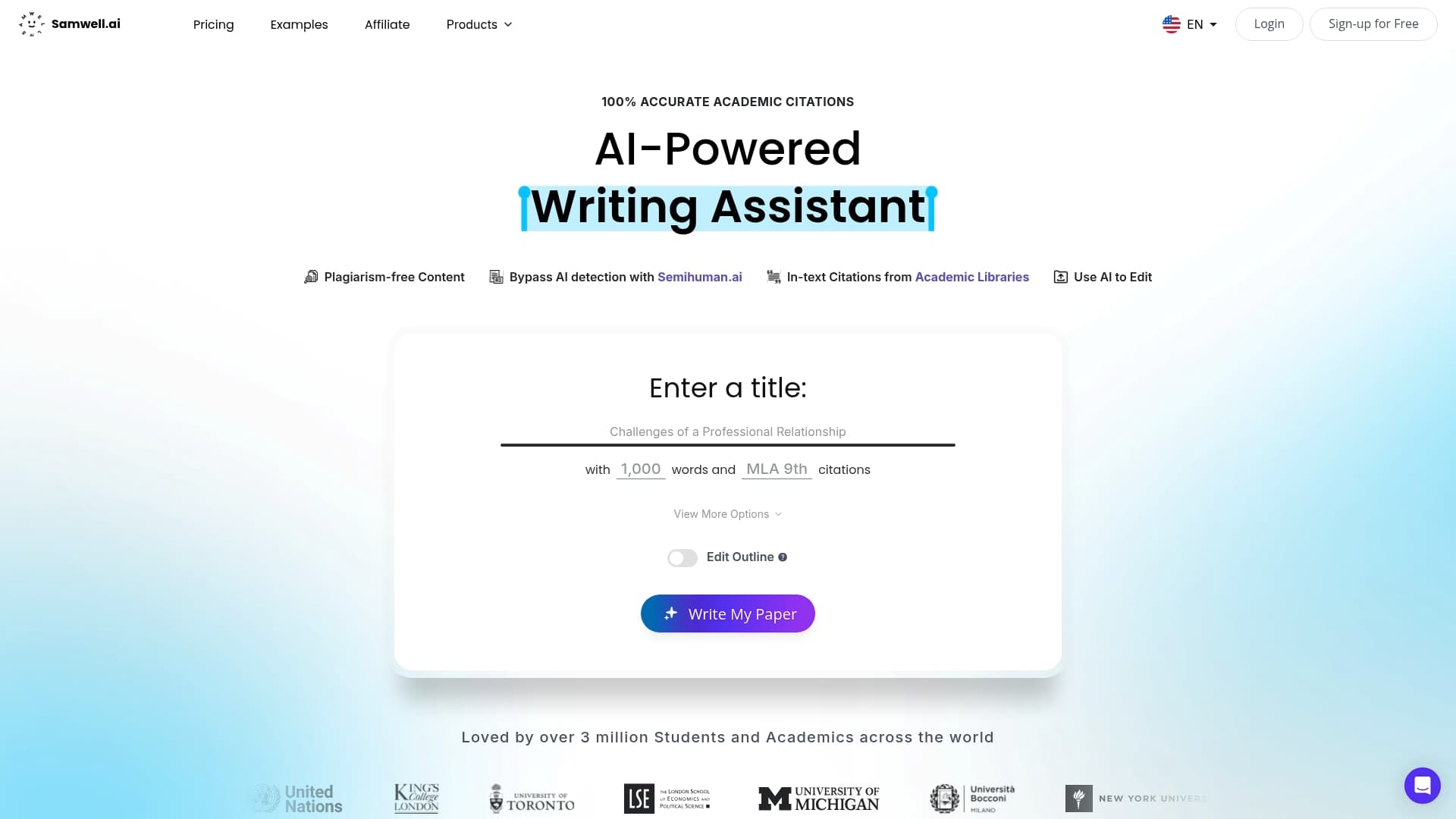
Discover how Samwell.ai’s innovative AI-driven platform, empowered by unique Semihuman.ai technology, simplifies citation generation and real-time plagiarism detection while supporting multiple citation styles such as APA and MLA. Whether you are creating detailed research papers or need assistance organizing your reference lists, features like the 'Power Editor' and 'Guided Essays' give you full control combined with time-saving automation. Visit Samwell.ai now to transform your academic writing workflow and build credibility in every paper you submit. You do not have to compromise quality or integrity when producing high-impact research documents.
Academic references are the citations and source information provided in research that allow readers to trace claims back to original sources. They are important for maintaining academic integrity, giving credit to original authors, and allowing readers to fact-check the work.
Citations are the in-text markers that indicate a source exists, while references are the full list of sources at the end of your paper. Both are necessary for proper attribution in academic writing.
Common types of sources include journal articles, books, government reports, conference papers, theses, websites, and datasets. Each type has its own formatting rules and serves different purposes in a research project.
To ensure credibility, start your research in academic databases, evaluate the author's expertise, check the publication's reputation, and cross-reference claims with other credible sources. This helps maintain the integrity and quality of your work.