Loading...

TL;DR:
- Citation generators format citations but do not verify source accuracy, requiring users to check metadata manually. They are best used alongside citation checkers and reference managers to ensure reliable bibliographies and maintain academic integrity. Proper workflow verification prevents errors, especially with AI tools increasing the risk of fabricated references.
Citation generators are everywhere in academic life, yet explaining citation generators clearly enough for students and researchers to use them correctly is rarer than you'd think. Most people assume these tools verify your sources automatically. They don't. A citation generator formats whatever data you give it. If the data is wrong, the citation comes out wrong, and polished formatting makes that error look trustworthy. This article breaks down exactly what citation generators are, how they compare to other reference tools, and how to build a workflow that actually protects your academic credibility.
| Point | Details |
|---|---|
| Generators format, not verify | Citation generators output formatted text but never confirm whether your source is real or accurate. |
| Three tools serve different roles | Citation generators, citation checkers, and reference managers each solve a different part of the citation problem. |
| Verify before you format | The safest academic workflow checks metadata accuracy before running it through a citation generator. |
| Time savings are real | Generators reduce formatting workload, letting you focus more on writing and ideas than on style rules. |
| AI raises the stakes | The rise of AI writing tools makes citation validation more urgent, not less, since fabricated references can appear perfectly formatted. |
A citation generator is an online tool that takes bibliographic information and converts it into a formatted citation that matches a specific style, such as APA, MLA, or Chicago. You supply the data, and the tool applies the formatting rules. That's the full scope of what it does.
Most citation generators accept input in a few ways:
The output is a pre-formatted citation string you copy into your paper. Switch the style selector from APA to MLA, and the same source reformats instantly. That flexibility is genuinely useful, especially when a journal requires a style you rarely use.
What citation generators cannot do is just as important to understand. Citation generators only format what you provide. They don't check whether a DOI resolves to a real article, whether the author name is spelled correctly, or whether the publication year matches the actual record. Automated scrapers are also prone to errors. Automated tools often mismap titles, capitalizing words incorrectly or missing required italicization. What you get back looks correct but may contain hidden errors.
Pro Tip: Before copying any generated citation, open the actual source and compare the author name, publication date, and title character by character. The formatting will be right; the data is your responsibility.
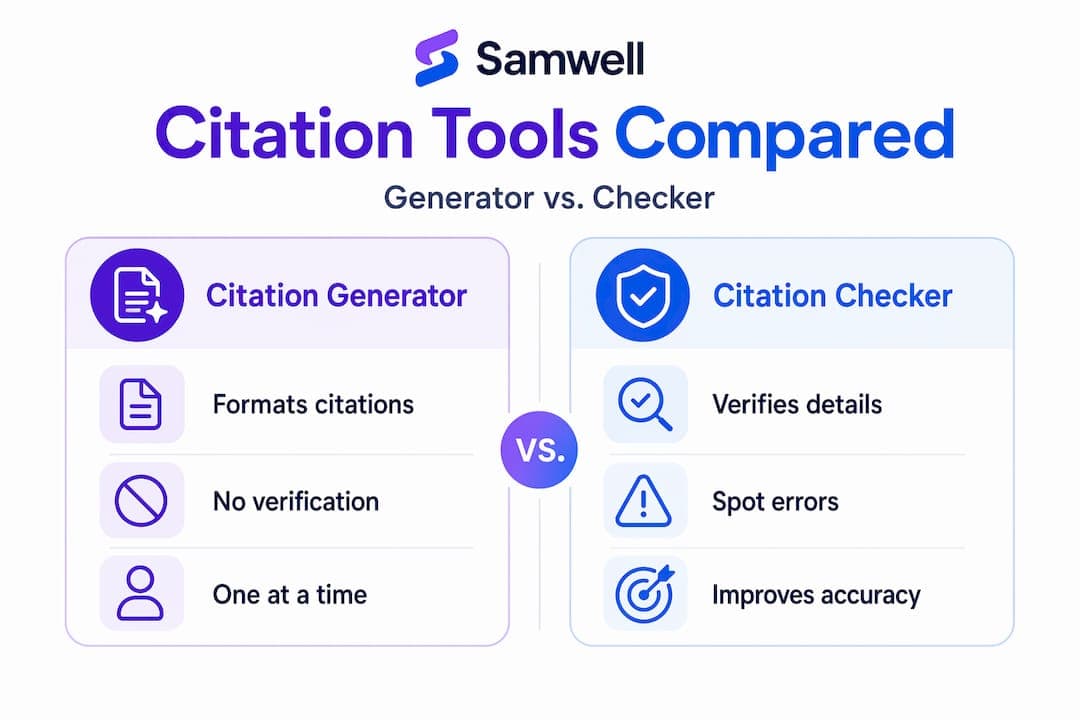
Students frequently treat these three categories as interchangeable. They aren't, and confusing them is one of the most reliable ways to end up with unreliable bibliographies.
| Tool type | Primary function | Verifies sources? | Stores sources? | Best for |
|---|---|---|---|---|
| Citation generator | Formats citations in a chosen style | No | No | Quick, one-off citations |
| Citation checker | Validates metadata and source existence | Yes | No | Catching errors before submission |
| Reference manager | Organizes, stores, and inserts citations | Partially | Yes | Long-term research projects |
A citation checker does what most people think a citation generator does. It takes a citation you've already written or generated and confirms whether the source actually exists, whether the DOI resolves, and whether the metadata matches the published record. Adding a verification step to your workflow reduces research verification time by up to 74% compared to catching errors only at the end.
Reference managers are a different category entirely. Tools in this space let you collect sources during research, store PDFs, tag and organize references, and then insert formatted citations directly into your manuscript. Reference managers like Zotero and EndNote enable organizing and storing references, inserting citations into manuscripts, and reformatting entire bibliographies when a style requirement changes. They also offer collaborative features including shared collections, retraction alerts, and duplicate detection for teams working on the same paper. Citation managers support collaboration and organization that citation generators simply don't offer.

The critical vulnerability shared by all three tools is what researchers call "stale citation drift." Sources move, journals retract papers, and metadata records get updated. Citation generators don't store your sources, so they can't flag when something changes. Reference managers maintain a stable source library with permanent corrections to metadata, which makes your citation accuracy improve over time rather than decay.
Pro Tip: For any paper longer than five pages, pair your citation generator with at least one reference manager. The generator handles style formatting; the manager handles everything else.
The benefits of citation tools are real, and the best citation generator options deliver genuine time savings when used for the right tasks.
The honest framing here is that citation generators are formatting assistants, not citation authorities. They shine in short projects, quick conversions, and situations where you've already verified your source data. For a dissertation or a multi-source review article, they need to be one piece of a larger system.
Using citation generators without understanding their limits is where academic integrity problems start. Here are the most common mistakes and how to correct them.
Trusting scraped metadata without checking. When you enter a URL, the generator reads whatever metadata the page publishes. Outdated or incorrectly tagged pages produce incorrect citations. Always open the source and verify author names, publication dates, and titles manually.
Skipping the DOI verification step. A generator will happily format a citation with a fake or broken DOI. Cross-reference every DOI at doi.org before submitting.
Copying formatted text and losing style markers. Pasting a citation from a web tool into Word can strip italics or convert straight quotes to smart quotes inconsistently. Paste as plain text first, then apply your document's citation formatting style.
Assuming the style selection is foolproof. Automated scrapers frequently misidentify source types, treating a chapter in an edited volume as a standalone article, for example. Verify that the generator used the correct source type before accepting the output.
Ignoring AI-generated references. If you used an AI writing assistant anywhere in your research process, treat any citations it produced with maximum skepticism. The rise of AI citation tools makes validation more critical than ever, since fabricated references can appear in a perfectly correct citation format.
Using a generator as your only citation system. Using citation generators without a verification workflow risks creating isolated, inconsistent bibliographies prone to errors. Treat every generator output as a draft, not a final product.
Pro Tip: Build a two-minute review into your workflow. After generating citations, paste them into a checklist document and verify source type, author spelling, year, and DOI one row at a time. Two minutes per source prevents hours of revision later.
Knowing how to use citation generators effectively means knowing where they fit and where they don't.
Learning which AI citation tools serve students best in 2026 is worth the research time before you commit to one generator as your default.
I've seen students confidently submit papers with beautifully formatted citations that point to sources that don't exist. That's not carelessness. That's misplaced trust in tools that look more capable than they are.
My position is straightforward: citation generators are good at exactly one thing, and that one thing has real value. Formatting is tedious. Style rules are finicky. Generators handle that well. Where I've watched researchers get into serious trouble is when they treat the formatted output as validated truth.
What I've learned from years of working with academic writing tools is that the "verify first, cite second" principle isn't just good advice. It's the difference between a reliable bibliography and one that could unravel under scrutiny. The evolving role of AI in academic writing raises this bar further. AI tools can generate citation text that looks entirely legitimate but references sources that were never published.
The researchers I've seen get this right treat citation generators the way a good editor treats spell check. Useful? Yes. Sufficient on its own? Never. That mental model gets you most of the way there.
— Tilen
If citation formatting is just one part of what's slowing your writing down, Samwell is worth a serious look. Samwell's AI-powered platform is built specifically for students and researchers who need more than a grammar check. It supports citation standards including APA and MLA, helps you expand underdeveloped sections with the paragraph expansion tool, and gives you a full essay enhancement workflow through the enhanced essay creator. More than one million students from leading universities already use it to close the gap between rough drafts and submission-ready papers.
Samwell's real-time AI detection checks and Semihuman.ai technology mean you get academic quality without sacrificing originality. Whether you're reformatting a bibliography or rebuilding an argument from scratch, it's the kind of tool that pays for itself the first time you submit with confidence.
A citation generator is a web-based tool that formats bibliographic information into a structured citation matching a style like APA, MLA, or Chicago. It formats the data you provide but does not verify whether the source is real or accurate.
No. Citation generators only format provided data and do not confirm whether a DOI, author, or publication actually exists. You need a citation checker or manual verification for that step.
A citation generator formats individual citations on demand. A reference manager stores your entire source library, allows metadata corrections, and inserts formatted citations directly into your document across long-term projects.
Verify the author name, publication date, title, and DOI against the original source before using any generated citation. Treat every generator output as a draft that needs a manual spot check.
Use a citation generator for quick, isolated citations or fast style conversions when you've already verified the source data. Use a reference manager for any multi-source project where consistency, organization, and long-term accuracy matter.