Loading...

Selecting the right persuasive essay example can feel overwhelming when you're trying to improve your writing skills. Many students struggle to find strong models that clearly demonstrate effective argumentation and evidence use. Understanding different persuasive essay styles helps you craft more compelling arguments and connect with your audience. This article explores seven distinct persuasive essay examples, analyzes their techniques, and provides practical guidance for choosing the best approach for your academic assignments.
| Point | Details |
|---|---|
| Evaluation criteria | Strong persuasive essays feature clear thesis statements, compelling evidence, logical organization, and emotional appeal. |
| Diverse examples | Seven essay examples demonstrate varied topics from environmental protection to technology's impact on society. |
| Comparison analysis | Side-by-side tables help identify which essay styles match specific assignment goals and audience expectations. |
| Selection strategy | Match example essay structure and tone to your assignment purpose, then adapt rather than copy. |
Before diving into specific examples, you need a solid framework for assessing persuasive essays. This evaluation process helps you identify which models will genuinely improve your writing rather than lead you astray.
Effective persuasive essays clearly state a position and support it with logical reasoning and credible evidence. Start by examining the thesis statement. Does it present a clear, debatable position? The best thesis statements avoid vague language and directly state what the writer aims to prove.
Next, evaluate the evidence quality. Strong persuasive essays incorporate statistics, expert opinions, real-world examples, and logical reasoning. The evidence should directly support each claim without relying on emotional manipulation alone. Look for essays that balance logical appeals with carefully chosen emotional connections.
Organization matters tremendously in persuasive writing. Each paragraph should flow naturally to the next, building a cumulative argument. The introduction hooks readers and previews the argument. Body paragraphs develop individual points with supporting evidence. The conclusion reinforces the main argument without simply repeating earlier content.
Consider these essential evaluation criteria:
Pro Tip: When evaluating examples, read the essay once for overall impression, then read again while noting how each paragraph advances the central argument. This two-pass approach reveals both surface effectiveness and structural strength.
Examining diverse examples offers insight into different persuasive strategies that can be adapted to your writing. Each example below demonstrates unique approaches to argumentation, evidence presentation, and audience engagement.
Environmental protection advocacy: This classic argument essay presents the thesis that immediate action on climate change is essential for future generations. The writer uses scientific data, economic projections, and emotional appeals about children's futures. The structure follows a traditional five-paragraph format with clear topic sentences introducing each supporting point.
Education reform proposal: This social issue essay argues for increased funding in public schools, particularly in underserved communities. The writer combines statistical evidence about educational outcomes with personal narratives from teachers and students. The organization alternates between data-driven paragraphs and human-interest examples, creating both logical and emotional resonance.
Technology impact analysis: This essay examines how social media affects mental health among teenagers, arguing for stricter age restrictions and parental controls. The writer presents psychological research, survey data, and case studies. The structure acknowledges benefits of technology before systematically addressing concerns, demonstrating balanced consideration before reaching a clear position.
Policy change debate: This debate-style essay advocates for universal healthcare implementation, directly addressing common counterarguments. The writer uses comparative international data, cost-benefit analysis, and moral reasoning. The organization dedicates specific sections to anticipated objections, strengthening the overall argument through thorough rebuttal.
Literary analysis with persuasive elements: This essay argues that a specific novel deserves canonical status in American literature. The writer analyzes themes, historical context, and literary techniques while building a case for the work's significance. The structure weaves textual evidence with broader cultural arguments, demonstrating how persuasive techniques apply beyond traditional argumentative topics.
Cultural critique: This essay examines representation in media, arguing for more diverse storytelling. The writer combines industry statistics, audience research, and critical theory. The organization moves from problem identification through solution proposals, maintaining persuasive momentum throughout.
Cause and effect with persuasive thesis: This essay explores how income inequality affects social mobility, arguing for specific policy interventions. The writer establishes causal relationships through economic data and sociological research. The structure clearly separates cause analysis from effect demonstration before presenting solutions.
Each example demonstrates different organizational patterns and evidence types. Some rely heavily on statistics and research, while others balance data with narrative elements. The variety shows how persuasive writing adapts to different topics and audiences while maintaining core argumentative principles.
Comparison tables help students quickly identify which essay styles best suit different assignment goals. This structured analysis highlights how each example approaches persuasion differently.
| Essay Example | Main Argument | Evidence Style | Organization | Best For | | --- | --- | --- | | Environmental Protection | Immediate climate action needed | Scientific data, projections | Traditional five-paragraph | Standard academic assignments | | Education Reform | Increase public school funding | Statistics plus narratives | Alternating data and stories | Social issue papers | | Technology Impact | Restrict teen social media use | Research studies, surveys | Balanced consideration | Argumentative research papers | | Policy Change Debate | Implement universal healthcare | Comparative data, analysis | Counterargument focused | Debate preparation | | Literary Analysis | Canonical status argument | Textual evidence, theory | Integrated analysis | Literature courses | | Cultural Critique | Improve media representation | Industry stats, theory | Problem to solution | Cultural studies | | Cause and Effect | Address income inequality | Economic and social research | Causal chain structure | Economics or sociology |
This comparison reveals patterns in how different topics and purposes shape essay structure. Essays addressing policy changes tend to emphasize counterargument rebuttal, while cultural critiques often move from problem identification to solution proposals. Scientific or data-heavy topics typically rely more on statistics and research studies, whereas literary or cultural arguments integrate more interpretive analysis.
Notice how evidence style correlates with subject matter. Hard sciences and policy debates lean toward quantitative data, while humanities topics incorporate more qualitative analysis and theoretical frameworks. Your assignment type should guide which example provides the most relevant model.

The organizational column shows structural variety. Some essays follow traditional formats, while others use more complex arrangements like alternating patterns or causal chains. Match your chosen structure to both your topic's demands and your audience's expectations.
After analyzing comparisons, you need a systematic approach for selecting the most appropriate example. Your choice should align with assignment requirements, audience expectations, and your own strengths as a writer.
Start by thoroughly understanding your assignment parameters. What topic are you addressing? What position are you taking? What length and format does your instructor require? Some assignments specify particular organizational structures or evidence types. Match these requirements to examples that demonstrate similar approaches.
Consider your audience carefully. Academic audiences expect rigorous evidence and logical progression. General audiences may respond better to narrative elements and accessible language. Professional audiences value practical implications and actionable recommendations. Choose examples that successfully engage similar audiences.
Your topic's nature influences which example provides the best model. Scientific or technical topics benefit from data-heavy approaches like the technology impact or policy change examples. Humanities topics might draw more from the literary analysis or cultural critique models. Social issues often work well with the balanced approach shown in the education reform example.
These selection guidelines help narrow your options:
Pro Tip: Don't limit yourself to one example. Extract the introduction strategy from one model, the body paragraph structure from another, and the conclusion approach from a third. This synthesis creates a personalized template suited to your specific needs.
Remember that examples provide frameworks, not scripts. Adapt structural elements and persuasive techniques to your unique argument rather than copying format mechanically. The goal is learning effective strategies, not reproducing existing essays. Analyze why certain techniques work in the examples, then apply those principles to your original content.
Learning from persuasive essay examples builds foundational skills, but modern tools can accelerate your writing development. Samwell AI offers specialized support for crafting compelling academic arguments while maintaining originality and academic integrity.
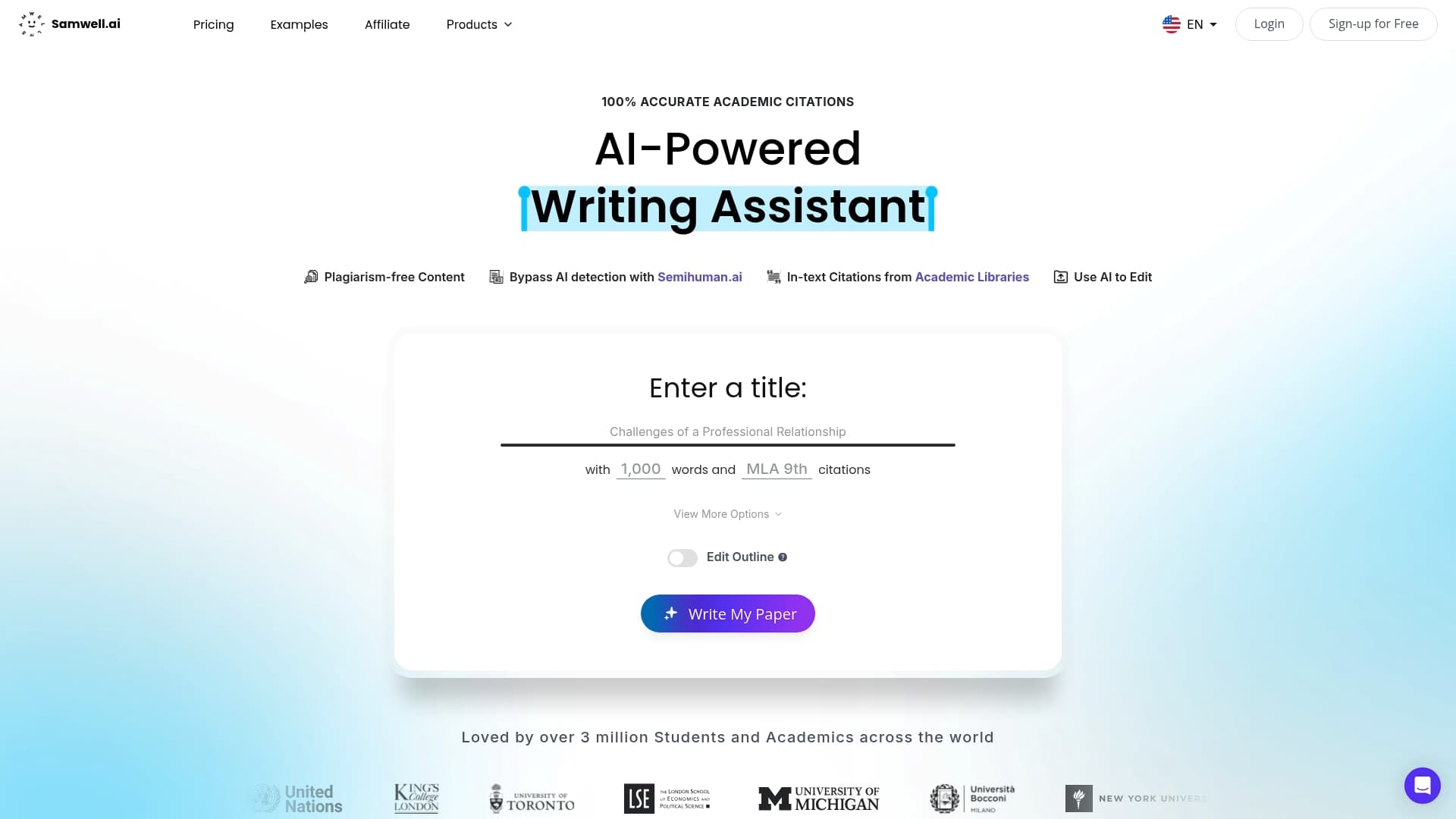
The platform's research paper assistance helps you integrate insights from essay examples into your own writing process. You can generate outlines based on proven persuasive structures, then develop each section with AI-powered suggestions that maintain your unique voice. The Power Editor feature lets you refine specific paragraphs, strengthening argument clarity and evidence integration.
Samwell AI's research paper generator adapts to your assignment requirements, helping you apply the organizational patterns and persuasive techniques you've learned from examples. The platform ensures proper citation formatting and originality checks, so you can focus on developing compelling arguments rather than worrying about technical details. With over 1,000,000 students and academics using these tools, you're joining a community that values both writing excellence and academic integrity.
Effective persuasive essays combine clear thesis statements with compelling evidence that appeals to both logic and emotion. They acknowledge counterarguments and provide thorough rebuttals, demonstrating the writer has considered multiple perspectives. Strong organization guides readers through a logical progression that builds toward a convincing conclusion.
Focus on extracting structural principles and persuasive techniques rather than copying content directly. Identify how the example organizes arguments, integrates evidence, and addresses counterpoints, then apply these strategies to your unique topic. Maintain your own voice and develop original arguments that reflect your research and perspective.
While the terms are often used interchangeably, argumentative essays typically emphasize logical reasoning and objective evidence, while persuasive essays may incorporate more emotional appeals and personal conviction. Argumentative writing often requires acknowledging opposing views more extensively, whereas persuasive writing focuses primarily on building the strongest case for one position.
Academic persuasive essays typically avoid first person to maintain objectivity and focus on evidence rather than personal opinion. However, some assignments or contexts may encourage first person when personal experience strengthens your argument. Check your assignment guidelines and examine examples in your field to determine appropriate voice.
Source quantity depends on essay length and assignment requirements, but quality matters more than quantity. A strong 1500-word persuasive essay might effectively use five to eight well-chosen, credible sources that directly support key claims. Prioritize authoritative, recent sources over accumulating numerous citations of questionable relevance or reliability.