Loading...

TL;DR:
- Starting a research paper from scratch can be challenging because students often face paralysis without a clear framework. Understanding that original research involves making a distinct contribution through a focused question, rigorous methods, and transparency is essential for success. Following a structured process of defining, reviewing, designing, obtaining approval, analyzing, writing, revising, and citing ensures credible and reproducible results that advance knowledge.
Starting a research paper from scratch is genuinely hard. Most students stare at a blank document for hours, unsure whether to begin with a title, a question, or a pile of journal articles. That paralysis is not a personal failure; it is a structural problem. Without a clear framework, even smart, motivated researchers spin their wheels. The good news is that original research follows a reproducible process, and once you understand the criteria, the steps, and the standards involved, the paper almost writes itself. This guide breaks down every essential stage so you can move from idea to polished manuscript with confidence.
| Point | Details |
|---|---|
| Start with a clear question | Defining your research question sets a strong foundation for your study's direction. |
| Follow a structured process | Each step—design, approval, data collection, writing, and revision—adds to paper quality and credibility. |
| Prioritize originality and transparency | Justify your methods, cite properly, and write clearly to enhance your research's impact. |
| Revise iteratively | Multiple rounds of revision improve your manuscript's clarity and scholarly value. |
| Use tools for integrity | Academic tools can help you avoid plagiarism and maintain citation standards efficiently. |
Before touching a keyboard, you need to understand what "original" actually means in academic writing. It does not always mean brand-new discoveries. It means your study makes a distinct contribution, whether through a new question, a novel dataset, a fresh analysis, or a meaningful synthesis nobody has done before. The role of research papers in academia is to advance knowledge, and even incremental contributions count when they are transparent and rigorous.
Successful original research papers share a core set of qualities:
The process of organizing academic research around these criteria is not optional. It is what separates publishable work from a class essay.
"Core steps for conducting original research include clarifying the research question, designing the study, selecting methods, obtaining ethics approval, collecting data, analyzing results, and writing the manuscript." How to Write an Original Research Paper
Notice that this sequence is ordered for a reason. Each step builds on the previous one. Skipping ethics approval, for example, can invalidate an entire study no matter how compelling the results are. Treat these criteria as your quality filter at every stage.
Now that you understand the overarching criteria, let's walk through each key step of the process with practical insights for every stage.
Writing an original paper follows a structured process, and structured writing from thesis to revision is the hallmark of credible research. Here are the eight steps every student and early-career researcher should follow:
Define your research question. This is the single most important decision you will make. A good question is specific, answerable, and relevant to an existing gap in the literature. Spend real time here. Vague questions produce vague papers.
Review the literature. Before you design anything, read what has already been done. You are looking for the gap your study will fill. A systematic literature review also reveals which methods worked well and which produced weak results, saving you from repeating others' mistakes.
Design your study and select methods. Your methodology must match your question. A quantitative survey is not appropriate for exploring lived experience, just as a qualitative interview study cannot generate statistical correlations. Be deliberate, and document every design choice with a rationale.
Obtain ethics approval. If your research involves human participants, animals, or sensitive data, institutional ethics review is mandatory. Submit your protocol early because approval can take weeks. Conducting research without clearance is not just procedurally wrong; it is ethically indefensible.
Collect and analyze your data. Keep meticulous records. Lab notebooks, coded interview transcripts, or spreadsheet logs all serve the same purpose: creating an audit trail that supports reproducibility. Analyze your data against the hypotheses you set in step one, not the results you hoped to find.
Write your manuscript sections. This is where many students feel lost, but the secret is to follow your research paper checklist section by section. Most scientific papers use the IMRaD format: Introduction, Methods, Results, and Discussion. Write Methods first while your procedures are still fresh.
Revise and edit iteratively. A first draft is just that. Read your paper as a skeptical peer reviewer. Does every claim have evidence? Are your results clearly separated from your interpretation? Does the conclusion match what your data actually shows? Revise until it does.
Cite all sources accurately. Every idea, fact, or phrase borrowed from another source requires a citation. Use your required style guide consistently. A single missed citation in a methods section can be flagged as plagiarism even when the omission was accidental.
Pro Tip: Start writing the Methods section immediately after data collection, directly from your lab notes or protocol documents. This is the section most researchers write best because the details are fresh, and strong methods are what make your paper reproducible.
The key to a smooth research paper workflow is treating this list as a loop, not a line. Expect to cycle back through earlier steps as your thinking sharpens.
As you carry out these steps, you will need to structure your paper and ensure citation standards are met. Here is exactly how major approaches compare.
The structure of a research paper typically includes a Title, Abstract, Introduction, Methods, Results, Discussion, Conclusion, and References, with each section serving a distinct purpose. The most widely used format is IMRaD, but some disciplines use variations. Here is a side-by-side comparison of the main formats and citation styles:

| Feature | IMRaD (Sciences) | Humanities format | Social sciences format |
|---|---|---|---|
| Primary structure | Intro, Methods, Results, Discussion | Thesis-driven argument | Literature review centered |
| Abstract | Structured (100-250 words) | Unstructured narrative | Semi-structured |
| Methods section | Highly detailed for reproducibility | Often absent or brief | Included, less technical |
| Citation style | APA or Vancouver | MLA or Chicago | APA or Harvard |
| References | Numbered or author-date | Footnotes or endnotes | Author-date |
| Emphasis | Empirical data and replication | Interpretation and argument | Theory and context |
Understanding research paper formatting for your specific discipline is not just about aesthetics. Different formats signal different epistemologies. A detailed Methods section in an IMRaD paper says: "Another lab can test this." A thesis-driven humanities paper says: "Follow my argument and evaluate my reasoning." Both are valid forms of original research; they just operate by different rules.
Citation standards matter just as much as structure. Citing research papers in the wrong format can result in grade penalties and, in a journal context, outright rejection. Here is a quick guide to the four dominant styles:
Whichever style you use, apply it consistently throughout. Even minor inconsistencies, such as mixing citation formats in a single reference list, undermine your paper's credibility.
With foundational formats covered, let's examine how you can ensure your paper is both truly original and transparent, two pillars of credible research.
Strong original research is not just about having a new idea. It is about communicating that idea so clearly that others can evaluate and replicate it. Here are the most impactful strategies for doing that:
Pro Tip: For clinical and health science papers, following CONSORT reporting guidelines dramatically improves transparency and reproducibility, and journals in those fields often require compliance before they will even send a paper out for peer review.
Avoiding plagiarism is its own discipline. Paraphrasing incorrectly, forgetting an in-text citation, or recycling large chunks of your own previous work without disclosure can all constitute academic misconduct. Use an originality checker before you submit, and treat citation as a habitual practice rather than a last-minute task.
After covering concrete steps and advanced tips, let's pause for a deeper look at what truly elevates student research beyond the basics.
Most guides treat original research as a checklist: define question, collect data, write paper, submit. That is useful as far as it goes. But the students who produce genuinely strong work understand something that checklists cannot capture: research writing is inherently iterative, and that iteration is not a sign of weakness. It is the process itself.
General university guides tend to emphasize the broad arc from topic selection to submission, while scientific writing guides focus on drafting from a thesis outward. Both traditions agree on one thing: the Methods section must be reproducible. But neither framework adequately prepares students for the discomfort of revision, where your original argument might not survive contact with your actual data.
Here is what experienced researchers know: your first draft reveals what you think you found. Your third draft reveals what you actually found. The gap between those two drafts is where originality lives. If your conclusion looks identical across all your revisions, you probably have not interrogated your data hard enough.
Transparency is equally undervalued in most student training. Being transparent does not just mean citing your sources. It means being honest about your study's limitations, acknowledging alternative interpretations of your results, and clearly distinguishing what your data shows from what you believe it implies. That level of intellectual honesty is what peer reviewers and journal editors are looking for, and it is what separates a paper that gets published from one that gets returned for major revisions.
The final thing most guides miss is voice. Academic writing does not have to be lifeless. Within the conventions of your discipline, there is room to write with precision and personality. Readers notice when a paper is written with genuine care for communication. That care is itself a form of originality.
If you are ready to put these strategies into action, you can simplify the process and safeguard originality with the right academic tools.
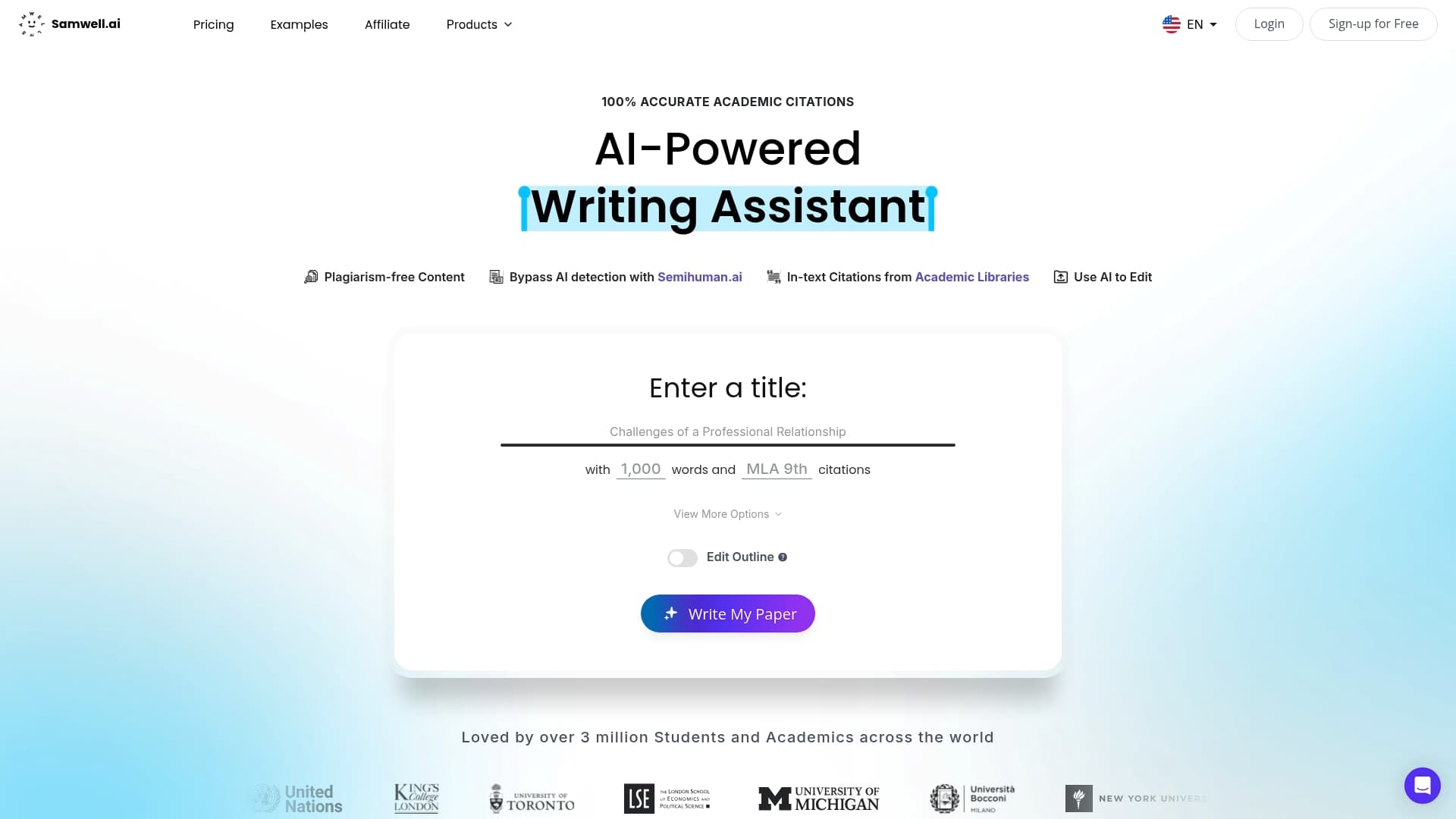
Samwell.ai is built specifically for students and researchers who need to produce original, well-cited academic work efficiently. The platform's Semihuman.ai technology minimizes plagiarism risks while helping you generate structured, credible content that matches your discipline's standards. Whether you need help formatting your IMRaD sections, generating a properly cited reference list in APA or MLA, or running real-time AI detection checks before submission, Samwell.ai handles it. You can also use the Power Editor to expand specific sections and the Guided Essays feature for structured outlines. If you want plagiarism-free essays without the hours of anxiety, this is where to start.
Clarifying your research question is the essential first step, as every subsequent decision about methods, data, and structure flows directly from it.
Always check your target journal or instructor's requirements, since paper structure and references must conform to the style designated by your discipline or publication.
Reproducibility ensures other researchers can validate and build on your results, and following CONSORT transparency guidelines is one concrete way to meet that standard in clinical and health research.
Always cite your sources accurately using your required style, and run an originality check before submission to catch accidental omissions or paraphrasing errors.
Yes. Revising iteratively strengthens clarity, catches logical gaps between your data and conclusions, and significantly improves the overall impact of your manuscript.