Loading...

TL;DR:
- MLA citation uses nine core elements that adapt based on source type, emphasizing flexibility.
- In-text citations follow an author-page format, placing the period after the citation.
- Proper paper formatting includes 1-inch margins, double-spacing, a hanging Works Cited page, and specific title styles.
One slip in MLA citation can cost you points, damage your credibility, or trigger a plagiarism flag. That's a high price for a missing period or a misplaced comma. MLA format, short for Modern Language Association format, is the standard citation system used across humanities courses worldwide. Millions of students submit papers every semester without fully understanding the rules they're following. This article breaks down every essential MLA rule you need, from core citation elements to tricky edge cases, so you can write with confidence and stop second-guessing every footnote.
| Point | Details |
|---|---|
| Nine core elements | Every MLA citation is built from nine flexible elements—omit what you don’t need. |
| In-text citation rules | Use author-page format without punctuation or 'p.' and always place the period after the citation. |
| Perfect formatting | Format your margins, font, header, and Works Cited page just as MLA requires. |
| Handle edge cases | MLA has rules for AI and tricky sources—use them to cite anything confidently. |
| Titles and poetry | Italicize major works, use quotes for small works, and follow MLA norms for poetry. |
Now that we know what's at stake, let's begin with what every MLA citation has in common: the foundational core elements.
The MLA 9th edition uses a flexible template of nine core elements to construct Works Cited entries. These elements appear in a specific order, and you include only the ones that apply to your source. That flexibility is actually one of MLA's greatest strengths. You don't need a different formula for every source type. You use the same nine-element framework and adapt it.
Here are the nine core elements in order:
Not every element applies to every source. A standalone book has no container. A website article may have no page numbers. Simply omit what isn't available or relevant, and move to the next element.
| Source type | Example Works Cited entry |
|---|---|
| Book | Smith, John. Writing Today. Penguin, 2022. |
| Journal article | Lee, Amy. "Digital Rhetoric." Journal of Writing, vol. 5, no. 2, 2021, pp. 45-60. |
| Website | Garcia, Maria. "MLA Basics." Purdue OWL, 15 Mar. 2023, owl.purdue.edu/mla. |
What to do when information is missing:
You can learn more about MLA citation basics to see these elements applied across dozens of real source types.
Pro Tip: The nine-element framework works for ANY source, including podcasts, TikTok videos, and museum exhibits. If you're unsure, just ask: who made it, what is it called, where does it live, and when was it published?
With your Works Cited foundation in place, let's look at how to cite smoothly within your writing.
In-text citations use author-page format: (Author page) without "p." or a comma. That means you write (Smith 45), not (Smith, p. 45). This is one of the most common mistakes students make, and it's an easy fix once you know the rule.
Here's how author-page format works for different author counts:
For citing multiple authors in MLA, the rule is simple: spell out both names for two authors, and use "et al." for three or more.
Rules for punctuation and placement:
Common mistake to avoid: Placing the period before the citation. Incorrect: "The results were significant. (Smith 45)" Correct: "The results were significant (Smith 45)."
Special scenarios come up often. If there's no author, use a shortened version of the title in quotes: ("Digital Writing" 12). If there are no page numbers at all, which is common with websites, use a paragraph number if available or omit the locator entirely. MLA allows this.
Pro Tip: Read your in-text citation out loud. If it sounds like you're reading a legal document, simplify it. MLA is designed to be minimal and unobtrusive so your argument stays front and center.
After learning in-text citation rules, it's crucial to ensure your paper and Works Cited page reflect proper MLA standards.
Paper formatting requires 1-inch margins, double-spacing, 12pt Times New Roman or a similar readable font, and a running header with your last name and page number in the top-right corner. These aren't arbitrary rules. They exist to make grading consistent and reading easy.

| Element | Paper body | Works Cited page |
|---|---|---|
| Margins | 1 inch on all sides | 1 inch on all sides |
| Font | 12pt Times New Roman | 12pt Times New Roman |
| Spacing | Double-spaced | Double-spaced |
| Indent | 0.5 inch for paragraphs | 0.5 inch hanging indent |
| Header | Last name and page number | Centered title "Works Cited" |
The Works Cited page starts on a new page titled "Works Cited" centered at the top, with entries in alphabetical order by the author's last name, using a 0.5 inch hanging indent, and double-spaced throughout.
Must-have items for your Works Cited page:
To set up a hanging indent in Microsoft Word, highlight your entries, go to Paragraph settings, and under "Special," select "Hanging" with a 0.5 inch value. In Google Docs, use Format > Align and indent > Indentation options.
For a deeper look at paper setup, the full MLA formatting guide walks through every step. You can also explore the role of MLA in academics to understand why these standards matter beyond just grades.
Even with standard sources covered, MLA throws some curveballs. Here's how to handle the exceptions with confidence.
The MLA Style Center provides clear guidance on edge cases: no author entries start with the title, no page numbers use paragraph or chapter references, and AI tools are cited as a container with the prompt description in the title, model and version listed, company as publisher, generation date, and a URL.
Here's a quick reference for the most common edge cases:
From the MLA Style Center: "When citing generative AI, describe the prompt you used as the title of the source, identify the AI model as the version, and list the company as the publisher."
Citing AI tools is genuinely new territory, and MLA has updated its guidance to keep pace. If you're working with sources that didn't exist five years ago, always verify your approach against the AI tools in MLA citations official guidance.
If you're switching between citation styles, understanding the differences between APA and MLA can save you from mixing up conventions. And if your course still uses an older edition, the MLA 8th edition differences article clarifies what changed.
Pro Tip: Always confirm special cases with the latest MLA handbook or the official MLA Style Center website. Citation generators often lag behind official updates, especially for newer source types like AI tools or social media posts.
Once you've mastered the basics and edge cases, don't neglect special rules for titles and poetry. These often trip up even advanced students.
Titles in MLA follow a clear rule: italicize self-contained works and use quotation marks for shorter pieces. The distinction matters because it signals to your reader what kind of source you're referencing.
Titles needing italics:
Titles needing quotation marks:
Key rule: If the work stands alone as its own complete publication, italicize it. If it lives inside a larger work, put it in quotes.
For citing poems in MLA, short quotations of three lines or fewer stay within your paragraph text, with a forward slash (/) marking each line break. For example: "Shall I compare thee to a summer's day? / Thou art more lovely and more temperate" (Shakespeare 1-2).
Longer poetry quotations, four lines or more, become long quotes formatted as indented block quotations. Indent the entire passage 0.5 inch from the left margin, maintain double-spacing, and place the citation in parentheses after the final punctuation mark. This is the one case where the period comes before the citation.
Short quotes use double quotation marks within the text, with the slash for line breaks. Long quotes are set as indented blocks without quotation marks. This rule applies to prose and poetry alike, though the line-break slash is specific to poetry.
For a complete walkthrough, the poem citation guide covers every scenario you're likely to encounter.
Here's what most citation guides won't tell you: memorizing MLA rules is the least effective strategy. Rules change. Editions update. New source types appear every year. What doesn't change is the underlying logic of citation, which is about giving readers enough information to find your source and evaluate your evidence.
Librarians don't memorize every citation format. They understand what information matters and why. When a new source type appears, they apply the same principles to figure it out. That's the mindset that makes citation genuinely easy over time.
Most students treat MLA like a recipe. Follow the steps, get the dish. But recipes break down the moment an ingredient is missing. Principles don't. When you understand that MLA is about traceability, credibility, and consistency, you can handle any source confidently, even ones that didn't exist when the handbook was written.
Build your MLA citation know-how on principles, not just patterns. Use official sources over random citation generators. The few minutes you invest in understanding the reasoning will save you hours of second-guessing across every paper you write.
If you want to put your new MLA skills into action, here's how Samwell.ai can make citation compliance stress-free.
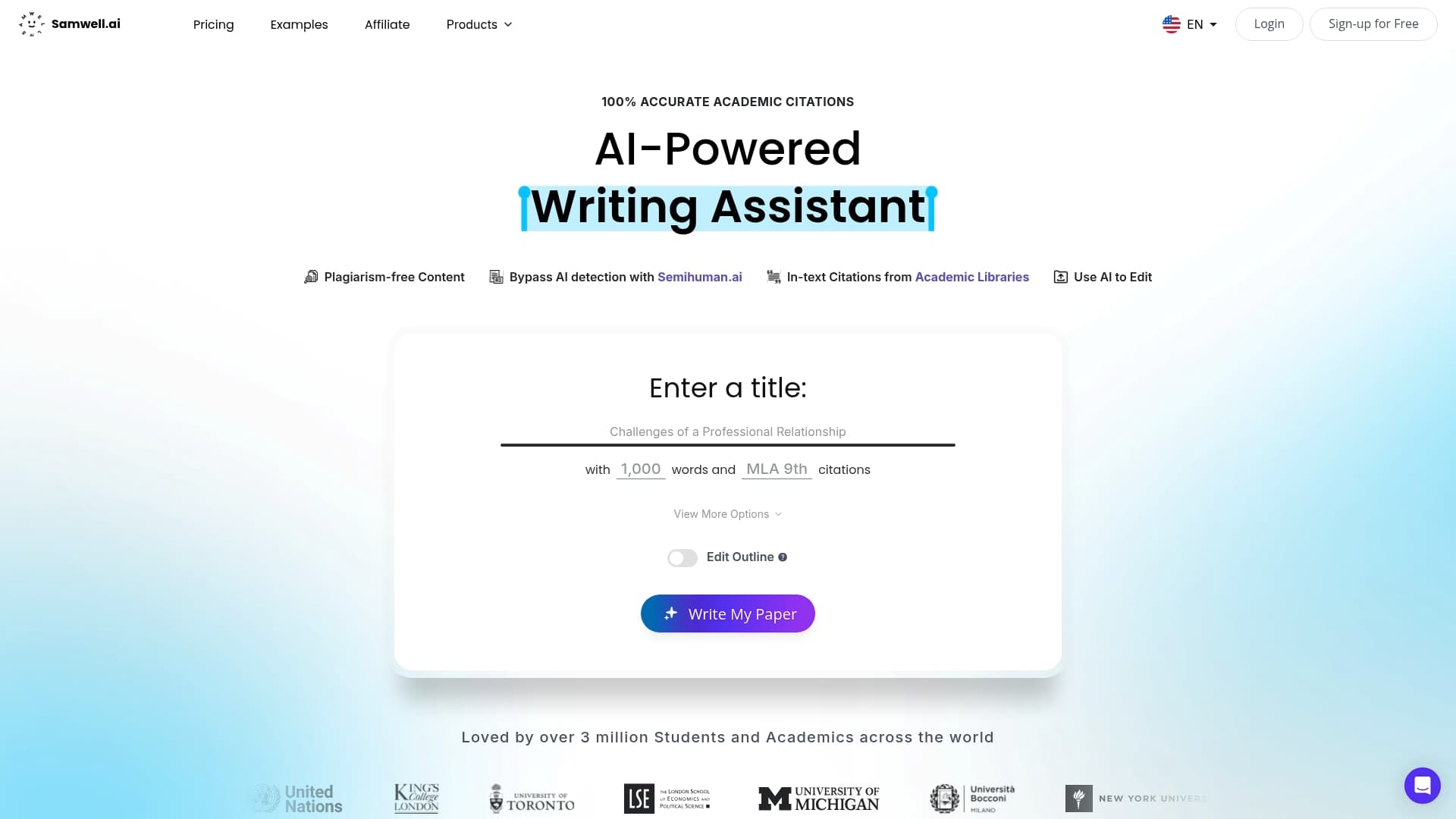
Samwell.ai gives students and researchers instant access to citation guides, formatting templates, and AI-powered writing tools built around MLA and APA standards. Instead of hunting through multiple sources to verify a citation format, you get structured support in one place. The platform's Power Editor helps you refine and expand your writing while keeping citations accurate, and the Guided Essays feature structures your paper from outline to Works Cited. With over 1,000,000 students already using it, Samwell.ai is built for the kind of academic writing where getting citations right is non-negotiable. Start with the step-by-step MLA tutorial and see how fast citation confidence builds.
MLA emphasizes principles over rigid rules, so use the nine core elements in order, omit what isn't available, and adapt the format to fit your source. MLA is flexible by design.
AI tools are cited as the container, with your prompt as the title, the model and version listed, the company as publisher, the generation date, and the URL included.
The period always comes after the in-text citation, not before it. A common pitfall is placing the period before the parenthetical, which is incorrect in MLA format.
Yes. Every entry on the Works Cited page uses a 0.5 inch hanging indent, with double-spacing throughout and no extra blank lines between entries.
Your first page should include your name, instructor name, course title, and date in the upper left corner, all double-spaced, along with a running header showing your last name and page number in the top-right corner.