Loading...

TL;DR:
- Academic essays should follow a clear structure: introduction, body, conclusion, and references.
- Strong paragraphs use the PEEL framework: Point, Evidence, Explanation, Link.
- Conclusions restate the thesis, summarize main points, and discuss broader implications without introducing new ideas.
Academic essays are not just collections of paragraphs thrown together with a thesis on top. They are strategic, structured arguments where every component plays a specific role. Many students struggle not because they lack ideas, but because they don't know how each part of an essay functions or connects to the others. The standard components of an academic essay are the title, introduction, body paragraphs, and conclusion, and understanding what each one must do changes how you write entirely. This guide breaks down every component with practical frameworks you can apply to your next assignment.
| Point | Details |
|---|---|
| Essay structure matters | A clear structure (introduction, body, conclusion) is essential for delivering a logical, persuasive argument. |
| PEEL provides clarity | Using PEEL in body paragraphs ensures points are supported, explained, and logically connected. |
| Formal tone and citations | Academic essays must maintain formal language and accurate references for credibility. |
| Avoid new info in conclusions | Effective conclusions recap your argument and discuss its significance, never introducing new ideas. |
Every academic essay, regardless of discipline or length, follows a recognizable architecture. Think of it like a court case: the introduction presents the claim, the body paragraphs argue the evidence, and the conclusion delivers the verdict. Without that structure, even brilliant ideas lose their persuasive force.
Understanding why structure matters in essays goes beyond following rules. Structure creates logic. It tells your reader where you are going, keeps your argument focused, and makes grading easier because your ideas are easy to follow.
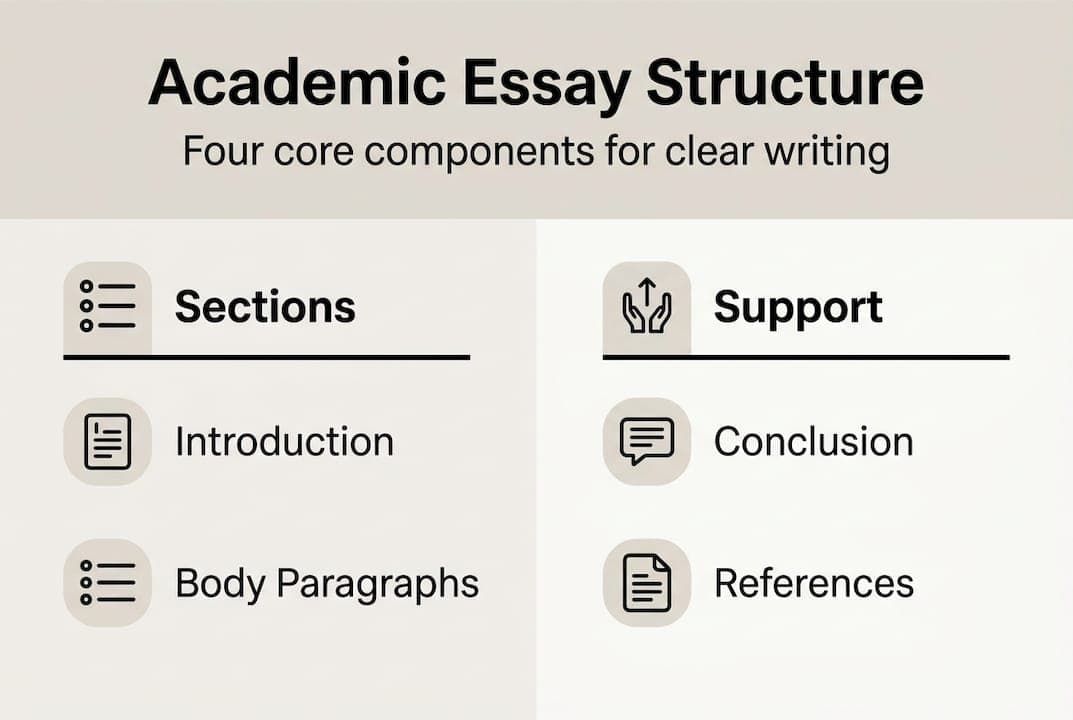
The standard components in a typical academic essay are the title, introduction, body paragraphs, and conclusion. Research essays sometimes use a different format called IMRAD, which stands for Introduction, Methods, Results, and Discussion. Here is how the two frameworks compare:
| Component | Standard essay | IMRAD research essay |
|---|---|---|
| Opening | Introduction with thesis | Introduction with research question |
| Core content | Body paragraphs with analysis | Methods, Results, Discussion sections |
| Closing | Conclusion with implications | Conclusion or Discussion wrap-up |
| Subheadings | Rarely used | Frequently required |
| Citation style | APA, MLA, Chicago | APA or discipline-specific |
For most undergraduate assignments, the standard structure applies. But if you are writing a lab report or empirical paper, IMRAD becomes the expected format. Knowing the difference before you start saves significant revision time.
A few additional structure elements worth noting:
For more guidance on formatting, a reliable essay structure guide can help you map your next paper before you write a single sentence.
Your introduction is where your reader decides whether your argument is worth following. A weak opening, one that is vague or slow to reach its point, signals disorganized thinking. A sharp introduction does three things immediately: it provides context, states your thesis, and signals how the essay will unfold.
According to academic writing standards, your introduction provides context, states the thesis, and outlines the structure of what follows. That is a lot of work for one section, which is why many students rush it.
Here is a practical sequence for writing a strong introduction:
For a 2,000-word essay, that means your introduction should be roughly 200 to 300 words. Students often write introductions that are either too brief (skipping the thesis entirely) or too long (burying the reader in background information).
A common mistake is writing a thesis that describes instead of argues. "This essay will discuss climate change" is not a thesis. "Immediate policy intervention is the only viable response to accelerating climate change" is. The difference is that the second one takes a position you can actually defend.
For research essays following IMRAD, the introduction has a slightly different job. It must establish the gap in existing literature and justify why your study was necessary. That shift in purpose changes the tone from argumentative to investigative.
Pro Tip: After you finish drafting your essay, re-read your introduction last. It should accurately preview what you actually wrote, not what you planned to write. This reverse check catches misalignment between your opening and your argument before your reader does. See more on structuring your introduction effectively for different essay types.
Body paragraphs are where your argument lives or dies. A common error students make is treating body paragraphs as information dumps, piling in facts without analysis. Strong body paragraphs do not just report evidence. They interpret it, connect it to the thesis, and move the argument forward.

The most widely recommended framework for body paragraphs is PEEL. Research and writing guides confirm that PEEL paragraph structure works by organizing each paragraph around a Point, Evidence, Explanation, and Link. Here is what each element does:
| PEEL element | Purpose | Example phrase |
|---|---|---|
| Point | States the paragraph's main claim | "Urban green spaces reduce stress levels..." |
| Evidence | Provides supporting data or quotes | "A 2023 WHO study found that..." |
| Explanation | Analyzes what the evidence means | "This suggests that city planners should..." |
| Link | Connects back to thesis or next paragraph | "This reinforces the argument that..." |
Each body paragraph should run 200 to 300 words, or roughly 5 to 8 sentences. Paragraphs shorter than that usually lack sufficient analysis. Paragraphs longer than that often contain more than one idea and should be split.
Key habits for strong body paragraphs:
Pro Tip: After drafting, try reverse outlining your body sections. Write one sentence summarizing each paragraph. If those sentences do not form a logical sequence that supports your thesis, reorder or rewrite before you submit.
For research-heavy essays, body sections may follow the IMRAD structure instead of PEEL. In that case, each section (Methods, Results, Discussion) has its own internal logic. But even within IMRAD, each paragraph still benefits from a clear topic sentence and analytical follow-through.
Your conclusion is not a formality. It is your final opportunity to make your argument stick. Many students underestimate this section and write a one-paragraph summary that repeats the introduction almost word for word. That approach leaves readers with nothing new to think about.
A strong conclusion does three things. It summarizes the main points made in the body, restates the thesis in light of the evidence presented, and discusses implications or broader significance. Critically, no new information belongs in the conclusion. Introducing a new argument or piece of evidence here breaks the logical contract you made with your reader at the start.
Here is a step-by-step approach to writing a conclusion that lands:
"The conclusion is not where you stop thinking. It is where you show the reader what your thinking adds up to."
Different disciplines expect slightly different conclusions. In humanities essays, implications often connect to broader cultural or social questions. In scientific papers, conclusions point to limitations and future research directions.
Learning expert conclusion sentence tips can help you craft endings that feel deliberate rather than rushed. Understanding conclusion paragraph format across disciplines ensures your final section meets your professor's expectations. For more on conclusion strategies that work in different contexts, revisit those frameworks before finalizing any major essay.
Even a well-structured essay with a compelling argument can lose credibility without proper citations and a consistent academic tone. Referencing is not just an administrative task. It is how you show your reader that your claims are grounded in real scholarship.
Academic writing requires careful attention to citations, formal tone, logical flow, and adherence to style guides like APA, MLA, or Chicago. Each style has specific rules for how you format in-text citations, reference lists, and even punctuation. Mixing styles within a single paper is one of the fastest ways to lose marks.
Here is a quick comparison of the most common citation styles:
Beyond citations, academic tone matters. Avoid contractions, slang, and first-person unless the assignment explicitly allows it. Each sentence should serve a logical purpose. Padding, filler phrases, and vague language weaken your argument even when your ideas are strong.
Pro Tip: Before submitting, re-read only your reference list. Check that every in-text citation has a matching entry, every author's name is spelled correctly, and every URL or DOI is functional. Reference errors are easy to fix but costly when left in.
Here is something most writing guides will not tell you: following the formula is not enough. Thousands of students produce structurally correct essays that still earn mediocre grades. Why? Because structure is the container, not the content. The real strength of an academic essay comes from the quality of your reasoning, not from whether you remembered to include a topic sentence.
The trap most students fall into is prioritizing format over argument. They spend time making sure the essay looks right while neglecting whether the logic actually holds. A conclusion that restates the thesis without demonstrating how the body paragraphs proved it is structurally correct but intellectually empty.
Understanding structure matters because it serves logic, not the other way around. Use reverse outlining on every major essay. It forces you to confront whether your paragraphs actually do what you think they do. If they don't, you have time to fix it before your reader notices.
Applying these frameworks consistently takes practice, but you don't have to do it alone.

Samwell.ai gives you tools built specifically for academic writing at every stage of the process. The enhanced essay creator helps you plan and generate structured essays that follow the exact components covered in this guide, from a focused introduction to a well-reasoned conclusion. Need to expand a body paragraph or sharpen your analysis? The sentence and paragraph expansion tool helps you develop ideas without losing your academic voice. With built-in citation support for APA, MLA, and more, Samwell.ai makes it easier to produce essays that are both structurally sound and academically credible.
The four main components are the introduction, body paragraphs, conclusion, and references or citations. A title is also required in most formal submissions.
A typical body paragraph should run 200 to 300 words, or approximately 5 to 8 sentences. Paragraphs shorter than this usually lack sufficient analysis.
Subheadings are appropriate in longer essays or research papers where navigation and section clarity are needed. Check your assignment guidelines before adding them to shorter essays.
The PEEL method stands for Point, Evidence, Explanation, and Link. It provides a reliable framework for structuring body paragraphs so each one supports your central argument clearly.
Do not introduce new information or arguments in the conclusion. The conclusion should synthesize what you have already argued, restate the thesis, and discuss broader implications.