Loading...

Every arts student has faced the challenge of framing a meaningful essay that goes beyond surface description. Defining an essay on arts starts with recognizing how complex concepts like creativity, expression, and emotional impact shape your approach. By understanding the fluid and culturally embedded character of art, you can move from basic observation to informed analysis. This article reveals how to construct nuanced arguments and master critical techniques to write arts essays that impress university instructors worldwide.
| Point | Details |
|---|---|
| Purpose of Arts Essays | Arts essays analyze and critique artistic works, focusing on their meaning and cultural significance rather than mere description. |
| Types of Arts Essays | Different essay types, such as analytical, interpretive, and historical, require distinct approaches and evidence. |
| Structure of Arguments | A strong essay must link claims, evidence, and analysis cohesively to build persuasive arguments. |
| Importance of Context | Understanding the cultural and historical context of art is essential to crafting nuanced arguments about its significance. |
An essay on arts isn't just a casual discussion of paintings or music. It's a structured academic argument that analyzes, interprets, or critiques artistic works, movements, or concepts.
Understanding what makes an arts essay distinct from other academic writing starts with recognizing its core purpose: to explore the meaning, context, and significance of creative expression.
Arts essays blend analytical thinking with creative interpretation. You're not simply describing what you see or hear. You're building a claim about why it matters.
Key characteristics include:
Arts essays demand that you synthesize observation with informed analysis, creating arguments that reveal deeper truths about human expression and cultural values.
Art's definition itself is contested, with creativity and emotional impact serving as central components. This complexity matters because it shapes how you approach your essay's thesis.
Consider that historical narratives shape how we understand art as a concept, rather than relying on rigid, unchanging definitions. Art adapts across time and cultures, and your essay should reflect this fluidity.
This means avoiding oversimplified claims like "this artwork is beautiful" or "this artist was important." Instead, construct nuanced arguments that address specific dimensions of artistic expression.
Your analysis typically operates across three interconnected areas:
When defining academic writing approaches, arts essays occupy a unique position. They require both objective observation and subjective interpretation, balanced within a rigorous analytical framework.

Most arts essay assignments expect you to move beyond personal preference. The question isn't "Do I like this?" but "What makes this significant, and why does it matter within its cultural context?"
Pro tip: Before writing, clearly distinguish between description (what you observe) and analysis (what it means). This mental separation prevents your essay from reading like a catalog of artistic features rather than a substantive argument.
Arts essays don't follow a one-size-fits-all formula. Different types demand different analytical strategies, and understanding which approach fits your assignment is crucial for success.
Your essay type shapes everything: your research methods, how you structure arguments, and what evidence you prioritize. Choosing the right approach prevents you from writing the wrong kind of essay entirely.
Arts essays typically fall into distinct categories, each with its own focus and expectations.
Each type requires different evidence and different analytical focus. An analytical essay examines technique; an interpretive essay explores meaning. These aren't interchangeable.
Here's a comparison of the main types of arts essays to help you identify the best fit for your assignment:
| Essay Type | Core Focus | Evidence Prioritized | Typical Outcome |
|---|---|---|---|
| Analytical | Examining artistic elements | Formal details from artwork | Reveals technique's effect |
| Interpretive | Arguing meaning or intent | Symbolism and artist context | Unveils deeper significance |
| Historical | Placing in cultural context | Historical facts, criticism | Shows art's societal role |
| Comparative | Side-by-side analysis | Parallels between works | Highlights similarities/differences |
| Critical | Evaluating merit and impact | Criteria-based observations | Assesses value or influence |
Artistic research integrates creative practice with academic inquiry, blending visual arts, music, performing arts, and design methodologies. This approach matters because it recognizes that creating art itself generates knowledge.

If your assignment involves studio practice or creative work alongside written analysis, you're likely using a practice-based approach. This means your essay doesn't just discuss art; it engages with making art as part of your research process.
Conversely, arts-based research encompasses creative methodologies utilized within research.pdf) to generate new knowledge. This broader framework includes data collection, interpretation, and dissemination strategies specific to artistic inquiry.
Understanding your essay's approach determines whether you're analyzing existing art, creating new art as research, or synthesizing both into a hybrid argument.
Your assignment details dictate which approach to use. Read carefully for clues:
Analytical essay examples demonstrate how to structure arguments around formal elements and how these choices create meaning. Studying strong examples helps you understand expectations before you write.
Misaligning your approach with your assignment creates immediate problems. A comparative essay requires different evidence organization than an analytical one. A historical essay demands different research than an interpretive one.
Pro tip: Review your assignment prompt twice, underlining verbs that describe what you should do (analyze, interpret, evaluate, compare). These verbs reveal your required essay type and approach, preventing wasted effort on the wrong analytical strategy.
A strong arts essay doesn't just throw ideas at the reader. It builds a logical progression where each point connects to the last, leading toward a compelling conclusion.
Structure transforms scattered thoughts into persuasive arguments. Without it, even brilliant analysis gets lost in confusion.
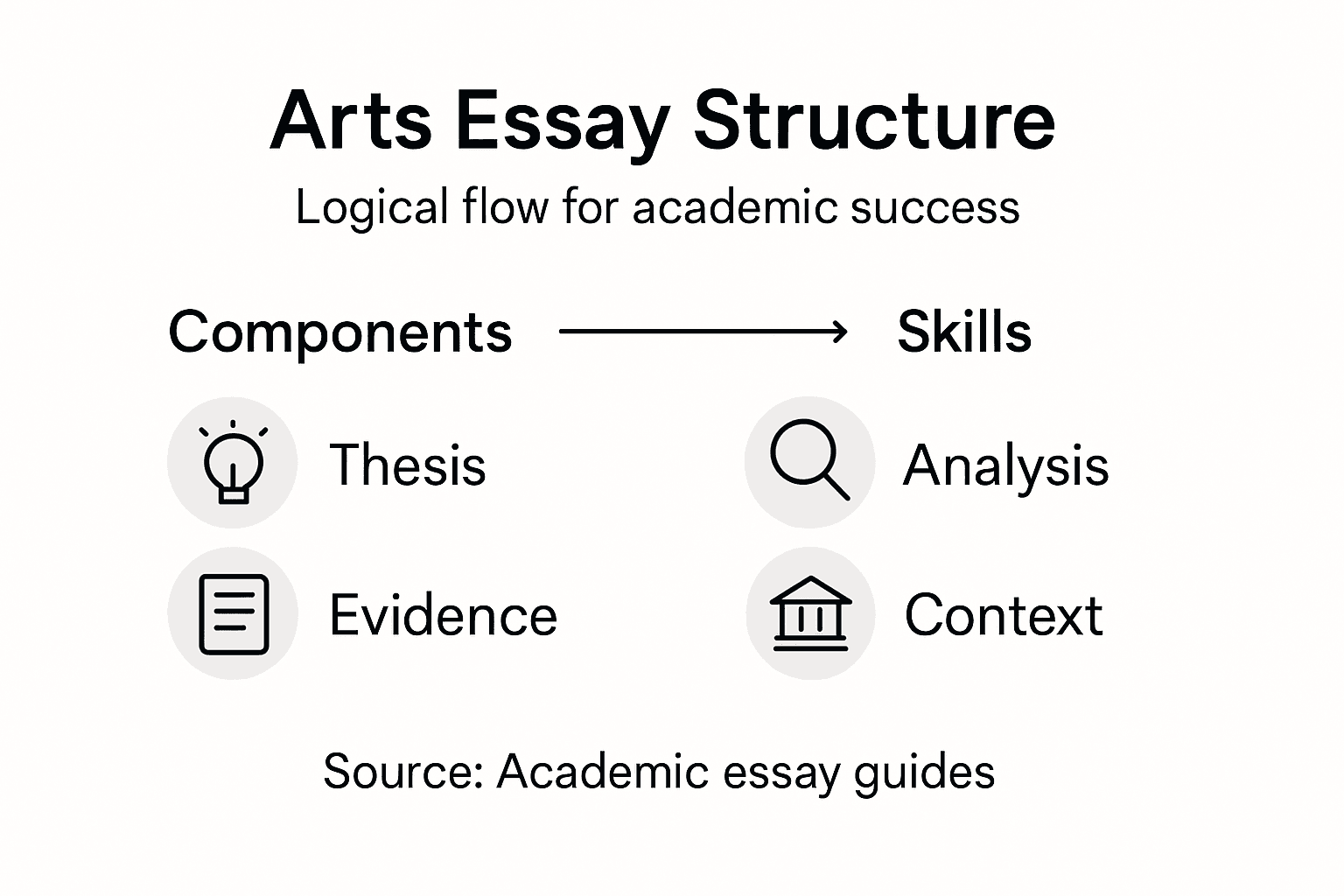
Every effective arts essay argument contains three interconnected parts:
Many students provide evidence without analysis. They describe what they see but never explain why it matters. That's description masquerading as argument.
Crafting academic arguments requires integrating claims with evidence coherently, developing complex analysis paths that engage deeply with sources. This means moving beyond summary to interpretation.
Use this reference to strengthen your essay arguments:
| Argument Component | What to Include | Why It Matters |
|---|---|---|
| Claim | Clear, specific assertion | Guides analysis direction |
| Evidence | Accurate examples from artwork | Grounds claims in reality |
| Analysis | Explanation linking evidence and claim | Deepens argument's impact |
Structuring arguments from introduction through conclusion demands clarity and logical flow. Each paragraph should start with a topic sentence supporting your thesis and connect coherently to preceding points.
A solid organizational strategy looks like this:
This approach ensures readers follow your thinking step by step.
Effective arts essays move beyond surface observation to reveal how formal choices, historical context, and artistic intent interconnect to create meaning.
Developing deeper analysis means asking follow-up questions. Don't just say "the artist used bold colors." Ask why. What effect do those colors create? How do they relate to the artwork's theme or context? What would change if different colors appeared?
When you use argument outline strategies, you create a roadmap before writing. This prevents tangents and ensures each paragraph advances your central claim.
Each body paragraph should build incrementally on the previous one. Paragraph two introduces new evidence; paragraph three complicates or deepens the argument further. This progression prevents repetition and maintains reader engagement.
Pro tip: After writing your first draft, outline what you actually wrote—not what you intended. Compare that outline to your thesis. If paragraphs don't connect directly to your main claim, they're either off-topic or need stronger topic sentences to show their relevance.
Powerful arts essays fail not because of weak ideas, but because of preventable mistakes. Knowing what derails most students helps you sidestep these traps before they damage your grade.
These aren't minor errors. They fundamentally undermine your argument and frustrate readers trying to follow your thinking.
You'd be surprised how often students write competent essays that answer the wrong question. They produce excellent analysis—just not the analysis the assignment requested.
Read your prompt three times before outlining. Highlight every verb and requirement. "Analyze the formal elements" demands something different from "interpret the artist's intent" or "evaluate this work's historical significance."
Common art essay writing mistakes include not addressing the prompt directly, causing essays to veer off-topic even when they contain solid observations. This wastes both your effort and your reader's time.
Create a simple checklist: Does my thesis directly answer the prompt's central question? Do my body paragraphs prove this thesis? Have I avoided tangents that seem interesting but don't support my main claim?
Description is your foundation, not your destination. Many student essays spend entire paragraphs explaining what's visible in an artwork without ever explaining why it matters.
Here's the critical difference:
The second version moves from observation to interpretation. It makes an argument about meaning and effect.
Balance description and analysis carefully: use description to support claims, never as the endpoint of your argument.
Artworks don't exist in vacuums. Ignoring their cultural, historical, or artistic context weakens your entire essay.
Research background information before writing:
This context doesn't appear randomly in your essay. It supports your specific claims about the artwork's meaning or significance.
General observations weaken essays. Specific details strengthen them. Instead of "the colors are vibrant," cite which colors, where they appear, and what effect they create.
Avoid these approaches:
Use actual quotations, visual details, and documented historical facts. These transform weak arguments into credible ones.
Understanding types of academic dishonesty prevents serious academic consequences. Paraphrasing without attribution, using others' interpretations without credit, or copying descriptions all constitute plagiarism.
Always cite sources. Distinguish between what you observe and what scholars argue about the work. This distinction protects your integrity while showing you've done legitimate research.
Pro tip: Track your sources as you research, not after. Note which interpretations come from scholars and which are your original observations. This habit prevents accidental plagiarism and makes citations quick when drafting.
AI writing assistants have transformed academic writing from a solitary struggle into a collaborative process. These tools aren't shortcuts—they're partners that amplify your thinking and improve your craft.
Using AI strategically means understanding what it does well and where human judgment remains irreplaceable. The combination delivers exceptional results.
AI-powered writing assistants enhance academic writing by offering grammar checks and style improvements, alongside personalized tutoring and drafting assistance. These capabilities promote self-directed learning and writing fluency when used ethically.
Most AI tools excel at these specific tasks:
AI stumbles with subjective interpretation and original analysis—the heart of arts essays. It generates plausible-sounding arguments that may oversimplify complex artworks or miss cultural nuances entirely.
Understanding AI capabilities and crafting effective prompts requires corroborating AI-generated content with reliable sources. This corroboration step separates legitimate assistance from academic dishonesty.
Here's how to integrate AI without compromising integrity:
Never submit AI-generated analysis as your own thinking. Your original interpretation of artworks is non-negotiable.
AI generates plausible arguments about art, but only you understand your assignment's specific requirements and your artwork's cultural context.
Your responsibilities remain entirely yours:
Use AI-powered essay tools to enhance writing quality, but recognize that these tools amplify mediocre thinking just as effectively as they amplify good thinking. Strong analysis remains your foundation.
AI works best as a writing editor, not a thinking substitute. Feed it your ideas, then critically evaluate its suggestions before accepting them.
Pro tip: After AI suggests improvements, ask yourself why that change works. If you can't articulate the reason, revert to your original wording. This habit ensures you understand every sentence in your essay, not just accepting AI recommendations blindly.
Writing compelling essays on arts requires balancing descriptive observation with sharp analysis while respecting academic integrity and effectively addressing your assignment's specific demands. If you find yourself stuck distinguishing description from analysis or unsure how to structure your arguments around complex art contexts, you are not alone. The challenges of interpreting meaning, integrating historical context, and crafting persuasive academic arguments call for smart tools designed for your success.

Elevate your arts essays now with Samwell.ai. Our advanced AI-driven platform offers tailored solutions including the Power Editor for refining nuanced academic writing, Guided Essays that help you outline structured arguments, and plagiarism-minimizing Semihuman.ai technology to maintain originality. Whether you need to develop clear claims, analyze artworks deeply, or format citations precisely, Samwell.ai supports your unique academic journey with expert precision and efficiency. Start writing confidently today and transform your complex insights into compelling essays that truly matter.
An essay on arts aims to analyze, interpret, or critique artistic works, movements, or concepts, exploring their meaning, context, and significance.
Arts essays focus on interpretation, use evidence-based arguments, demonstrate cultural awareness, and maintain a critical perspective that questions assumptions and explores multiple viewpoints.
An effective arts essay should include a clear introduction with a thesis statement, body paragraphs focusing on specific points that support the thesis, and a conclusion that synthesizes the arguments presented.
The main types of arts essays include analytical, interpretive, historical, comparative, and critical essays, each requiring different analytical strategies and evidence.