
Loading...

A successful essay in Spanish-language writing follows one clear method: state a thesis, build two or three developed body paragraphs around it, and close with a concise synthesis. An "essay" in this context is usually an ensayo or redacción, structured writing that argues or explains a position. Matching that structure to your CEFR level and tying paragraphs together with connectors is what separates a readable essay from a disorganized one.
TL;DR:
- For a 400 to 600 word assignment, use two or three body paragraphs of four to six sentences, each with a reason and supporting example.
- Reserve the final 10 to 20 minutes for revision, checking cohesion first, then tense and agreement, and finally formal register and required citations.
- Match the argument to your level: begin with a clear opinion and reasons, then add counterarguments and outside sources as your skills advance.
- Confirm the required citation style with your instructor, because Spanish language courses may use APA, MLA, or discipline specific systems rather than one universal standard.
Spanish has three common words for "essay." Picking the right one depends on context. Ensayo refers to a formal, often argumentative essay, closer to the English literary sense. Redacción is the term most commonly used in schools for a written composition or assignment. Trabajo refers to a longer academic paper or project. The Cambridge English-Spanish dictionary lists all three as valid translations depending on register and length, and the RAE confirms the distinct senses: ensayo carries the literary or argumentative weight, while redacción points to a school exercise.
Useful phrases to know before you start writing:
Use entregar when a sentence is about deadlines or submission, and escribir when it is about the act of drafting. Cambridge's own example, "The student had an essay due on Wednesday" translating to "El estudiante debía entregar un ensayo el miércoles," shows that distinction clearly.
A Spanish essay follows the same three-part logic as most academic writing, but the Spanish terms for each part are worth knowing cold before you draft.
Useful sentence starters for the introduction include "El presente ensayo analiza..." (This essay analyzes...) or "A lo largo de este trabajo, se argumentará que..." (Throughout this paper, it will be argued that...). For body paragraphs, "En primer lugar..." (First...) and "Otro aspecto importante es..." (Another important aspect is...) work well as topic-sentence openers. This scaffold applies whether you are writing a short classroom redacción or a longer ensayo for a university course.
Writing well under time pressure comes down to reading the prompt correctly before you write a single sentence. The CEFR Companion Volume frames written production as a process of planning, monitoring, and repair, and that sequence works as a practical checklist.
Pro Tip: Reserve the last 10 to 20 minutes of any timed essay purely for revision: read for cohesion first, then grammar, then register.
This order matters because a well-organized but grammatically imperfect essay usually scores higher than a polished paragraph that wanders off thesis.
Cohesion often matters more than vocabulary range when Spanish instructors evaluate an essay. The Cervantes Institute's guide to discursive connectors groups these words by function, additive, adversative, causal, and consecutive, and that grouping is the fastest way to learn them with purpose rather than by rote.
| Function | Spanish connectors | Example use |
|---|---|---|
| Addition | además, además de, asimismo | Además, los datos apoyan esta idea. |
| Contrast | sin embargo, no obstante, aunque | Sin embargo, otros estudios discrepan. |
| Cause | porque, debido a, ya que | El cambio ocurrió debido a nuevas políticas. |
| Result | por lo tanto, por consiguiente, así que | Por lo tanto, la conclusión es clara. |
| Conclusion | en resumen, para concluir, en definitiva | En resumen, el ensayo confirma la tesis. |
Beyond connectors, a short set of academic verbs and nouns raises the register of any draft: argumentar (to argue), demostrar (to demonstrate), plantear (to pose or raise an issue), evidencia (evidence), and conclusión (conclusion). A sentence like "El autor argumenta que la evidencia demuestra..." (The author argues that the evidence demonstrates...) links a verb and noun from this list in a pattern you can reuse across topics. According to the Cervantes resource, mastering a handful of high-frequency connectors tends to produce more visible gains in cohesion than memorizing long vocabulary lists.
Essay expectations shift noticeably as you move up the CEFR scale, and knowing the target descriptor helps you practice the right skill instead of the wrong one. At B1, simple linked sentences and a clear opinion are usually enough. At B2, the CEFR framework expects a developed argument with supporting points and reasons. At C1, essays need clear structure and attention to the most salient issues in a topic. At C2, the expectation rises to smooth flow and critical appreciation of the subject matter.
A sensible practice sequence follows that progression: start with explanatory prompts you can answer in plain sentences, then add explicit reasons, then introduce a counterargument, and finally bring in outside sources to support your position. Trying to write C1-level argumentation before you can reliably produce a clear B1 paragraph usually produces essays that are long on vocabulary and short on coherence.
The last stretch before submitting is where most avoidable points get lost, so work through a fixed checklist rather than rereading at random.
Running these three passes separately, rather than trying to catch everything in one read, tends to catch more errors in the same amount of time.
Spanish-language academic writing generally follows the same major citation families used internationally, APA and MLA among the most common, with the specific choice set by the institution or course rather than by language. Spanish-speaking universities frequently adapt APA style, since its author-date format suits the flexible word order of Spanish sentences more easily than numbered footnote systems.
What changes in Spanish is often terminology rather than mechanics: a bibliography may be labeled bibliografía or referencias, and in-text citations follow the same parenthetical author-year pattern as English APA style, for example "(García, 2020)." Quotation conventions can also differ slightly, with some Spanish academic traditions favoring guillemets (« ») or lowered quotation marks in formal publishing, though standard double quotation marks remain acceptable in most student writing.
Before citing anything, confirm which standard your instructor or institution requires, since Spanish-language journals and universities do not use one single system. When in doubt, matching the citation format to the discipline, APA for social sciences, a numbered or footnote system for some humanities journals, is safer than assuming one universal rule applies across every Spanish-speaking country.
Academic Spanish draws a sharper line between formal and informal register than many students expect coming from English. Formal essay writing avoids contractions, slang, and the informal "tú" form in favor of more neutral constructions, often using impersonal structures like "se considera que" (it is considered that) instead of "yo creo que" (I think that).
Verb mood and pronoun choice both signal register. Formal Spanish essays favor third-person or impersonal phrasing over direct first-person opinion statements, and they avoid regional slang entirely, since academic writing aims for a neutral, widely understood register regardless of the writer's country. Informal register, with colloquial expressions, contractions, and direct address to the reader, belongs in personal blogs or casual correspondence, not in a graded essay.
A quick formality check: if a sentence would sound natural in a text message to a friend, it probably needs rewriting for an academic draft. Replacing casual connectors like "o sea" (I mean) with formal equivalents like "es decir" (that is to say) is a small change that raises the perceived register of an entire paragraph.
AI writing tools work best as a structuring and revision aid rather than a replacement for your own thesis and argument. Use them to generate an outline from your prompt, to check that your connectors are doing real cohesive work, and to catch grammar issues like gender agreement or missing accents that are easy to miss on a self-read.
The most effective approach treats an AI draft as a starting point: write your own thesis and topic sentences first, then use a tool to expand, tighten, or restructure specific paragraphs rather than generating an entire essay blind. This keeps your argument your own while letting the tool catch mechanical errors. It is also worth running any AI-assisted draft through a plagiarism or AI-detection check before submission, since many instructors now use these tools themselves and academic integrity policies increasingly require disclosure of AI assistance.
Treat suggested vocabulary with some skepticism, since AI tools can suggest words that are technically correct but regionally unusual or overly formal for the assignment's level. Cross-checking unfamiliar vocabulary against a dictionary like the RAE before using it keeps your essay sounding like your own level of Spanish rather than an inflated one.
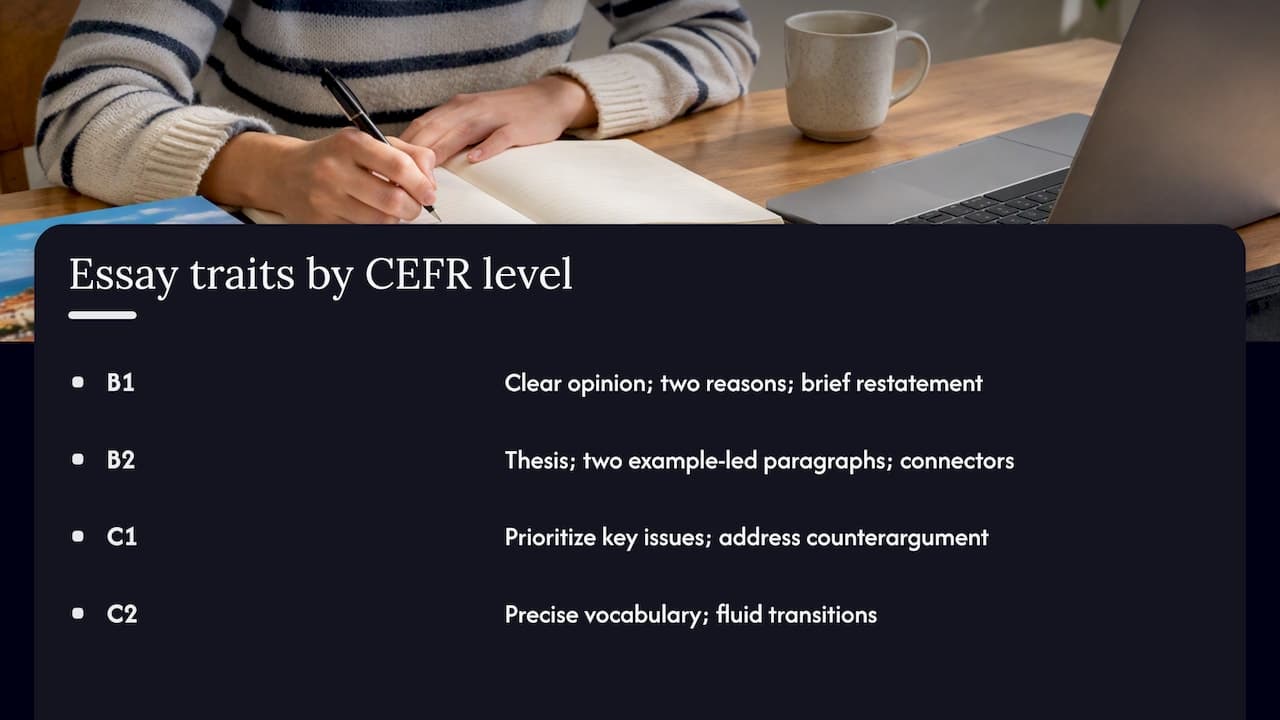
A strong B1-level essay is short, direct, and built on simple linked sentences: a clear opinion stated early, two reasons supporting it, and a brief restatement at the end. At this level, correctness and clarity matter more than stylistic range.
A strong B2 essay adds a visible argument structure: a thesis, two developed body paragraphs each with a reason and a concrete example, and connectors that explicitly signal contrast or addition between points. The difference from B1 is less about vocabulary and more about the essay showing its own organization.
At C1, well-written essays identify the most important issues in a topic rather than covering everything evenly, and they use varied sentence structures and a wider connector range to move between ideas smoothly. A C1 essay on a social issue, for instance, might dedicate a full paragraph to acknowledging a counterargument before responding to it, something B1 and B2 essays rarely attempt.
At C2, the hallmark is flow: paragraphs transition without heavy signposting, vocabulary is precise rather than broad, and the essay shows genuine critical appreciation of the topic rather than simply presenting both sides. Across all four levels, the throughline is that structure and argument quality, not just vocabulary, define what "well-written" means at each stage.
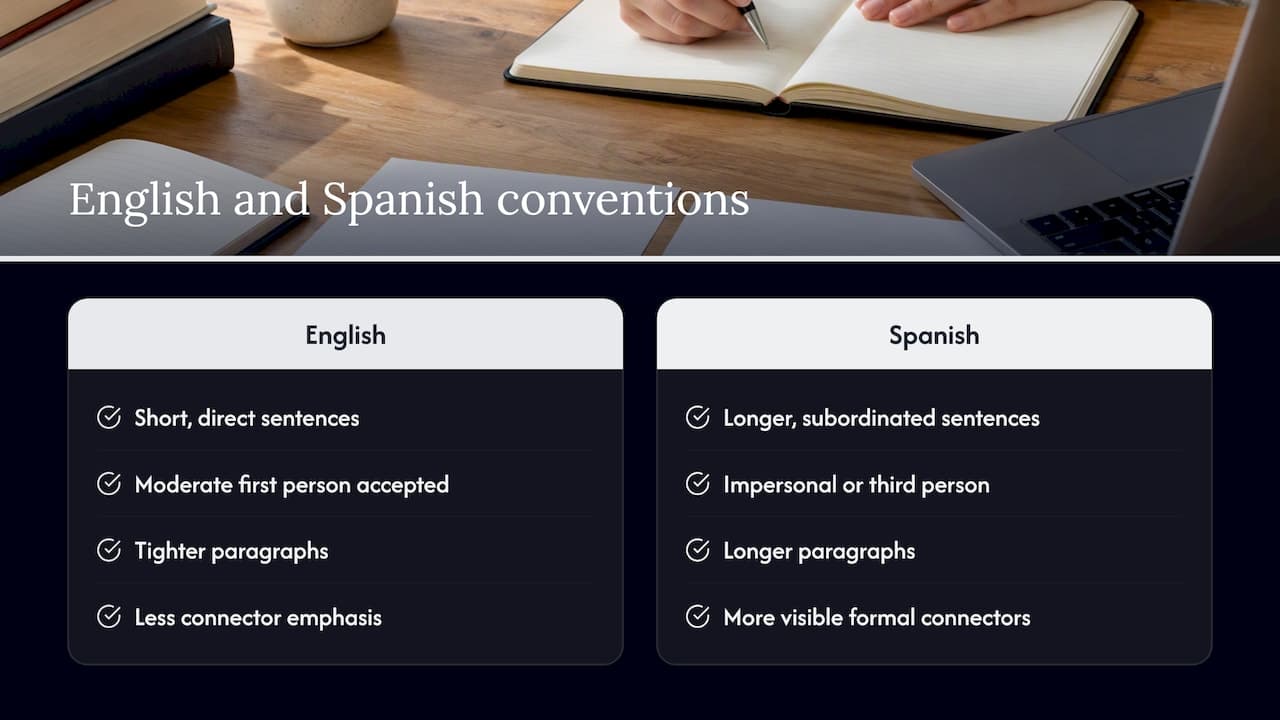
Spanish academic writing tends to tolerate longer, more subordinated sentences than English essay conventions typically favor. Where English academic style often prizes short, direct sentences, Spanish essays frequently build longer sentences with multiple clauses connected by relative pronouns and connectors, which can feel dense to an English-trained writer.
Register expectations also diverge. English academic writing increasingly accepts a moderate first-person voice ("I argue that"), while formal Spanish essays lean more heavily on impersonal or third-person constructions, treating direct first-person opinion as less formal. Spanish essays also use formal connectors more visibly and more often than English equivalents, since cohesion markers carry more of the structural weight in Spanish academic prose.
Paragraph length conventions shift too: Spanish academic paragraphs can run longer than the tight, one-idea paragraphs often taught in English composition courses, bundling a topic sentence, explanation, and example into a single, more extended block. Recognizing these differences matters most for students translating their English essay instincts into Spanish, since a direct structural copy often reads as too clipped or too informal for a Spanish academic audience.
Cultural context shapes not just vocabulary choice but the kinds of examples and arguments that read as natural in a Spanish-language essay. A persuasive essay written for a Mexican classroom, an Argentine university, or a Spanish secondary school may reference different historical events, authors, or social debates as shared points of reference, even when the assigned topic and required structure are identical.
Rhetorical style also carries cultural weight. Some academic traditions in Spanish-speaking countries value a more elaborate, formally expressive style, while others, particularly in scientific or technical fields, favor the more compact style common internationally. Being aware of which convention your specific course or institution expects matters more than assuming one "Spanish style" applies everywhere Spanish is spoken.
Idiomatic expressions and set phrases also vary by region, so an essay written for a Spain-based audience might reach for different turns of phrase than one written for a Latin American readership. When in doubt, neutral, widely used vocabulary and connectors, the kind found in standard dictionaries like the RAE, are the safest choice for an international or unspecified audience.
Vocabulary lists feel productive, but they rarely translate into better essays on their own. What actually moves a draft forward is practicing the right task for your level: a clear thesis and paragraph structure at B1 or B2, then counterargument and source integration as you approach C1 and C2.
Tools like Samwell.ai's Outline Generator can support that structure-first habit by giving you a paragraph-by-paragraph skeleton before you write a single full sentence, which keeps practice focused on organization rather than just word count.
— Tilen
Getting from a blank page to a structured, well-cited Spanish essay is faster when the outlining, editing, and citation work happen in one place. We built Samwell around that exact workflow.

We offer a Free Plan to try the outline and editing tools on a shorter essay, and an Academic Plan for students handling heavier, recurring writing loads. For a draft you already have and want to revise in place, our enhanced essay creator is the fastest way to get hands-on with your own text.
"Essay draft" translates as borrador del ensayo or borrador de la redacción, depending on which word for "essay" your assignment uses. Both terms are listed in standard bilingual dictionaries and are interchangeable in most classroom contexts.
A practical starter set includes ensayo (essay), tesis (thesis), argumentar (to argue), evidencia (evidence), conclusión (conclusion), además (in addition), sin embargo (however), porque (because), por lo tanto (therefore), and plantear (to raise or pose an issue). These cover the core moves of stating a thesis, supporting it, and concluding.
In Spanish, "ensayo" most often refers to a formal or argumentative essay, while "redacción" typically means a shorter school composition and "trabajo" implies a longer academic paper. The right translation depends on the length and formality the assignment calls for, as confirmed by entries in the RAE.
"Efe" is simply the name of the letter F in the Spanish alphabet, with no connection to essay writing or academic vocabulary. It commonly appears in spelling out acronyms or names aloud, such as saying "efe" for an initial that starts with F.



