
Loading...
If you landed here searching "do my homework maths," what you likely need is help writing or editing a math paper, proof, or essay, not someone solving numeric problem sets for you. For that kind of academic writing support, Samwell is a direct option: draft your theorem statement, gather your sources, and start an edit request.
TL;DR:
- Most editing is about improving proof structure and clarity, not just fixing grammar or notation errors.
- Preparing a clear theorem statement, relevant notes, and source references speeds up the editing process and reduces revision rounds.
- Use a step-by-step framework: define variables, plan dependencies, draft in full paragraphs, and display key formulas separately.
- Include and save vector-formatted figures with standalone captions and editable sources for efficient revisions and high-quality publication.
- AI assistance is valuable for scaffolding and expansion but requires thorough verification and disclosure to ensure accuracy.
Good math-writing support is not a vague polish. It produces specific, usable outputs: LaTeX-ready drafts, proofs rewritten in clear paragraph form, consistently numbered theorems and lemmas, a complete reference list, and vector figures that hold up at print resolution. Before you request help from an editor or a tool, gather a few things so the handoff goes quickly.
Scope matters here too. Light proofreading (grammar, notation consistency, formatting) is a different job from a structural rewrite (reordering lemmas, fixing a broken proof flow) and both are different from drafting an essay from scratch out of your notes. Naming which one you need before you ask saves everyone a round of revisions.
Most unreadable proofs are not wrong, they are badly ordered. A repeatable method fixes this whether you write the draft yourself or hand it to someone else to formalize.
Mapping lemmas and their dependencies before you write prevents the common failure of a "backward" proof, one that only makes sense once you already know the conclusion, according to MIT notes on drafting proofs. The classic guidance from Knuth and coauthors on mathematical writing adds a sentence-level rule worth memorizing: never start a sentence with a symbol, always separate symbols with words, and display long expressions rather than cramming them inline.
Pro Tip: Read your proof aloud before you call it done. Spots where you stumble are usually spots where the logic jumps too far.
Math papers tend to carry fewer figures than other disciplines, which makes the ones you include count more. A single conceptual figure in the introduction that gives readers intuition, paired with detailed diagrams later for algorithms or constructions, tends to work better than scattering illustrations throughout, an approach noted in observations on figures in math papers.
A few practical habits make the difference between a figure that looks thrown together and one that reads as finished work.
Designing figures with your actual audience in mind, and keeping editable sources on hand, is a core recommendation in slides on effective use of figures presented at Harvard Medical School. Reviewers and readers often form their first impression of a paper's rigor from its figures before they read a single proof.
A short checklist run before submission catches most of the errors that make a proof hard to trust, whether you are the writer, a teaching assistant, or an editor reviewing someone else's draft.
Quick tests catch what a silent read-through misses: read the proof aloud, have a peer check the logic independently, and verify that every cross-reference to an earlier theorem or equation actually points to the right number. Before submission, confirm the LaTeX file compiles cleanly, figures remain vector quality at final size, and the bibliography is complete.
Pro Tip: Ask a peer who was not involved in writing the proof to walk through it line by line. If they get stuck at the same point twice, that's where the writing needs work, not the math.
The American Mathematical Society's guidance on mathematical exposition frames this well: proofs need guiding transitions between formal steps, because mathematical writing is meant to be an intellectual experience for the reader, not just a verification record.
Using AI to draft, restructure, or edit a math paper is increasingly common, but it comes with rules you cannot skip. COPE's position on authorship and AI tools is direct: AI tools cannot be listed as an author, and any use of AI in preparing a manuscript must be disclosed transparently, typically in the Materials and Methods section or the Acknowledgments. The author remains fully responsible for the content regardless of what tool helped produce it.
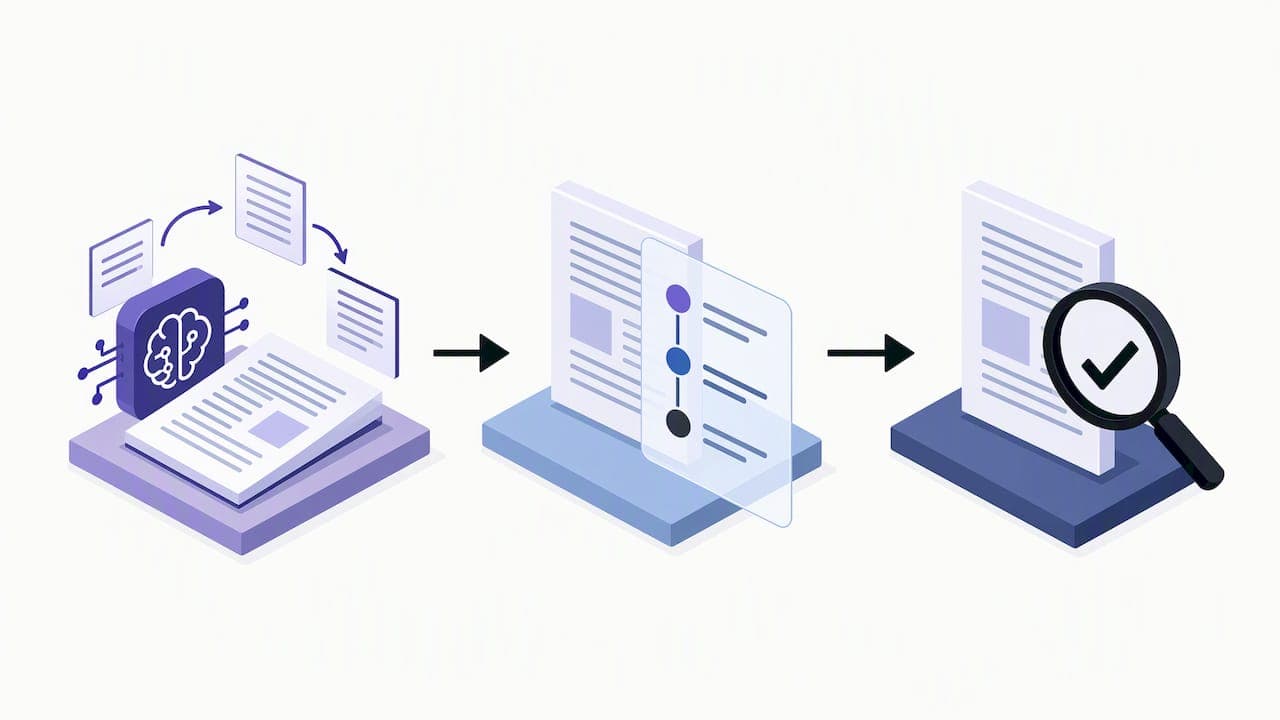
A workable disclosure line is short: something like "AI-assisted tools were used to support drafting and editing; all mathematical content was verified by the author." Keep an internal record of what you used and where, even if the published disclosure is brief.
AI tools used without verification risk hallucinated citations and unchecked logical gaps, a concern raised directly in COPE's broader discussion of AI and authorship. Before submission:
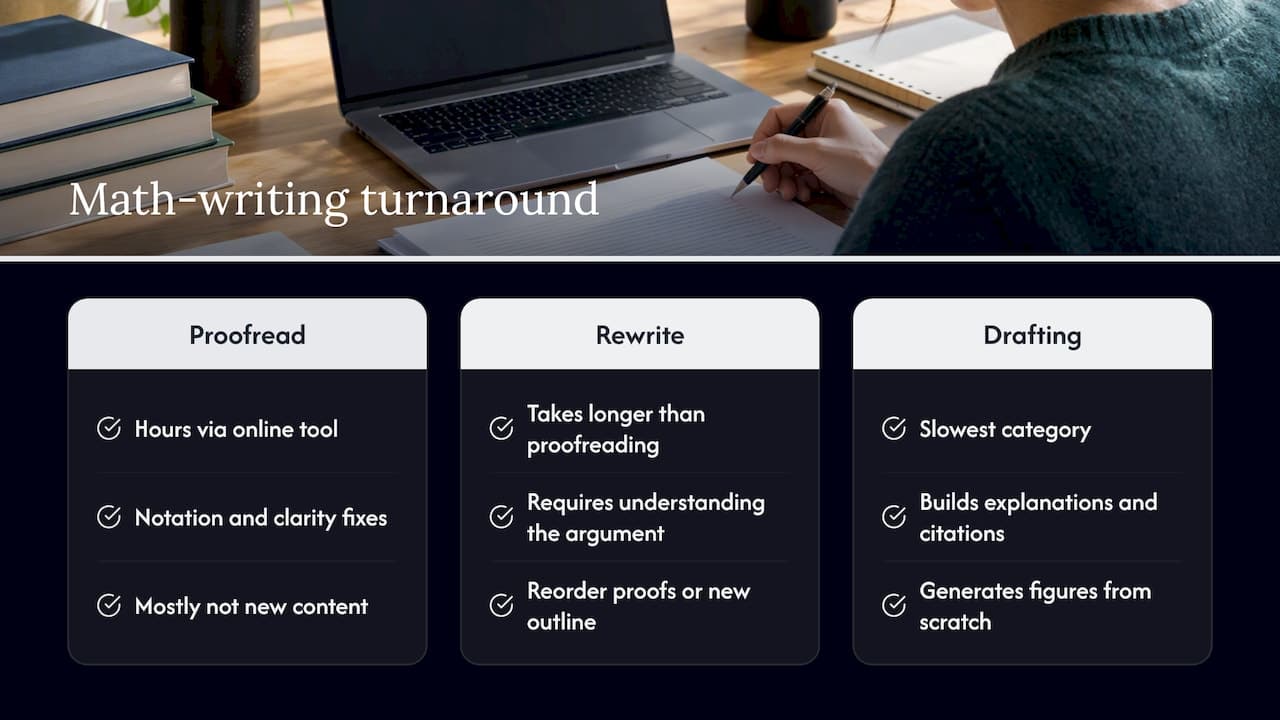
Turnaround depends heavily on what you are asking for. A light proofreading pass on a short proof or problem set write-up can come back within hours when you use an online editing tool, since the work is mostly notation and clarity fixes rather than new content. A structural rewrite, where a proof needs reordering or an essay needs a new outline, typically takes longer because the editor or tool has to understand your argument before improving it.
Full drafting from notes, such as turning a set of partial calculations into a complete literature review or research paper section, is the slowest category, since it involves building out missing explanation, adding proper citations, and generating figures from scratch. Platforms built for this kind of work compress these timelines by handling outline generation, citation formatting, and first-pass drafting in parallel rather than sequentially, which is part of why AI-assisted tools have become a common first step before human review rather than a replacement for it.
Deadlines close to a submission date call for scoping the request narrowly: ask for a specific proof or section rewritten rather than a full-paper pass, and reserve time afterward for your own verification and a peer check. No disclosure or ethics guideline shortens that final human review step, so build it into your timeline regardless of how fast the drafting stage goes.
Pricing for academic writing assistance generally falls into a few structures rather than a single flat rate. Free tiers typically cap the amount of text you can generate or edit before you hit a word limit, which works for a single short proof but not for a full paper. Paid subscription tiers then unlock higher word counts and additional features, billed on a recurring basis rather than per document.
The subscription model matters because the cost is not the document, it is the access: you are paying for ongoing capacity to draft, edit, and revise across a semester or a research project rather than a one-time transaction. Samwell.ai follows this structure with a Free Plan, an Academic Plan, and Custom Professional Plans for heavier or institutional use; exact pricing for the paid tiers is available on the upgrade page rather than published as a flat number here.
Watch for the real "hidden fee" in this category, which is rarely a line-item charge: it is the cost of resubmitting work that was not verified. A free or low-cost draft that still needs a full rewrite after an originality check or a professor's feedback ends up costing more in time than paying for the right tier upfront. Matching your plan to the actual volume and complexity of what you are writing, rather than defaulting to the free tier for a full paper, tends to be the cheaper path overall.
We built our platform around the handoff points described above: you bring the theorem statement, notes, and sources, and our tools take it from rough draft to submission-ready. Our Power Editor targets specific sections for expansion or revision rather than rewriting an entire document blind, and Guided Essays gives you a structured outline before you commit to full drafting. Real-time, detection-aware checks run alongside editing so you can see how a draft reads before you submit it.

Getting started follows the same preparation steps covered earlier in this piece: write out your theorem statement, collect your reference list, and decide whether you need a light edit or a full draft. From there:
Review the LaTeX-ready return against the checklist above before you submit anything. If you want a sense of how a draft changes from rough to polished, our writing samples walk through real before-and-after examples.
I treat AI the way I'd treat a sharp coauthor who never gets tired: great for scaffolding an outline, expanding a thin paragraph, or catching a numbering error, never a substitute for verifying the logic yourself. Run a small test draft through the workflow above, then check every proof step against your own understanding or a peer's before you trust it.
— Tilen
Not in the way this guide uses it. Here, the phrase refers to getting help writing, structuring, or editing math-focused prose, like proofs, essays, or research papers, not paying someone to compute numeric answers.
No. COPE's authorship guidance states that AI tools cannot be credited as authors, and any assistance must be disclosed transparently while the human author remains responsible for the content.
Bring a precise theorem statement, any partial notes or calculations, your intended audience, and your reference list. Having raw figure data ready, rather than finished images, also speeds up revisions.
Samwell.ai offers a Free Plan with limited word count, along with an Academic Plan and Custom Professional Plans for extended features; exact pricing for paid tiers is listed on the upgrade page.
Mathematical arguments often rely on precise notation rather than visuals, so papers tend to include one conceptual figure for intuition in the introduction and save detailed diagrams for sections where a construction genuinely needs illustrating, as noted in observations on figures in math papers.



