Loading...

Most students believe a thesis introduction should summarize their entire research paper upfront, but that's a recipe for losing readers before they reach your main argument. A strong thesis introduction does something different: it frames your research question, establishes context, and creates momentum that pulls readers through your work. This guide breaks down what makes thesis introductions effective, provides concrete examples across academic disciplines, and shows you how to avoid the pitfalls that weaken student writing. You'll learn to craft introductions that engage readers and set clear expectations for your essay or research paper.
| Point | Details |
|---|---|
| Clear research question | Your introduction must state what you're investigating and why it matters to readers |
| Concise background | Provide only the context necessary to understand your thesis, avoiding information overload |
| Structural roadmap | Preview your argument's direction without revealing all conclusions upfront |
| Avoid common errors | Steer clear of vagueness, excessive jargon, and unfocused opening paragraphs |
| Discipline-specific adaptation | Tailor introduction elements to match conventions in humanities, sciences, or social sciences |
Your thesis introduction serves as the gateway to your entire academic argument. It establishes the research problem, signals your approach, and convinces readers that your work deserves their attention. Unlike an abstract that summarizes findings or a conclusion that synthesizes arguments, the introduction frames reader expectations and clarifies the research problem you're addressing.
Many students confuse introductions with comprehensive literature reviews or detailed methodology sections. That confusion leads to bloated opening paragraphs that bury the actual thesis statement under layers of unnecessary detail. Your introduction should orient readers quickly, establishing just enough background to make your research question intelligible without overwhelming them with tangential information.
The core elements every strong introduction includes are:
Think of your introduction as a contract with readers. You're promising to address a specific question or problem, and you're outlining the path you'll take to fulfill that promise. When you deliver on that contract, readers stay engaged because they understand where you're heading and why the journey matters.
Pro Tip: Read your introduction aloud after drafting your body paragraphs. If it doesn't accurately reflect what you actually argued, revise it to match your final paper rather than forcing your argument to fit an outdated introduction.
"The introduction is where you earn the reader's trust by demonstrating that you understand both the problem and the scholarly conversation surrounding it."
Common misconceptions include believing introductions must be written first or that longer introductions signal more thorough research. Neither assumption holds true. Many experienced writers draft introductions last because they need to see their full argument before accurately framing it. Length matters far less than precision and relevance to your specific research focus.
Breaking down a successful thesis introduction reveals consistent structural elements that work across disciplines. A structured thesis introduction typically includes background, problem statement, research objectives, and thesis statement, though the emphasis on each component varies by field and paper type.
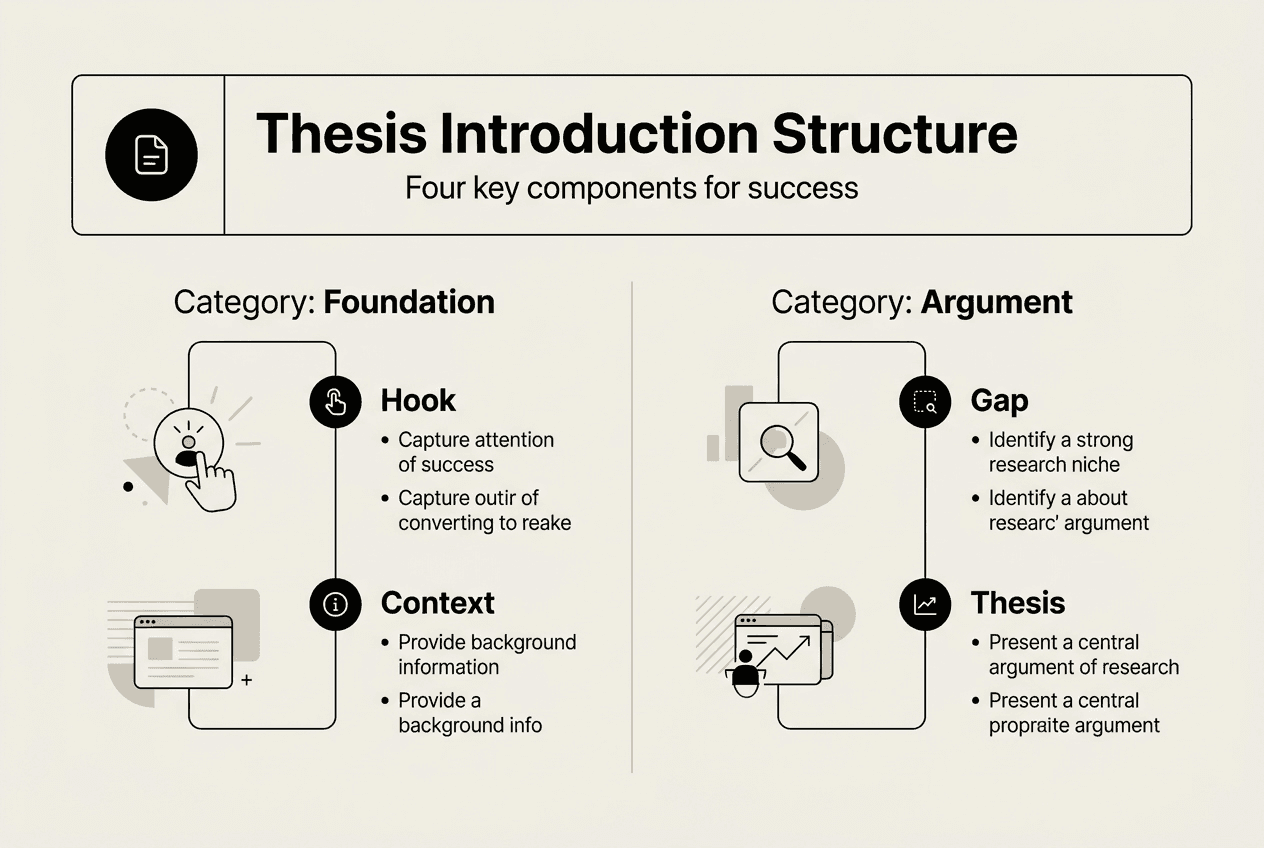
Here's how these components function together:
| Component | Purpose | Typical Placement |
|---|---|---|
| Hook | Captures attention and establishes relevance | Opening sentence |
| Background context | Provides necessary historical or conceptual foundation | Early paragraphs |
| Problem statement | Identifies the gap or question your research addresses | Middle section |
| Research objectives | Clarifies what you aim to accomplish or prove | After problem statement |
| Thesis statement | Presents your central argument or hypothesis | Final paragraph |
| Structural preview | Outlines how your paper will proceed | Closing sentences |
Consider this excerpt from a literature thesis introduction: "While scholars have extensively analyzed symbolism in modernist poetry, few have examined how economic anxiety shaped metaphor choices during the 1930s. This paper argues that Depression-era poets deliberately employed financial imagery to critique capitalism's psychological toll on workers."
Notice how it establishes existing scholarship, identifies a gap, and states a clear argument in just two sentences. The writer doesn't explain modernist poetry's entire history or list every scholar who studied symbolism. Instead, they provide just enough context to make their specific contribution clear.
For a science paper, the structure shifts slightly: "Recent studies show antibiotic resistance increasing 15% annually in hospital settings, yet current protocols fail to address cross-contamination from shared medical equipment. Our research examines whether UV sterilization between patient uses reduces resistant bacterial transmission by 40% or more."
Here the introduction leads with quantifiable data, establishes a practical problem, and frames the research as hypothesis testing rather than argument building. The thesis paragraph components adapt to disciplinary expectations while maintaining clarity about research scope and purpose.
Key tips for maintaining coherence:
Pro Tip: Limit background information to what a reasonably informed reader needs to grasp your thesis. If you're explaining concepts covered in introductory courses within your field, you've likely gone too broad.
Even strong students stumble over predictable introduction pitfalls that undermine their credibility before readers reach the main argument. Many thesis introductions fail due to vagueness, lack of focus, or ignoring audience needs, creating confusion about the paper's actual contribution.
The most frequent errors include:
Consider this weak introduction: "Education is important in society. Many factors affect learning. Technology has changed schools. This paper will discuss technology in education." Every sentence states an obvious fact without establishing a specific research angle or argument. Readers finish this paragraph knowing nothing about what the paper actually claims or investigates.
Compare that to: "While schools have invested billions in classroom technology, student outcomes show minimal improvement, suggesting implementation strategies matter more than device access. This paper examines whether teacher training in digital pedagogy produces better results than simply providing tablets to students."
The revision specifies the problem, hints at existing research, and clearly states what the paper will investigate. It gives readers a reason to continue by identifying a puzzle worth solving.

Another common mistake involves writing introductions before understanding your own argument. Students often draft an introduction, write the body, then discover their actual thesis differs from what they originally planned. The solution isn't forcing your body paragraphs to match an outdated introduction. Instead, revise the introduction after completing your analysis to ensure accurate framing.
Pro Tip: After finishing your first draft, highlight your thesis statement. If you can't find a single clear sentence that states your argument, your introduction needs restructuring. Every introduction must contain an explicit thesis that readers can identify without guessing.
Technical writing presents unique challenges. Science and social science papers often require methodology previews in introductions, but students frequently confuse preview with exhaustive detail. Mention your approach without explaining every procedure: "We used qualitative interviews with 30 participants" works better than describing your entire interview protocol in the introduction.
Avoid these strong thesis writing tips mistakes by testing your introduction against these questions: Does it state a specific research question? Does it explain why that question matters? Can readers predict what type of evidence or analysis will follow? If you answer no to any question, revision is necessary.
Seeing how successful introductions work across disciplines helps you adapt techniques to your specific research area. Examples help students visualize effective introductions and adapt techniques to their discipline, whether you're writing in humanities, sciences, or social sciences.
Here's a comparison of introduction approaches:
| Field | Opening Strategy | Evidence Type | Thesis Placement |
|---|---|---|---|
| Humanities | Scholarly debate or textual puzzle | Interpretive analysis of primary sources | End of introduction |
| Natural Sciences | Empirical gap or phenomenon | Quantitative data and prior studies | Early, with hypothesis |
| Social Sciences | Social problem or behavioral pattern | Mixed methods and statistical trends | Middle to end |
Humanities example: "Critics have long debated whether Shakespeare's Hamlet feigns madness or genuinely descends into psychological crisis. Yet this binary overlooks how Renaissance medical theory understood madness as performative and authentic simultaneously. By examining period medical texts alongside Hamlet's soliloquies, this paper argues Shakespeare deliberately blurs the distinction to critique contemporary assumptions about observable versus internal truth."
This introduction engages with existing scholarship, identifies an overlooked angle, and states a clear interpretive argument. It signals the paper will use historical context and close reading without detailing every text analyzed.
Natural sciences example: "Coral bleaching events have increased 300% since 1980, threatening marine biodiversity across tropical ecosystems. While rising ocean temperatures are the primary driver, recent research suggests certain coral species show unexpected resilience. Our study examines whether symbiotic algae diversity correlates with bleaching resistance in Caribbean reef systems, testing the hypothesis that genetic variation in zooxanthellae populations predicts coral survival rates during thermal stress events."
Notice the quantifiable hook, immediate problem identification, and hypothesis statement. Science introductions typically present the research question as a testable prediction rather than an argument to prove through interpretation.
Social sciences example: "Despite decades of educational reform, achievement gaps between socioeconomic groups persist across American schools. Recent policy initiatives emphasize standardized testing, yet little research examines whether assessment frequency improves or hinders learning for low-income students. This study analyzes three years of district data to determine whether increased testing correlates with achievement gains or contributes to student disengagement in under-resourced schools."
The expository thesis introduction examples show how social science introductions blend empirical data with social relevance, framing research as addressing practical problems while contributing to theoretical understanding.
Key elements these examples share:
When adapting these templates, maintain your field's conventions while ensuring clarity for educated non-specialists. A biology professor should understand your history thesis introduction's basic argument even if unfamiliar with your specific historical period. That accessibility comes from explaining your contribution's significance in terms anyone can grasp, then layering in specialized details as needed.
Crafting a compelling thesis introduction becomes easier when you have the right support. Samwell AI offers specialized tools designed to help students and academics refine their academic writing, ensuring introductions are clear, engaging, and properly structured. Whether you're struggling to articulate your research question or need help tightening your opening paragraphs, these resources provide targeted assistance.
The platform's enhanced essay creator helps you develop stronger thesis statements and organize introduction components logically. You can input your research topic and receive structured guidance on framing your argument effectively. For students who have solid ideas but struggle with expression, the sentence and paragraph expansion tools help you develop concise points into fully realized academic prose while maintaining clarity.
These writing enhancement features integrate seamlessly with your revision process, allowing you to strengthen introductions after drafting body sections. The tools support various citation styles and help maintain academic integrity while improving your writing's flow and precision. Over 1,000,000 students have used Samwell AI to elevate their academic work, finding that expert assistance accelerates the revision process without replacing their own critical thinking.
The ideal length depends on your overall paper length but typically ranges from 5 to 10 percent of your total manuscript. A 10-page essay might have a one-page introduction, while a 50-page thesis could extend to three or four pages. Balance thoroughness with conciseness, providing enough context to frame your argument without overwhelming readers before they reach your analysis.
Start with a relevant hook that establishes why your research question matters to readers beyond your immediate field. Clearly state the significance of your research by identifying what gap you're filling or what problem you're solving. Avoid jargon and keep language accessible, remembering that even specialists appreciate clarity over unnecessary complexity.
Many experts recommend drafting your introduction after completing the body paragraphs because you'll have clearer understanding of your actual argument. An initial draft written early can serve as a roadmap to guide your research and writing, but expect substantial revisions once you've developed your full analysis. The introduction you start with rarely matches the introduction your final paper needs.
A thesis statement presents your central argument or claim that the paper will prove through evidence and analysis. A research question identifies what you're investigating without predicting the answer. Humanities papers typically use thesis statements, while scientific papers often frame research as questions or hypotheses to test. Both approaches require specificity about scope and focus.
Include only the contextual information necessary for readers to understand your specific research contribution. If you're explaining basic concepts covered in introductory courses, you've likely provided too much background. Aim for the minimum context that makes your thesis statement intelligible to educated readers outside your specialty, then trust that your body paragraphs will develop details as needed.