
Loading...

The safest route through a tough coursework deadline is legitimate academic support: your school's writing center, a qualified tutor, or a transparent AI-assisted platform like Samwell.ai that you use openly and document. Ghost-writing services that produce and submit a finished paper for you carry real academic and legal risk, and that risk rarely matches the short-term relief they promise.
TL;DR:
- Most students who buy coursework often underestimate how common and accepted outsourcing remains, despite universities treating it as misconduct.
- Prices vary significantly depending on urgency and complexity, with rush orders under 24 hours carrying the highest risk of low-quality or recycled content.
- Trustworthy support includes clear scope, transparent sources, qualified tutors, and explicit details about originality checks before payment.
- Generative AI tools are most effective when used openly for outlining and editing, with documentation of the process to avoid integrity violations.
- Avoid services offering ghost-written papers and be cautious of providers with vague pricing, unverified claims, or threatening tactics to protect your academic standing.
"Coursework writing services" covers a wide range of businesses, and the label hides real differences in what you actually get. Some sell finished, ghost-written papers. Others only edit what you already wrote. Still others are tutoring services or AI tools that help you build your own draft. Knowing which category a provider falls into tells you more than any testimonial on its homepage.
Common deliverables advertised across this market include:
The delivery model matters more than the marketing copy. A custom-writing service assigns a ghost-writer to produce a paper from scratch, which is the model tied to contract cheating. An editing-only service works from your own words and should not be rewriting your argument for you. Tutoring services teach you how to build the paper yourself, session by session. AI-assisted platforms sit in a different category again: tools generate drafts, outlines, or edits based on your prompts and sources, and the output is meant to be a starting point you revise and own.
Marketing language in this space is often vague by design. "100% original" usually just means the text was not copy-pasted from an existing source, not that the work is free of integrity concerns if someone else wrote it for you. "Expert writers" rarely comes with verifiable credentials attached. "Unlimited revisions" sometimes means unlimited requests but a cap on how substantially the provider will actually change the work. Reading the actual service description, not the headline promise, is the only reliable way to know what you are paying for.
Prices in this market swing widely because four variables do most of the work: urgency, academic level, length, and complexity. A short, low-level piece with a two-week deadline costs far less than a graduate-level paper due in 24 hours, and that spread is where a lot of providers build in hidden markups.
Turnaround expectations generally follow a predictable pattern:
Pro Tip: Treat any rush order under 24 hours on a graduate-level paper as a quality gamble, regardless of the price quoted.
Cost red flags are fairly consistent across the industry. Watch for a quote that is dramatically lower than every competitor for the same scope, a price that changes significantly after you submit payment details, extra charges for "formatting" or "a plagiarism report" added after the fact, and vague billing language that avoids stating a firm total upfront. A provider unwilling to give you a fixed price before you share personal or payment information is a provider you should walk away from.
The deeper cost here is not financial. Independent research using incentivized methods, which reward honest answers more reliably than a standard anonymous survey, estimated that a notable share of students in an Australian sample had bought and submitted work from a commercial contract-cheating provider, with another 11.4% outsourcing through file-sharing sites, figures notably higher than what simple self-report surveys tend to capture (Curtis et al.). That gap between what students admit outright and what they admit under better survey conditions says something about how underreported this behavior is, and how much institutions are likely still underestimating it.
Contract cheating is the practice of paying a third party to produce an assignment that you then submit as your own work, whether that is a full essay, a chunk of a dissertation, or a complete lab report. It is treated as academic misconduct at essentially every university, regardless of how the provider markets itself, because the submission misrepresents who actually did the work (University of Auckland).
The scale of the problem is larger than most students assume. A systematic review of contract cheating research found that commercial essay mills and their marketplace variants rely heavily on persuasive marketing, fast turnaround promises, and search visibility tactics that frame outsourcing as ordinary "help" rather than misconduct (systematic review). Gig-economy sellers and file-sharing platforms add another layer, since they can look more like informal peer support than a commercial cheating service, which makes the ethical line easier to blur in a student's mind.
Submitting work produced by someone else, regardless of a provider's "plagiarism-free" label, is treated as plagiarism by the institution receiving it.
Predatory tactics show up again and again across institutional guidance. Some providers use contract terms that quietly shift all liability onto the student if the work is flagged. Others have been known to threaten students who refuse further payment, including threats to report the original transaction to the student's school, a pattern blunt enough that some universities now warn explicitly that you should never hand identifying documents or student IDs to a third-party writing service (Brunel University). A "plagiarism-free" guarantee is also frequently used to paper over the fact that the content is ghost-written rather than actually original to the student, which is a separate problem from text-matching software catching a copied sentence.
If you have already used a provider like this and are worried about consequences, you are not necessarily out of options. Several institutions run honest-disclosure or amnesty pathways that treat voluntary self-reporting far more leniently than a case discovered through a formal investigation (University of Wisconsin). Checking your own school's policy before assuming the worst outcome is always worth the five minutes it takes.
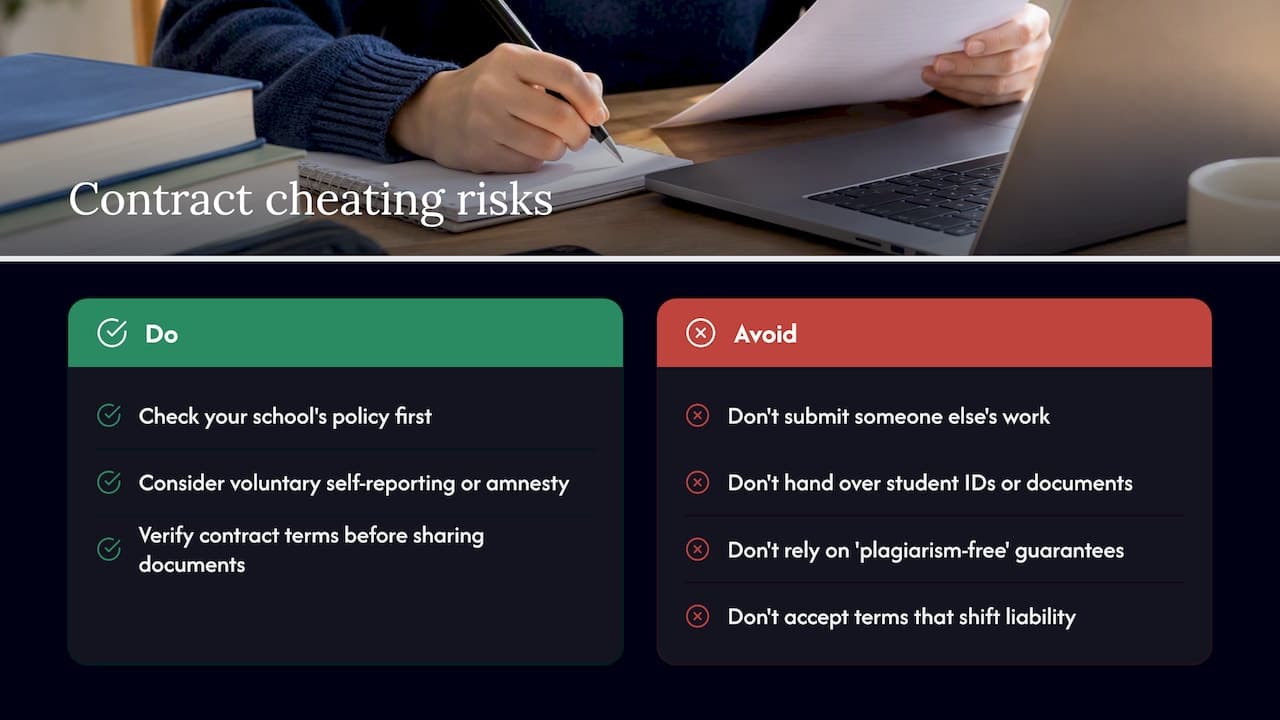
Picking a provider you can trust comes down to a short list of checks, done before you pay anything.
A few scripted questions make these checks concrete. Try asking directly: "Can I see a sample of work on a similar topic?" "Will you send me the reference list separately so I can verify the sources exist?" "What happens if my university's citation style does not match your default format?" A provider that answers clearly and quickly is behaving like a legitimate business. A provider that stalls, changes the subject, or pressures you to pay before answering is showing you a red flag.
Pro Tip: Before paying anyone for writing help, ask for two or three sample citations from the proposed source list and spend five minutes confirming they are real, published sources. It is one of the fastest ways to separate a legitimate research-based service from one that fabricates references.
University guidance consistently points in the same direction: verify alignment with your institution's own rules before you commit to any outside help, since what counts as acceptable support varies by school and by assignment type (UNSW Sydney).
Before paying anyone, it is worth exhausting the support your tuition already covers. University writing centers exist specifically to help with structure, argument, and revision, and they do it without putting your academic standing at risk. Academic-skills consultations and peer-tutoring programs serve a similar function for subjects beyond writing itself.
Writing centers have also adapted quickly to generative AI, and their guidance is a useful template for using these tools responsibly yourself:
The Judith Anderson Herbert Writing Center frames generative AI explicitly as an assistive tool, useful for brainstorming and structural feedback, not a replacement for your own drafting. The Writing & AI Literacy Center at the College of Western Idaho takes the same stance, building skills like revision and critical thinking rather than producing finished work on a student's behalf.
Used this way, Samwell.ai fits the same model. Its Power Editor supports targeted revision rather than wholesale rewriting, Guided Essays builds a structured outline you fill in and expand yourself, and built-in citation tools and real-time AI-detection checks give you the kind of transparency a responsible workflow depends on.
Pro Tip: Keep a simple log of your prompts and the drafts an AI tool produces. If an instructor ever asks how you used the tool, a documented trail is the fastest way to show your process was above board.
Deadlines are real, and so is the temptation to make a problem disappear by paying someone else to solve it. The honest trade-off is this: a purchased paper fixes one deadline and teaches you nothing, while a tutoring session or a well-used AI tool costs more effort upfront but builds a skill you will need again next semester and in whatever job comes after graduation.
My own view, after looking at how this market actually operates, is that the providers worth avoiding are not always the obviously sketchy ones. The smoother and more "customer-friendly" a ghost-writing service sounds, the more it is worth asking what exactly you are buying. Combine a writing center's structural feedback with a transparent AI tool for outlining and editing, and you get most of the speed without giving up the parts of the assignment that actually build competence. Treat AI literacy as a skill in its own right, not a shortcut around learning to write.
— Tilen
We built Samwell.ai around the idea that AI assistance and academic integrity are not in tension when the process stays visible. Our Power Editor lets you expand or tighten specific sections instead of regenerating an entire paper, our Guided Essays feature walks you through a structured outline before any full draft exists, and our Semihuman.ai technology is designed to reduce plagiarism risk while keeping the writing recognizably your own. Built-in citation support covers styles like APA and MLA, and real-time AI-detection checks mean you are never guessing what a detector might flag later.

A typical workflow looks like this:
For complex tasks, our research paper and literature review tools handle source integration and structure specifically for those formats, and our Upload Essay feature lets you bring in a draft you already started and work from there rather than from a blank page. Our Free Plan gives you a limited word allowance to try the workflow, and our Academic Plan unlocks higher word limits and the full editing toolkit for students who need it through the semester.
Sites that pay writers daily are freelance marketplaces for content work, a different category from coursework writing services aimed at students. We do not operate as a freelance marketplace, so this question falls outside what a coursework-focused platform like ours can answer.
Coursework includes any graded assignment completed during a class rather than as a final exam, such as an essay, a lab report, a literature review, a case study response, or a research paper. The exact format depends on the subject and the instructor's requirements.
We cannot recommend a specific third-party dissertation-writing service, since paying someone to write a dissertation section for you falls under contract cheating at most UK institutions (University of Auckland guidance). A safer route is your university's dissertation supervisor, academic-skills service, or a transparent AI-assisted editing tool used on your own draft.
Prices vary widely based on urgency, academic level, length, and complexity, and providers rarely publish consistent rates. Beyond the financial cost, paying someone to write and submit an essay on your behalf is treated as academic misconduct at most institutions, which carries a separate and often more serious risk.
Used transparently, AI tools can be a safe way to outline, edit, and refine your own writing, as long as you document your use and verify anything the tool generates. University writing centers now actively teach students how to use generative AI this way rather than banning it outright (writing center guidance).



