Loading...

TL;DR:
- Getting citations right is essential to maintaining academic credibility and avoiding plagiarism. Different disciplines require specific styles like APA, MLA, Chicago, or IEEE, each with core elements such as author, title, and DOI that must be accurately included. Verifying AI-generated references and tracking sources from the outset ensure your work remains trustworthy and error-free.
Whether you're racing toward a submission deadline or carefully polishing a dissertation chapter, getting your citations wrong can cost you more than a few points. Incorrect references undermine your credibility, raise plagiarism flags, and signal to reviewers that you haven't engaged seriously with existing scholarship. This citation guide for academics covers everything you need: how to pick the right style for your discipline, what elements every citation must include, how to build clean reference lists, and why manual verification matters more than ever now that AI tools have entered the writing process.
| Point | Details |
|---|---|
| Match style to discipline | APA, MLA, Chicago, and IEEE each serve different fields — confirm with your instructor first. |
| Core elements are universal | Every citation needs author, title, publisher, date, and DOI (when available). |
| Cite paraphrases too | In-text citations apply to reworded ideas, not just direct quotes. |
| Verify AI-generated citations | AI tools frequently fabricate references — always check against the original source. |
| Start citation management early | Using software like Zotero from day one prevents missing entries at submission. |
Picking the wrong citation style is one of the most common mistakes students make, usually because they assume any style will do. It won't. APA is standard for Education, Psychology, and the Sciences, MLA is the default for Humanities, and Chicago or Turabian covers Business, History, and Fine Arts. IEEE is the go-to for engineering and computer science, using a numbered reference system that keeps technical papers clean and readable.
Here's a quick reference to which style fits where:
The most reliable source for which style you should use isn't a style guide. It's your instructor or department. Many departments publish explicit guidelines, and some journals in your field will list required formats in their submission instructions. When in doubt, ask before you write. Reformatting 60 citations from APA to MLA after the fact is far more painful than a two-minute email to your professor.
The style you use also shapes how citation information is presented. APA puts the date immediately after the author (author-date system), which signals to readers how current a source is. MLA uses the author's last name and page number in-text, reflecting the Humanities' emphasis on close reading of specific passages. IEEE uses bracketed numbers, prioritizing the flow of technical argument over source prominence. These aren't arbitrary rules. Each system reflects what scholars in that discipline actually care about.
Regardless of which style you use, every citation must include core elements: author, title, container (the journal, book, or website), publisher, date, and location or DOI. Think of these as the GPS coordinates of a source. Without them, your reader can't find what you're pointing to.
The DOI (Digital Object Identifier) deserves special attention. For online sources, a DOI creates a persistent link that doesn't break the way standard URLs do. If a DOI is available, include it. Always. A missing DOI is one of the most flagged errors in academic peer review, and it's entirely avoidable.
Here are the most common formatting pitfalls to watch for:
Pro Tip: When you find a source, record all citation elements immediately. Hunting for a publisher's location or a journal's volume number at 11pm before a deadline is avoidable if you capture the data when the source is open in front of you.
Consistency across citations builds your credibility as a scholar. A reference list with inconsistent formatting tells reviewers you either didn't proofread or don't understand the conventions. Both impressions damage your work.

Getting in-text citations right is non-negotiable. In-text citations are mandatory for paraphrases and direct quotations to avoid plagiarism. Many students only cite word-for-word quotes. But if you reword someone's argument and don't cite it, that's still plagiarism. The idea came from somewhere. Credit it.
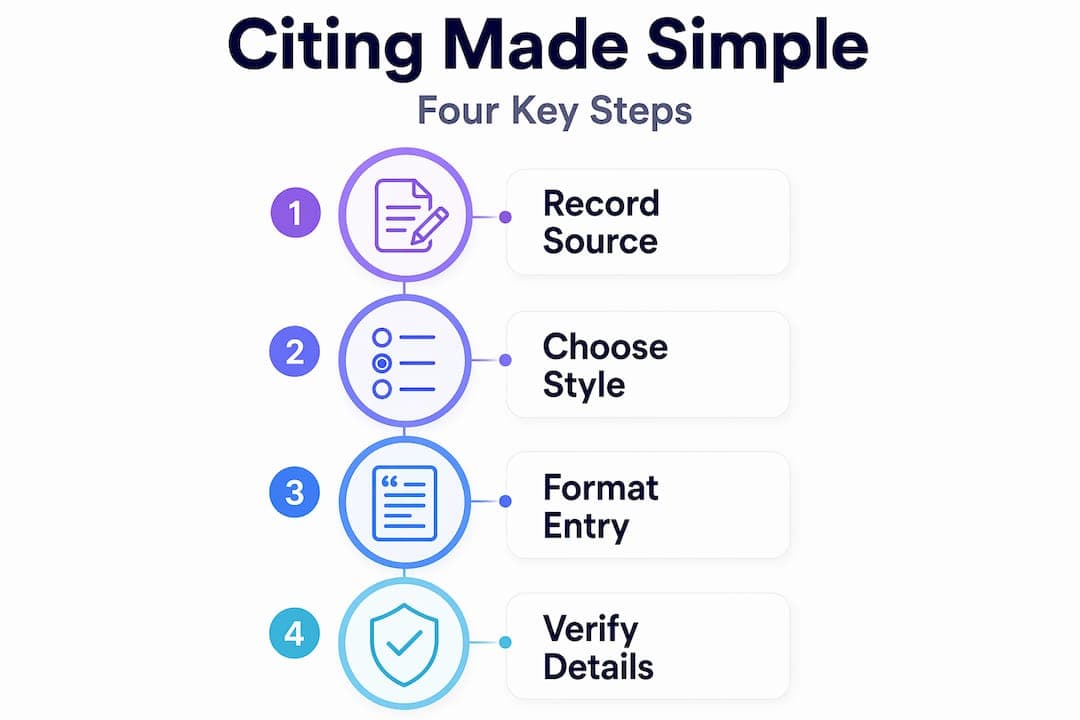
Here's a step-by-step approach to building your citation system:
Pro Tip: Write your reference list in a separate document as you go, not at the end. Paste it into your paper when you're done. This forces you to format each entry correctly in the moment rather than rushing through 30 citations the night before submission.
Different styles also handle secondary sources and personal communications differently. APA discourages citing sources you haven't read directly. If you want to reference a study you found cited in another paper, track down the original. This habit sharpens your scholarship and prevents the cascade of errors that comes from citing citations of citations.
Software like Zotero, Mendeley, and EndNote has made citation management dramatically faster. Starting with reference management software from the beginning of a project increases accuracy and saves significant time at the editing stage. These tools import metadata directly from databases like JSTOR, PubMed, and Google Scholar, format citations in your chosen style, and sync across devices. That's genuinely useful.
Here's a comparison of the three most widely used tools:
| Tool | Cost | Best for | Key strength |
|---|---|---|---|
| Zotero | Free | Students, general academic use | Browser integration, open source |
| Mendeley | Free (basic) | Science and medical researchers | PDF annotation and collaboration |
| EndNote | Paid | Graduate students, faculty | Advanced formatting, journal matching |
But here's where many academics get into trouble: they treat AI-generated citations as finished products. They are not. AI-generated citations frequently hallucinate references not found in any database. A recent Lancet study documented a steep rise in fraudulent citations tied to AI writing tools, with fabricated papers passing through peer review because reviewers assumed citations were checked. The consequences range from embarrassing corrections to retraction.
You can learn more about which AI citation tools perform best in real academic conditions by checking Samwell's review of AI citation generators, which covers accuracy benchmarks across several popular platforms.
Citation generators can also mix styles and omit critical elements like DOIs for online articles. Common errors include incorrect hanging indents, wrong date formats, and missing volume or issue numbers. Automation handles the heavy lifting, but you own the accuracy. Always cross-check a generated citation against the original source before submitting.
Most citation errors fall into a handful of predictable categories. Knowing them in advance is the fastest way to avoid them.
"The reference list is more than a bibliography. It is a record of the intellectual work that shaped your thinking, and its accuracy reflects your scholarly integrity." (APA Style References Guidelines)
One area that deserves more attention in academic writing is inclusive citation practice. Scholarship has historically over-represented certain voices, and actively seeking out diverse perspectives among the sources you cite enriches your work and counters that imbalance. It's worth periodically reviewing whose work you're centering in your reference list.
I've spent years working at the intersection of academic writing and research methodology, and the thing I keep coming back to is this: citation is fundamentally about respect. Not bureaucratic compliance. Respect for the scholar who spent years developing the idea you're using in a paragraph.
That framing changes how you approach the whole process. When I started treating citations as credit rather than formality, I became more careful about what I cited and why. I stopped padding reference lists with sources I'd only skimmed. I started tracking down originals instead of relying on secondhand summaries. The work got better.
The AI era has introduced a genuinely new problem. I've seen graduate students submit papers with citations that look plausible but lead nowhere. The sources don't exist. The authors are real, the journal titles sound real, the years are plausible, but the papers are invented. Verifying manually isn't optional anymore. It's a core academic skill, and the rise of AI in academic writing requires every writer to approach automation with clear-eyed skepticism.
My practical advice: check every DOI before you submit. It takes ten seconds per citation. If the DOI resolves to the paper you cited, you're good. If it doesn't resolve at all, you have a problem worth fixing before your committee or editor does it for you.
Consistency isn't perfectionism. It's the baseline that lets readers trust your work.
— Tilen
Handling citations correctly while also writing a strong paper is a real cognitive load, especially when you're managing dozens of sources across a long project. Samwell was built specifically for this situation.
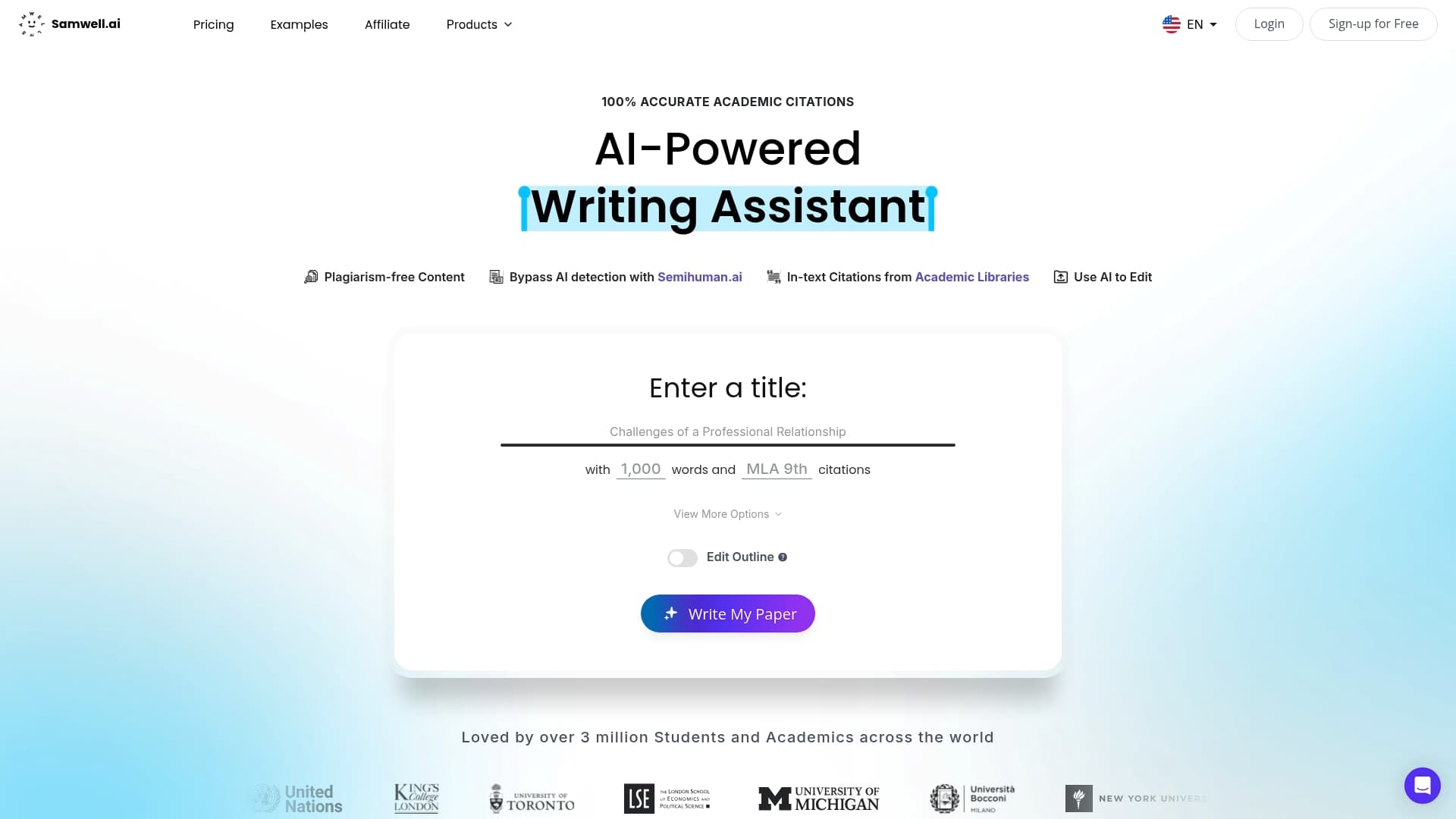
With over 1,000,000 students and academics using the platform, Samwell integrates citation compliance directly into the writing process. Its tools support APA citation style, MLA citation guide formatting, and other major referencing styles, and its AI assistance is designed to flag rather than fabricate. Whether you're working on a research paper, dissertation chapter, or journal submission, you can explore Samwell's academic writing tools to see how the platform helps you write with accuracy and confidence. You do the thinking. Samwell handles the formatting.
Your discipline determines your style. APA is standard for Sciences and Social Sciences, MLA for Humanities, and Chicago for History and Business. Always confirm with your instructor or department guidelines before starting.
Yes. In-text citations are required for any idea you've borrowed, whether you quoted it word for word or rewrote it entirely in your own words.
Not without verification. AI-generated citations can include fabricated references that appear credible but don't exist. Always verify each citation against the original source using the DOI or database search.
A DOI (Digital Object Identifier) is a permanent link assigned to a published source. Including it in your citation ensures readers can locate the exact source, even if a URL changes. For electronic sources, include the DOI whenever one is available.
Zotero is widely recommended for students because it's free, works with most browsers, and integrates directly with word processors. Starting with reference management software early in your project prevents formatting errors and missing entries at the end.