
Loading...

A call to action in an essay is the sentence, or short set of sentences, that answers the question "now what?" after your argument is made. It almost always lands at the end of the conclusion, and it works only when it names a specific, realistic step your reader can actually take, one that grows directly out of the evidence you already presented.
TL;DR:
- The call to action should be directly anchored to strong evidence from your essay and use a clear, specific action verb.
- It must be brief, ideally one to two sentences, and scaled to what your audience can realistically do.
- Addressing counterarguments briefly in the CTA can enhance credibility and persuasiveness.
- A well-placed, concise, and concrete CTA at the conclusion reinforces your argument and encourages reader engagement.
- Avoid vagueness, overreach, confrontational tone, or introducing new evidence in the final sentence.
A call to action in an argumentative essay directs the reader toward a specific step or shift in thinking rather than just wrapping up what was already said. That's the whole distinction between a CTA and a summary: a summary loops back over your points, while a CTA points forward.
Not every CTA asks for the same kind of movement. The common categories:
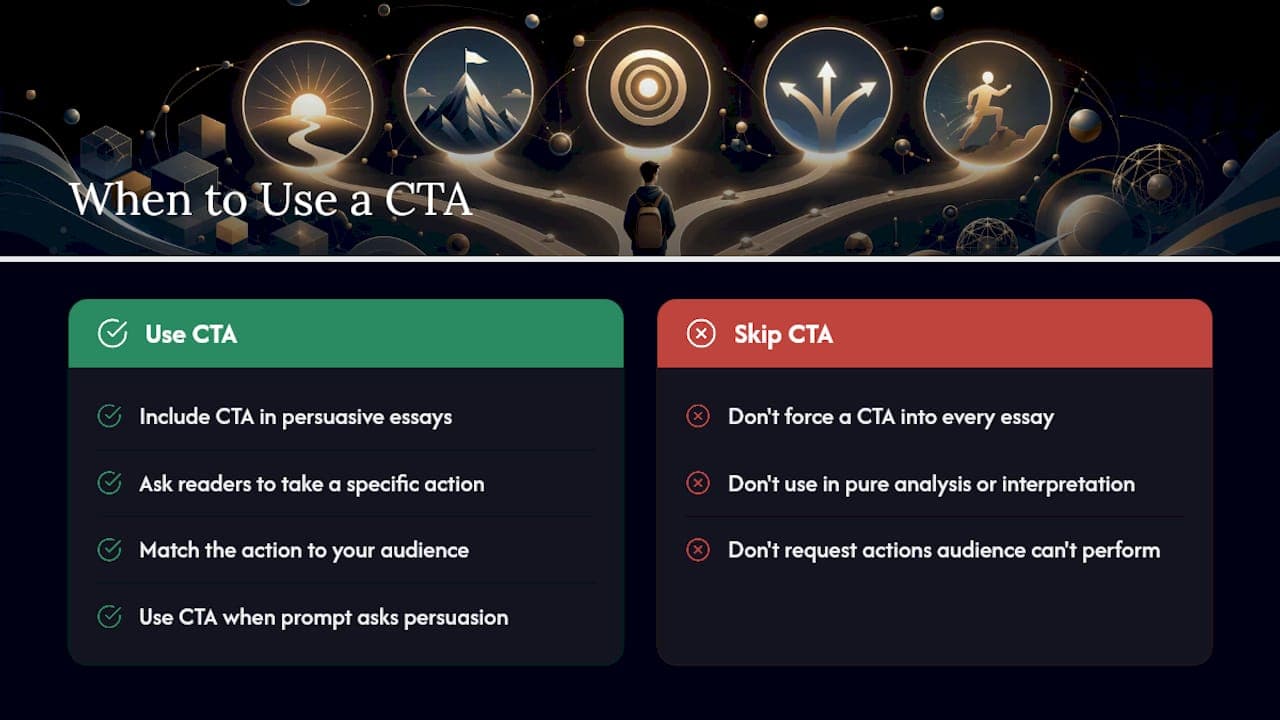
The right choice depends on your rhetorical situation. A CTA aimed at classmates should ask for something a classmate can do; one aimed at legislators can ask for policy change. Fiveable's AP Lang framework makes this condition explicit: the technique only counts as effective when the audience can realistically act on it.
Not every essay needs one, and forcing a CTA into the wrong assignment usually backfires. AP Lang's own guidance treats the CTA as one option among several conclusion strategies, not a mandatory closer.
Skip the CTA in purely analytical or interpretive essays (literary analysis, a rhetorical breakdown, a compare-and-contrast piece) unless your prompt specifically asks for a persuasive angle. Save it for persuasive and argumentative essays, where you're asking readers to agree with a claim and then, logically, to do something about it.
Scale matters too. A civics paper aimed at policymakers can ask for legislative action. A paper aimed at your classmates should ask for something a classmate can do this week, not something only a senator could authorize.
Building a CTA is less about inspiration and more about following a tight sequence. Here's the order that works:
Before you call the conclusion finished, run it through a five-part check: actor, action verb, specificity, scale, and evidence link. If any piece is missing, the CTA is not done yet.
Pro Tip: Try the ClimbTheLadder five-word template: [Actor] + [Action verb] + [Object/Target] + [When/How] + [Why briefly]. Force your CTA through those five slots and vague endings tend to disappear on their own.
These are short enough to lift directly into a draft and adjust for your specific claim.
A CTA can also ask readers to feel differently, not just act differently, and still count as effective if it's tied to real evidence, according to Duarte's guidance on persuasive calls to action.
Most weak CTAs fail for one of four reasons, and each has a quick fix.
The CTA belongs at the very end of your conclusion, and the final sentence carries the most weight of any line in the essay. That's not accidental. Readers remember endings disproportionately, which is why a call to action's placement in the final paragraph gives it outsized emphasis.
A few techniques make that last line land: keep it short, paint a concrete image of what happens if the reader acts (or doesn't), and tie the single-step directive back to evidence you already established. Debate Ladder's structural guidance recommends reframing the stakes and ending on one sharp sentence rather than trailing off into restatement. Avoid introducing anything new here; your job is to sharpen, not expand.
Samwell's blog post on classroom-tested CTA endings walks through short, adaptable closing sentences built for persuasive essays. Inside the platform, Guided Essays helps structure a conclusion so the CTA has somewhere solid to land, and the Power Editor lets you draft two or three CTA variants and compare which one reads tightest. Running a clarity pass on each version before you commit is a fast way to catch the vagueness and overreach problems covered above.
Most writing guides treat the call to action like a rhetorical flourish, something you bolt on after the "real" argument is finished. That gets the priority order wrong. A weak CTA doesn't just end an essay poorly; it exposes whether the argument actually built toward anything. If you can't name one concrete thing a reader should do differently, you've probably written an analysis, not a persuasive essay, no matter what the assignment sheet says.
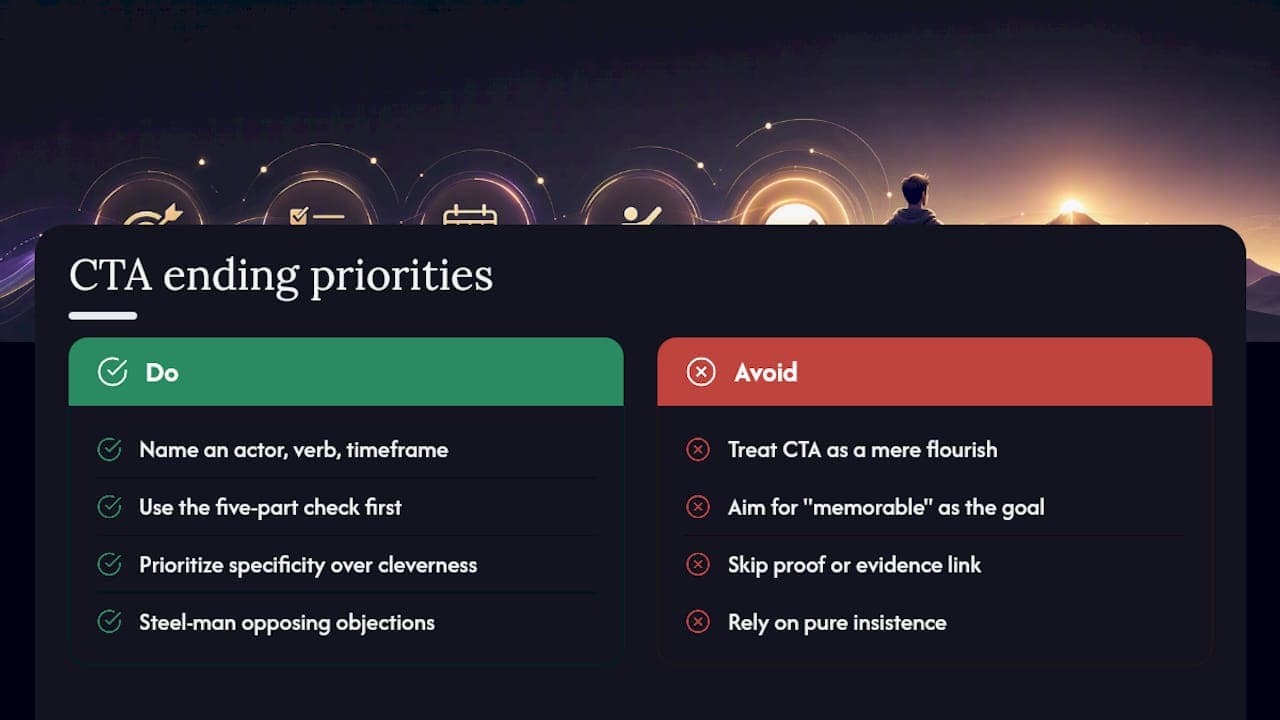
The most overrated piece of common advice is "end with something memorable." Memorable is a byproduct, not a goal. Chase specificity instead: name an actor, a verb, a timeframe, and a reason. Do that consistently and memorable takes care of itself. What most students should prioritize first is not clever phrasing but the five-part check covered earlier: actor, verb, specificity, scale, evidence link. Get those five right before you worry about cadence.
The steel-manning step gets skipped more than any other, and it's the one that separates a CTA that sounds preachy from one that sounds earned. A sentence that quietly acknowledges "some will argue the cost is too high, but the pilot program in the earlier example ran under budget" does more persuasive work than three sentences of pure insistence.
— Tilen
Samwell gives you a faster way to test whether your call to action actually works, without rewriting your conclusion five times by hand. Draft a version, then use the Power Editor to tighten the verb choice, cut vague phrasing, and check that the ask still scales to your reader.

If you're finishing a persuasive essay and want a second pass on the ending before you turn it in, Samwell's research paper tools let you draft, expand, and compare conclusion variants in one place. Try Guided Essays for the outline and structure, then run the Power Editor over your final paragraph to see which CTA phrasing lands hardest.
For deeper reading: Fiveable's AP Lang definition for exam-aligned framing, and the KSJ Handbook's call-to-action chapter for professional-writing technique.



