Loading...

A call to action in an essay is a direct, specific instruction telling the reader what to do with the argument you just made, and it almost always belongs in the final paragraph. It works only when it names one concrete action, not a vague appeal to "make a difference." The goal is simple: move the reader from agreement to a single, doable next step.
TL;DR:
- A call to action must be a specific, actionable instruction that clearly follows from the evidence and reasoning presented.
- Effective CTAs open with a strong verb, specify one concrete action, and include a genuine benefit relevant to the reader.
- Urgency should be used sparingly and only when genuinely supported by the essay's context and timeline.
- The placement and brevity of the CTA are crucial; it should be one of the shortest, clearest sentences at the end of the conclusion.
- Peer review and testing are essential to ensure the CTA is convincing, relevant, and capable of prompting real action.
A call to action essay conclusion works differently than a standard summary. A summary looks backward, restating what you already proved. A CTA looks forward, telling the reader what to do because you proved it. Mixing the two is the most common way student conclusions go flat: three sentences of recap followed by a fourth that suddenly demands the reader "get involved," with no bridge between the two.
The CTA works as a structural hinge. It follows the warrant, the line of reasoning that connects your evidence to your claim, and it converts that reasoning into an instruction. Purdue Global's Writing Center frames this as applying the thesis to a broader context and, only then, issuing a request that the argument has actually earned. Skip the warrant and the CTA feels bolted on, no matter how well written the sentence itself is.
Classical rhetoric explains why this bridge matters. Aristotle's three appeals still describe how persuasion actually lands:
A CTA that skips straight to pathos ("think of the children") without logos behind it reads as manipulative. One built on logos alone can feel cold. The strongest conclusions braid all three together, then land on one instruction.
Marketing research and academic writing guides converge on the same short list of ingredients, and it's worth borrowing directly from both. PayPal's guide to writing calls to action identifies clarity, strong verbs, appropriate urgency, and a clear value proposition as the core drivers of whether a CTA actually moves someone. Academic writing adds one more requirement: the instruction has to be logically earned, not just persuasive in isolation.
Run every CTA draft through this checklist:
Placement matters as much as wording. Shopify's research on CTA design notes that short, visible CTAs outperform buried or wordy ones, a principle that holds just as well at the end of an essay as it does on a landing page. Your CTA sentence should be one of the shortest, most direct sentences in the entire piece.
Pro Tip: Write your CTA sentence before you write the rest of your conclusion. If you can't state the action in under ten words on the first try, your argument probably hasn't narrowed enough yet to earn one.
Different essay topics call for different registers. A civic policy essay can be blunt. A personal behavior essay usually needs a softer, more collaborative tone. Below are examples across four common academic categories, each with an academic-tone and a more motivating-tone variant.
Civic and policy action
Campus policy
Personal behavior change
Academic follow-up
Ten sentence starters you can adapt directly:
A functional CTA paragraph typically runs three to five sentences, moving the reader from understanding to action in a tight arc, according to WritingsLab's guide to CTA paragraphs: remind the stakes, add urgency if it's genuine, then give a specific instruction. Here's how to build that arc under time pressure.
Here's what the finished formula looks like assembled:
"Rising absenteeism costs this district measurable instruction time each semester. Without a change in the current attendance policy, that gap will only widen next year. The board is scheduled to vote on the proposed revision on March 12. Attend that meeting, or submit written testimony to the district office before March 10, and ask specifically for the tiered intervention model outlined above."
Pro Tip: If you're stuck on step two, finish this sentence first: "This matters because, without action, ___ will continue to happen." Whatever fills that blank is your warrant.
For more on tightening the paragraph once it's drafted, a guide to concluding sentences walks through cutting filler without losing the point.
Most weak CTAs share the same handful of problems, and they're fast to diagnose once you know what to look for.
Run this checklist before you submit:
The only real test of a CTA is whether it changes what someone would do next, and the fastest way to check that is peer review. ReadWriteThink's persuasive writing strategy guide recommends asking reviewers one direct question: "Will this actually convince you to act?" Vague answers ("it's fine") mean the CTA needs another pass; specific pushback means you've found the actual weak point.
A few classroom-ready methods work well here:
Drafting a CTA under a deadline is exactly the kind of tight, structural editing task Samwell's tools are built for. Guided Essays map out your conclusion's structure before you write it, so the warrant sentence and the CTA aren't competing for the same three lines. The Power Editor targets a single paragraph, letting you tighten a five-sentence CTA down to three without touching the rest of the essay.
A simple workflow:
Samwell.ai supports more than 1,000,000 students and academic professionals with this kind of targeted, paragraph-level editing rather than full-essay rewrites.
A CTA is a request for someone's time and trust, not a debate trick. The strongest ones stay tethered to the evidence that came before them and respect that the reader might reasonably say no. Urgency deployed honestly moves people; urgency invented for effect erodes the credibility you spent the whole essay building. The most persuasive student writers I've read treat the reader as someone to convince, not someone to corner, and that distinction shows up in every line of the conclusion.
— Tilen
Once you've written the warrant sentence and the instruction, the real work is compression: cutting a CTA down to the two or three lines that actually land. Samwell's Power Editor is built for exactly that kind of paragraph-level tightening, without forcing you to rewrite the rest of your essay to fix one weak ending.
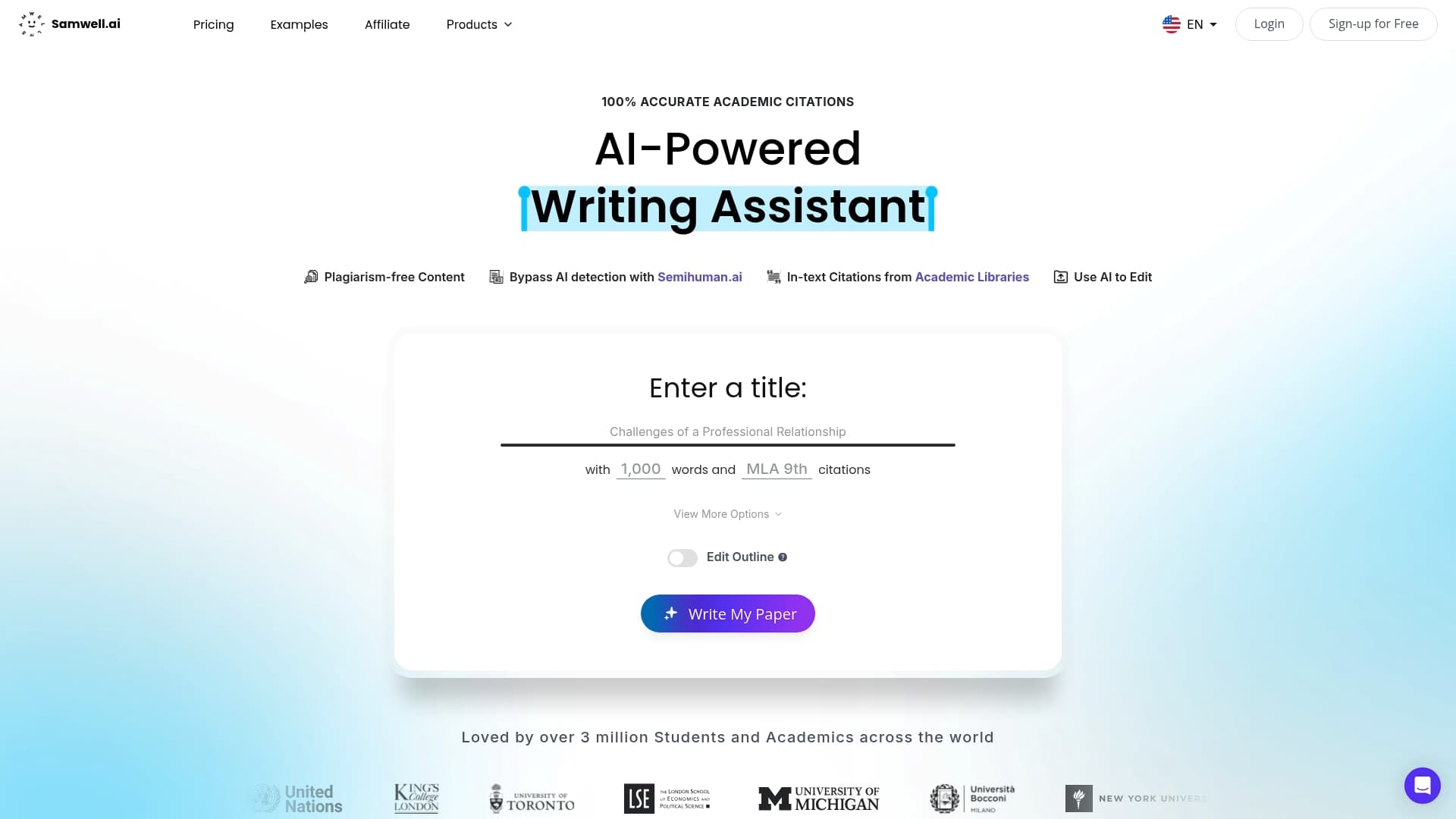
Paste your CTA paragraph into Samwell's Guided Essays tool and run it through a structure check before your next peer-review round. It's a faster way to catch a broken warrant or a buried instruction than waiting for feedback day. If you're still building the conclusion around it, the guide to concluding paragraphs walks through the structural side while Samwell handles the line-level tightening. Start with one paragraph and see what changes.