Loading...

TL;DR:
- Effective research paper writing involves following a structured process from planning to revision to ensure clarity and focus. Using formats like IMRaD helps organize empirical studies, while AI tools support literature review, drafting, and citation management but require strict source verification. The key to success lies in clear thinking and a strong core claim, which guide each drafting step and improve overall quality.
Assistance with writing a research paper means mastering a structured process to plan, draft, and polish scholarly work that meets academic standards. Research paper writing, known formally as scientific or academic writing, is not a talent reserved for experienced scholars. It is a learnable skill built on clear argument, logical structure, and accurate citation. Students and researchers who treat writing as a process rather than a single event consistently produce stronger papers. This guide covers every stage from planning your argument to managing citations with modern AI tools, giving you a practical framework you can apply immediately.

Effective help with research paper writing starts before you type a single sentence. The most common mistake students make is opening a blank document and writing from the top down. That approach produces unfocused drafts that are hard to revise.
The foundation of any strong paper is a clear core claim. Writing a one-sentence summary of your paper before drafting helps clarify your main contribution and keeps the manuscript focused. If you cannot write that sentence, your argument is not ready. That single test saves hours of wasted drafting.
Good guidance on academic writing also means understanding what type of paper you are producing. A systematic review follows different conventions than an empirical study or a theoretical essay. Choosing the right format before you write prevents structural problems that are expensive to fix later.
Planning separates papers that get published from papers that get rejected. The planning stage has three concrete steps: identify the research gap, choose your paper type, and build your outline.
Identifying the research gap means answering one question: what does your paper add that existing work does not? Your answer becomes the core of your introduction and your one-sentence summary. Journals reject papers that do not answer this question clearly.
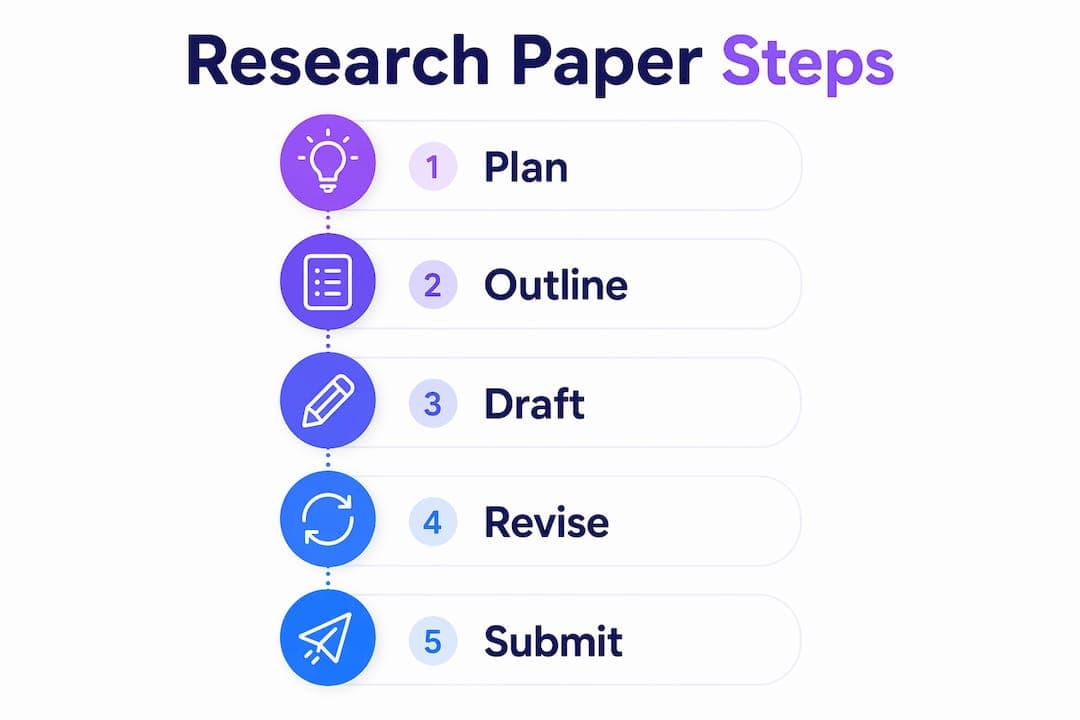
Choosing your paper type determines your structure. The table below shows the most common formats and when each applies.
| Paper type | Best used when | Typical structure |
|---|---|---|
| Empirical study | You collected original data | IMRaD |
| Systematic review | You synthesized existing literature | Background, Methods, Results, Discussion |
| Theoretical paper | You propose a new framework | Introduction, Theory, Implications |
| Case study | You analyze a specific instance | Context, Analysis, Lessons |
IMRaD format stands for Introduction, Methods, Results, and Discussion. Most scientific journals require it because it mirrors the logic of an investigation: why you did it, how you did it, what you found, and what it means. Learning this structure is the single most transferable skill in academic writing.
Pro Tip: Build your outline by writing one sentence for each planned section. If a section cannot be summarized in one sentence, it needs more thinking before you draft it.
Most experienced researchers do not write from the introduction to the conclusion in order. They write Methods first, then Results, then Discussion, then Introduction, and finally the Abstract. This sequence works because each section informs the next.
Methods describes exactly what you did so another researcher could replicate your work. Use past tense, be specific about instruments and procedures, and cite established protocols. Results presents your findings without interpretation. Researchers should follow the one-idea-per-paragraph rule, starting each paragraph with a topic sentence. That rule applies especially in Results, where mixing findings with interpretation confuses readers.
Tables and figures in Results must stand alone. A reader who looks only at your figure should understand what it shows without reading the surrounding text. Write captions that describe the data, not just label the chart.
The Discussion is where you interpret your findings, compare them to existing literature, and acknowledge limitations. A common error is restating Results in the Discussion. State what your findings mean, not what they are.
The Introduction follows a funnel structure: broad context, narrowing to the specific gap, then your contribution. Write it after the Discussion so you know exactly what your paper delivers. That knowledge makes the Introduction sharper and more honest.
Write the Abstract last. Structured abstracts improve clarity by covering context, objectives, methods, findings, and implications in labeled sections. Guidelines from ICMJE, CONSORT, and PRISMA specify structured formats for abstracts in clinical and health research. Even when a journal does not require labeled sections, following that five-part logic produces a tighter abstract.
Pro Tip: Read your abstract aloud after writing it. If any sentence requires knowledge from the paper body to make sense, rewrite that sentence to be self-contained.
The numbered sequence below summarizes the recommended drafting order:
AI tools have changed how students and researchers approach the early stages of writing. They are most useful for literature discovery, draft generation, grammar checking, and citation formatting. They are least reliable for factual accuracy, which means every AI output requires verification against primary sources.
Key tools and practices that support research paper writing assistance include:
Samwell uses Semihuman.ai technology to minimize plagiarism risk while generating research paper drafts. It also runs real-time AI detection checks, which is a feature that matters as journals update their policies on AI-assisted writing. Transparency about AI use is now an academic writing best practice at most institutions.
Every researcher hits the same walls. Knowing the fix before you hit them saves time and frustration.
Unclear argument. If your paper feels unfocused, return to your one-sentence summary. Inability to write a clear core claim indicates the argument needs further development, not more writing. Stop drafting and think harder about your contribution.
Structural problems. Split paragraphs that contain more than one idea. Merge paragraphs that repeat the same point. Effective revision layers edits in sequence: structure first, then sentence clarity, then consistency checks. Trying to fix everything at once produces incomplete revisions.
Missing reporting items. Checklists like CONSORT for clinical trials and PRISMA for systematic reviews exist because researchers routinely omit required reporting elements. Download the relevant checklist and work through it line by line before submission.
Weak feedback. Most researchers only ask specialists to review their drafts. Peer feedback from both specialists and non-specialists improves clarity and argument effectiveness. A non-specialist reader who cannot follow your logic reveals gaps that a specialist overlooks because they fill in gaps automatically.
Reviewer comments. Treat reviewer comments as a prioritized task list. Address each comment in a response document, noting what you changed and where. Journals look favorably on authors who engage with every comment, even when they disagree.
Clear writing reflects clear thinking. When prose feels tangled, the problem is usually in the underlying logic, not the sentences. Revisit your argument before you edit your words.
Effective research paper writing follows a structured, repeatable process that any student or researcher can learn with the right planning, drafting sequence, and revision discipline.
| Point | Details |
|---|---|
| Start with a core claim | Write one sentence summarizing your contribution before drafting anything else. |
| Match structure to paper type | Use IMRaD for empirical work; adapt the format for reviews and theoretical papers. |
| Draft in the right order | Write Methods, Results, Discussion, Introduction, and Abstract in that sequence. |
| Use AI tools with verification | AI speeds up drafting and grammar checks, but every factual claim needs source confirmation. |
| Revise in layers | Fix structure first, then sentence clarity, then citation consistency before submission. |
I have reviewed dozens of research papers from graduate students and early-career researchers, and the pattern is consistent. The papers that struggle most are not poorly written. They are poorly thought through. The sentences are grammatically fine, but the argument wanders because the writer never committed to a single, honest core claim.
The advice I give every researcher I work with is the same: write your one-sentence summary on a sticky note and put it on your monitor. Every paragraph you write should connect to that sentence. If it does not, cut it or rethink it. That discipline alone eliminates most structural problems before revision begins.
I also push back on the idea that AI tools are a shortcut. They are a first-draft accelerator, and that is genuinely useful. But researchers who hand their outline to an AI and accept the output without deep revision produce papers that read like AI output. Journals notice. Reviewers notice. The researchers who use AI well treat it the way a good editor treats a rough draft: as raw material that needs judgment applied to it.
The scientific writing principles that have always mattered still matter. Clarity, specificity, and honest acknowledgment of limitations are what separate papers that get accepted from papers that get desk-rejected. No tool changes that.
— Tilen
Writing a research paper from scratch is time-consuming, and the structural decisions alone can stall progress for days.
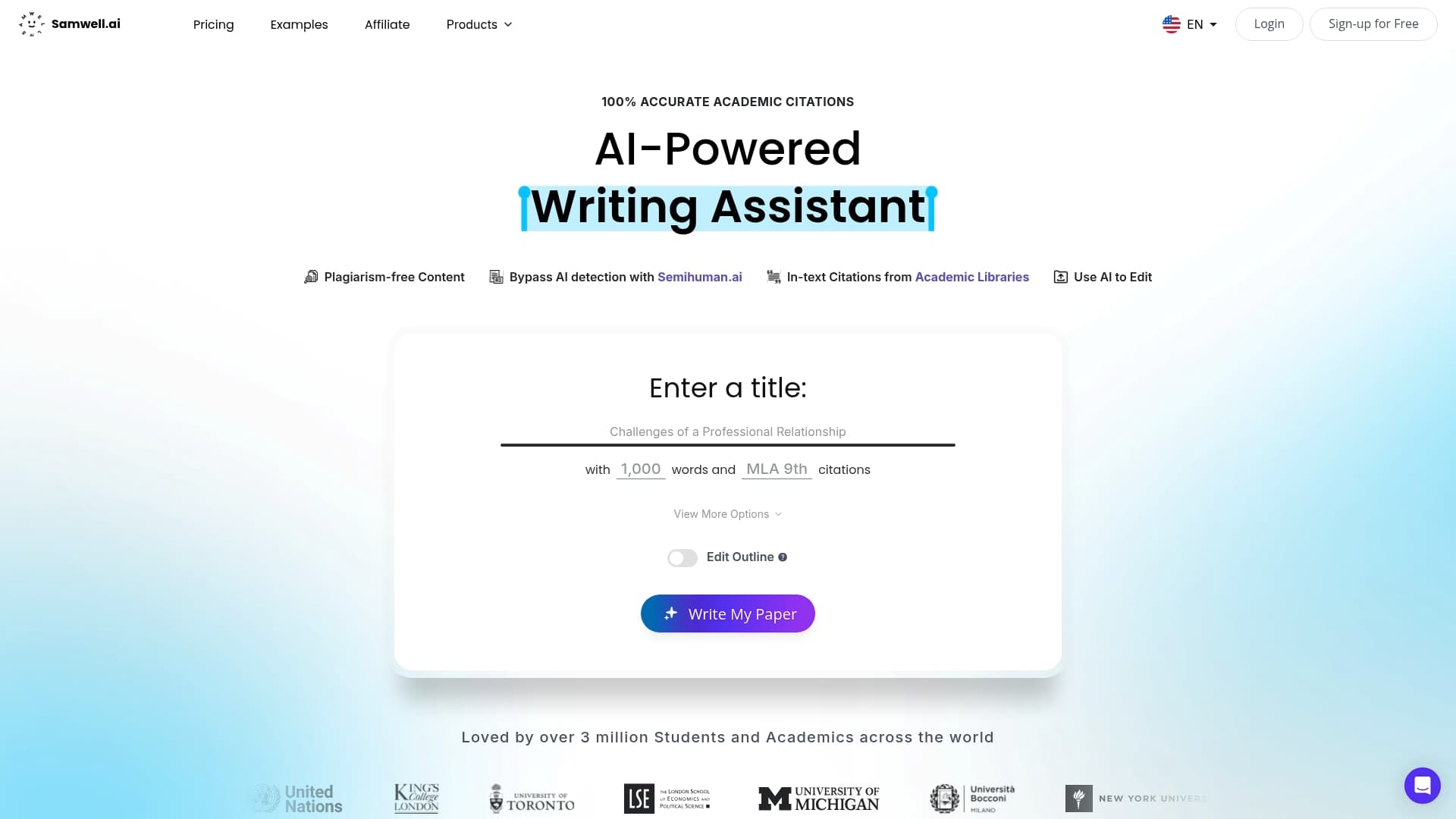
Samwell's research paper generator helps students and researchers move from outline to structured draft without losing academic integrity. You provide your core claim, preferred sources, and target format, and Samwell generates a draft aligned with accepted structures like IMRaD. The Power Editor lets you expand or refine specific sections, while built-in citation tools handle APA and MLA formatting automatically. Real-time AI detection checks keep your paper within institutional guidelines. Over 1,000,000 students and academic professionals already use Samwell to produce A-level research papers with greater speed and confidence.
The IMRaD format (Introduction, Methods, Results, and Discussion) is the most widely accepted structure for empirical research papers. Systematic reviews and theoretical papers follow adapted formats, but the same logic of separating motivation, execution, findings, and interpretation applies.
Write one sentence that summarizes your paper's core contribution before drafting anything else. If you cannot write that sentence clearly, your argument needs more development before you begin drafting sections.
AI tools can assist with literature summarization, draft generation, grammar checking, and citation formatting when used transparently. Every AI-generated claim requires verification against primary sources, and most institutions require disclosure of AI assistance in submitted work.
Address each reviewer comment in a numbered response document, noting what you changed and where in the manuscript. Journals view thorough engagement with reviewer feedback as a sign of professional rigor, even when you disagree with a comment.
The required citation format depends on your discipline and target journal. APA is standard in social sciences and psychology, MLA in humanities, and Chicago in history. Always check the journal's author guidelines before formatting your reference list.