Loading...

For most people, the fastest way to find the right artificial intelligence writing tool is to match your primary task to a category rather than chase a single "best" tool. Academic writers get the most from citation-first platforms. SEO content teams do better with tools that integrate keyword scoring. General drafters and editors can cover a lot of ground with a capable generative assistant paired with a grammar layer.
Here is the short version:
These picks come from standardized prompt testing across common task types, manual quality scoring, and cross-checks for citation fidelity and source transparency. Plagiarism and citation support were weighted heavily for academic profiles. Pricing tiers were verified against each tool's public listings at the time of writing.
Matching your primary task to the right tool category is the single most important decision in choosing an AI writing tool.
| Point | Details |
|---|---|
| Match task to category first | Academic, SEO, and editing tasks need different tool types; no single tool leads every category. |
| Citation support is non-negotiable for academics | Verify that citation generation is traceable and formatted correctly before submitting any academic work. |
| Agentic tools outperform generative tools for research | Multi-source synthesis and literature reviews need agentic browsing, not single-shot generation. |
| Free tiers evaluate quality, not full features | Run your actual use-case prompt on the free tier; upgrade only if quality is there and needed features are gated. |
| Samwell.ai for academic writing | Samwell.ai combines MLA/APA citation generation, Semihuman.ai originality checks, and AI-detection in one academic workflow. |
Re-evaluate your primary tool at each major model release cycle. The category that fits your workflow today may have a stronger option in six months.
The table below maps five tool categories to the dimensions that actually matter when you are choosing. Use it for first-pass filtering: find the row that matches your primary task, then read the card reviews in the next section for specifics.
A few pricing notes worth flagging: free tiers across nearly every category impose word or generation limits that make them useful for evaluation but not for sustained output. Paid plans typically unlock higher word limits, team seats, API access, and, in the academic category, full citation and originality-check features. SEO integrations (Surfer scoring, keyword density tools) almost always sit behind a paid tier. If citation support is a hard requirement for your workflow, confirm it is available on the specific plan you intend to use before committing.
Category comparisons like this one reduce brand clutter and keep the focus on fit. Once you have identified the right category, the card reviews below will help you pick a specific tool to trial.
Independent roundups consistently show that different audiences favor entirely different tools, and the gap between a fiction author's needs and an SEO writer's needs is wide enough that a single "best" pick is rarely honest. The cards below are grouped by category.
ChatGPT (OpenAI) ChatGPT's browsing mode and Code Interpreter make it the most flexible research agent for general use. It handles multi-step tasks well, from summarizing papers to drafting structured outlines with inline references.
Claude (Anthropic) Claude's long context window (up to 200K tokens on paid plans) makes it particularly good at reading and analyzing full documents, not just snippets. It tends to produce measured, well-structured prose.
Elicit Elicit is built specifically for systematic-review-style workflows, with structured report generation and high reported accuracy on screening and data extraction tasks. It is not a general-purpose writer.
Jasper Jasper is built for marketing teams that publish at volume. Its template library covers blog posts, ad copy, product descriptions, and email sequences, and it integrates with Surfer for in-editor SEO scoring.
Writesonic Writesonic covers a similar range to Jasper at a lower entry price. Its Chatsonic feature adds web search to drafts, which helps with factual accuracy on current topics.
Surfer (SurferSEO) Surfer is primarily an SEO optimization layer, not a standalone writer. Its Content Editor scores drafts against top-ranking pages in real time, and its AI writing feature generates keyword-optimized outlines and paragraphs.
Pro Tip: When using any SEO/content generator, run the same brief through two tools and score both against Surfer's Content Editor. The gap in scores often reveals which tool handles your specific niche better than any feature list will.
Grammarly Grammarly's AI writing assistant goes well beyond grammar. It now includes generative prompts, tone adjustment, and formality controls that work across browser tabs, Google Docs, and Microsoft Word. The combination of generative and editing features in one interface is what separates it from standalone grammar checkers.
Rytr Rytr is one of the most affordable options in the category, with a free tier that covers basic use cases and paid plans that stay well below most competitors. Output quality is adequate for short-form copy and social posts.
Copy.ai Copy.ai has expanded from a short-form tool into a broader content workflow platform, with multi-step workflows and CRM integrations on higher plans. The free tier remains one of the more generous in the category.
Samwell.ai Samwell.ai is the most integrated option for students and academic researchers who need citation support and originality assurance in the same platform. It generates structured academic essays with MLA and APA citations, runs real-time AI-detection checks using Semihuman.ai technology, and includes a Power Editor for targeted revisions and Guided Essays for structured outlines.
Purdue University Library's guidance on AI writing tools categorizes tools by function and specifically flags citation and integrity concerns for academic use. Samwell.ai directly addresses both.
Output quality is the obvious starting point, but it is rarely the deciding factor once you get past the top tier of tools. The criteria below are the ones that actually separate a good fit from a frustrating one.
Output quality and control. Test tone, length, and customization options on your actual content type, not a generic demo prompt. A tool that writes excellent marketing copy may produce flat academic prose. Ask: can you adjust formality, set a word target, and steer the voice without rewriting the whole output?
Citation and plagiarism support. For academic users, this is non-negotiable. Confirm whether the tool generates formatted citations (MLA, APA, Chicago), whether it flags AI-generated content, and whether it links outputs to verifiable sources. Tools that skip this step create downstream integrity risk.
Integrations and export options. Check whether the tool connects to the environments you already use: Google Docs, Microsoft Word, your CMS, or your SEO platform. Copy-paste workflows add friction and introduce formatting errors.
Privacy and data handling. Read the data retention policy before uploading proprietary research or unpublished work. Some tools use submitted content to train models; others offer enterprise agreements with stricter data controls.
Cost structure. Map the feature you actually need to the plan that includes it. Citation support, team seats, and SEO integrations almost always sit behind a paid tier. A free trial is useful for evaluation but rarely reflects the full feature set.
Questions to ask during a 7–14 day trial:
Red flags to watch for: opaque sourcing with no way to trace claims, missing citation support for academic workflows, poor or missing export options, no team features on plans marketed to teams, and vague or absent data retention policies.
Pro Tip: Run the same 200-word prompt through your two finalist tools and score both on accuracy, tone match, and edit time. A single structured comparison like this reveals more than hours of reading feature pages.
The evaluation for this roundup used a consistent set of tasks across all tools:
Constraints and limitations: Testing used short trial windows and a limited set of prompts. AI tools update frequently, sometimes weekly, so performance on any specific task can shift between model versions. Pricing was verified against public listings and may change. Team features were tested only where a free team trial was available.
Pricing disclosure: Every tool in this roundup offers either a free tier or a free trial. Paid plans were noted where team features, citation support, or SEO integrations required an upgrade. No tool was evaluated on a paid enterprise plan unless that plan was publicly available for trial.
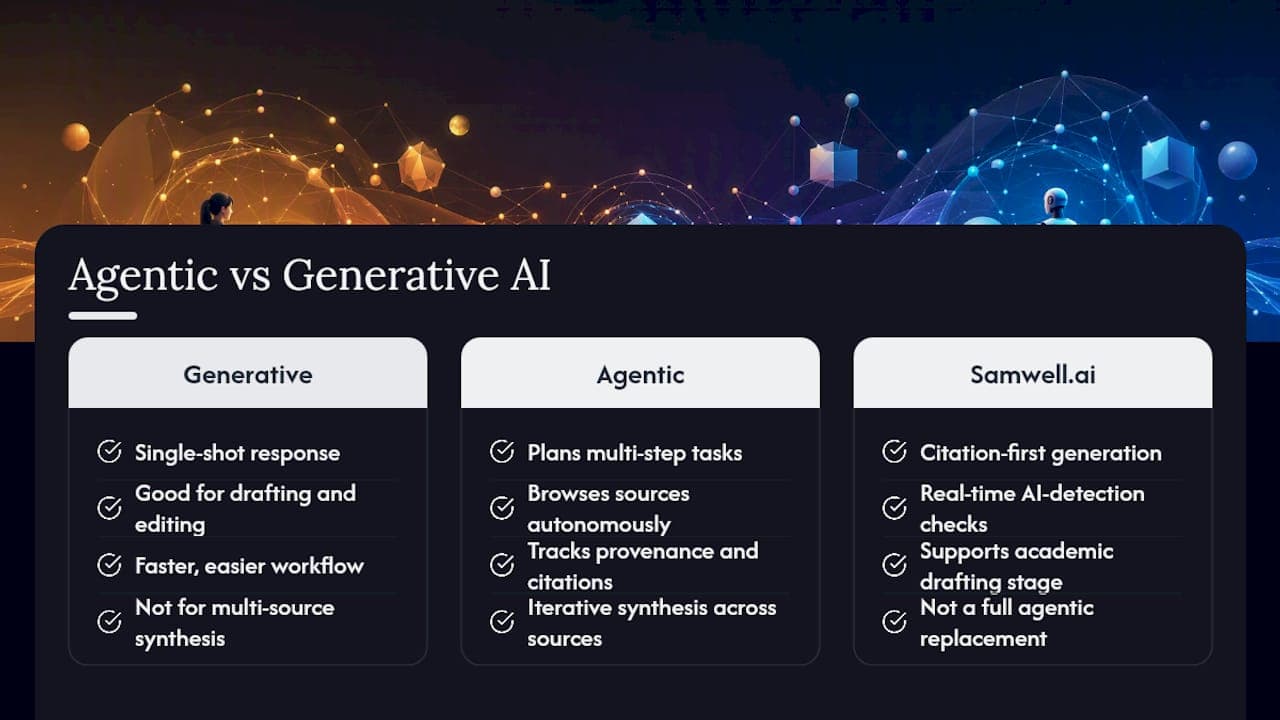
Most AI writing tools are generative: you submit a prompt, and the tool returns a single response. That is useful for drafting, rewriting, and editing, but it has a hard ceiling for research tasks that require pulling from many sources, tracking provenance, and synthesizing across a body of literature.
Agentic AI works differently. It plans multi-step tasks, browses sources autonomously, and iterates on its findings before returning a result. Gemini Deep Research, for example, can browse hundreds of web pages and user-owned files in Google Drive and Gmail, show its intermediate reasoning in a "thinking panel," and produce multi-page reports with audio overviews. That is a qualitatively different workflow from a single-shot prompt.
The Web of Science Research Assistant takes a similar approach but pairs generative and agentic AI with the Web of Science Core Collection, a curated database of peer-reviewed literature. It supports structured literature reviews with interactive visualizations and clear provenance for every cited paper. That provenance layer is what makes it genuinely useful for academic work, where tracing a claim back to its source is not optional.
When agentic features materially improve research outcomes: Systematic literature reviews covering dozens or hundreds of papers; research questions that require synthesizing conflicting findings across sources; structured reports where every claim needs a traceable citation; and any workflow where a single missed source could undermine the conclusion. For these tasks, a generative tool that returns one response is not a substitute for an agent that can browse, compare, and synthesize iteratively.
For tasks that do not require multi-source synthesis, a strong generative tool is often faster and easier. Drafting a blog post, rewriting a paragraph for tone, or generating a first-pass outline rarely needs agentic capabilities. The decision rule is simple: if your task requires tracing claims to sources and synthesizing across many of them, use an agentic or research-grade tool. If it requires producing polished prose from a brief you already have, a generative tool is the right fit.
Samwell.ai sits at the intersection of these two modes for academic users. It does not replace a full agentic research agent for systematic reviews, but it pairs citation-first generation with real-time AI-detection checks in a way that supports academic integrity at the drafting stage, which is where most students and researchers actually need help.
For academic users specifically: citation and plagiarism checks are not a nice-to-have. They are the difference between a tool that helps you write and one that creates a liability. Samwell.ai is the option in this roundup built specifically around that requirement.
Free tiers across this category are genuinely useful for evaluation, but nearly every tool gates its most valuable features behind a paid plan. Here is what that boundary typically looks like in practice.
What free tiers usually include: a word or generation limit per day or month, access to core templates or basic drafting, and enough output to assess quality on your specific content type. Grammarly's free tier covers grammar and basic clarity. Rytr's free tier allows a set number of characters per month. Copy.ai's free tier is among the more generous, covering basic workflow access.
What paid plans unlock: higher or unlimited word limits, team seats and collaboration features, SEO integrations (Surfer scoring, keyword tools), full citation and originality-check features in academic tools, API access for custom integrations, and priority support. For Samwell.ai, the full citation support and AI-detection workflow sit on paid plans.
The practical advice: use the free tier to run the standardized trial from the buying guide. Submit your actual use-case prompt, not a generic one. If the output quality is there and the features you need are locked behind a paywall, the upgrade decision becomes straightforward. If the free-tier output already requires heavy editing, a paid plan will not fix a fundamental fit problem.
Support quality varies more than most feature comparisons acknowledge. ChatGPT and Claude benefit from large, active user communities on Reddit and Discord where prompt strategies and workarounds circulate quickly. Jasper has a dedicated academy and live chat support on paid plans. Grammarly's support is well-documented, with a large knowledge base and responsive email support.
For academic tools, community matters differently. Samwell.ai's user base of over 1,000,000 students means there is a growing body of shared experience around academic workflows, though a formal public community forum is not prominently listed. Elicit has a research-focused user community and publishes methodology notes that are useful for understanding its evaluation approach.
The practical signal: if you are likely to hit edge cases or need workflow help quickly, prioritize tools with active communities or responsive live support. For academic users, look specifically for tools that publish clear documentation on how citation generation and AI-detection work, not just that they exist.
The range of control you get over tone, length, and register varies significantly across categories. Editing assistants like Grammarly give you the most granular control over formality and clarity, applied to text you have already written. SEO generators like Jasper and Writesonic offer tone selectors and length targets at the prompt level, which is faster but less precise.
Academic tools tend to prioritize structure over stylistic flexibility. Samwell.ai's Power Editor lets you target specific sections for expansion or revision, and Guided Essays provide structured outlines that constrain the output toward academic conventions. That is the right trade-off for a student who needs a correctly formatted paper, but it is not the right tool for a marketer who needs punchy ad copy.
ChatGPT and Claude offer the most open-ended customization, because you can engineer the prompt to specify almost any style constraint. The trade-off is that this requires prompt skill. Output quality from these tools reflects how precisely you frame multi-step instructions, which means a non-technical user may get inconsistent results without practice.
For multilingual needs: most major tools support multiple languages to varying degrees, but English-language output quality is consistently higher across the board. If you are writing in a language other than English, test specifically on that language before committing to a plan.
No tool in this category is without meaningful limitations, and the marketing around AI writing tools tends to understate them.
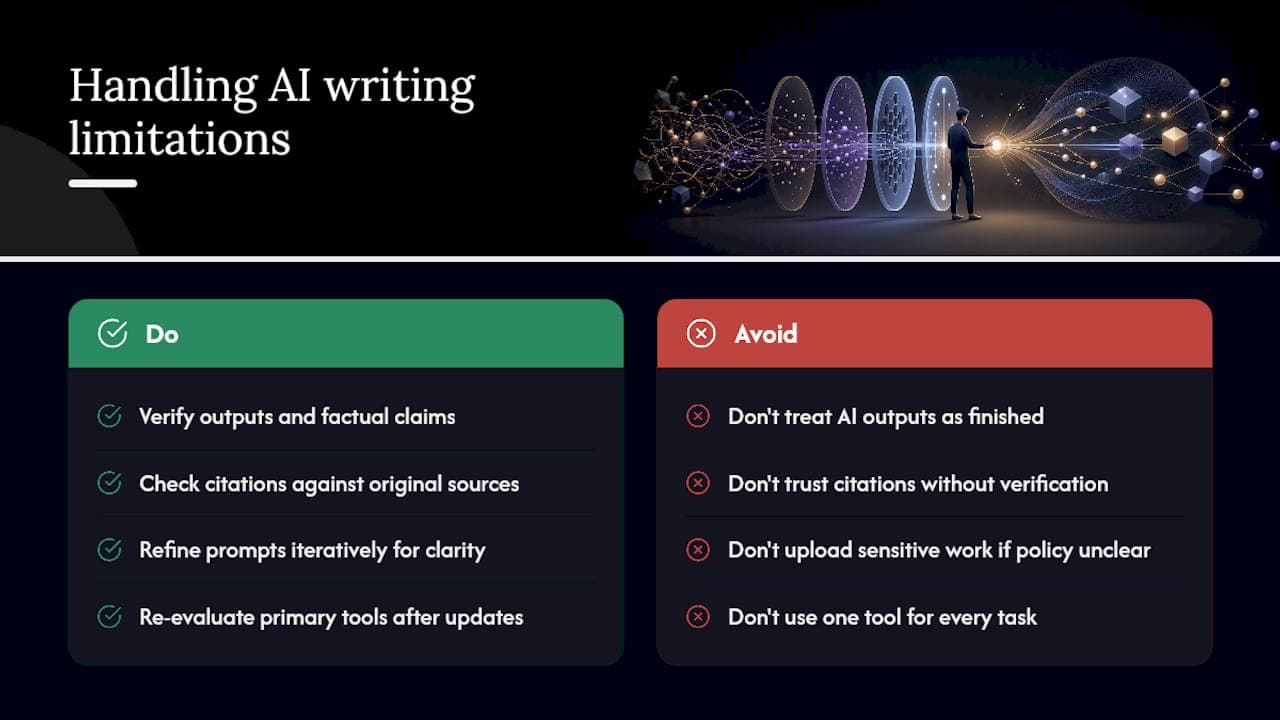
Hallucination and factual accuracy. Generative tools can produce confident, well-formatted text that is factually wrong. This is a particular risk for academic and research use cases, where a hallucinated citation or misattributed finding can undermine an entire paper. Academic library guidance consistently recommends treating AI outputs as drafts requiring verification, not finished work.
Citation reliability. Even tools that advertise citation support can generate incorrectly formatted or entirely fabricated references. Always verify citations against the original source before submitting academic work. SciSpace's AI Writer draws citations from a scholarly corpus, which reduces but does not eliminate this risk.
Prompt dependency. Output quality depends heavily on how precisely you frame your instructions. A vague prompt produces a vague draft. This is not a flaw unique to any one tool; it is a structural feature of how large language models work. Users who invest time in prompt refinement consistently get better results.
Privacy and data retention. Uploading unpublished research or proprietary content to a cloud-based AI tool carries real risk if the tool's data retention policy is unclear. Read it before you upload anything sensitive.
Rapid model changes. Tools update frequently. A capability that works well today may behave differently after a model update. Re-evaluate your primary tool at least once per major model release cycle, especially if your workflow depends on consistent output style.
Narrow specialization vs. general capability. The tools that do one thing exceptionally well (Elicit for systematic reviews, Surfer for SEO scoring) are often poor choices outside their specialty. Resist the temptation to use a single tool for every task.
The conventional advice in AI writing tool roundups is to rank tools from best to worst and pick number one. That advice is wrong for most readers, and the reason is obvious once you look at the actual use-case spread: a tool that tops the list for SEO content will frustrate an academic researcher, and a citation-first academic platform will feel limiting to a marketing team.
The more useful frame is to identify your primary task type first, then evaluate two or three tools within that category using a standardized prompt on your actual content. The buying guide section above gives you the exact questions to ask and the red flags to watch for. That process takes less than two weeks and produces a decision grounded in your specific workflow rather than a generic ranking.
One thing the conventional advice also underweights: the cost of getting citation and plagiarism support wrong in an academic context. A tool that generates plausible-sounding references that do not exist is not a time-saver; it is a liability. For students and researchers, the single most important filter is whether the tool's citation workflow is traceable and verifiable, not whether it produces the most fluent prose.
The agentic vs. generative distinction matters more than most roundups acknowledge. For tasks that require synthesizing across many sources, an agentic research tool will produce materially better outcomes than a generative writer, regardless of how good the generative writer is. Knowing which mode your task requires is the decision that actually determines whether an AI tool helps or creates more work.
Most AI writing tools treat citation support as a checkbox feature. Samwell.ai treats it as the core of the product. For students and researchers who need citation-ready output with built-in originality assurance, that difference is what makes it worth trialing before anything else.
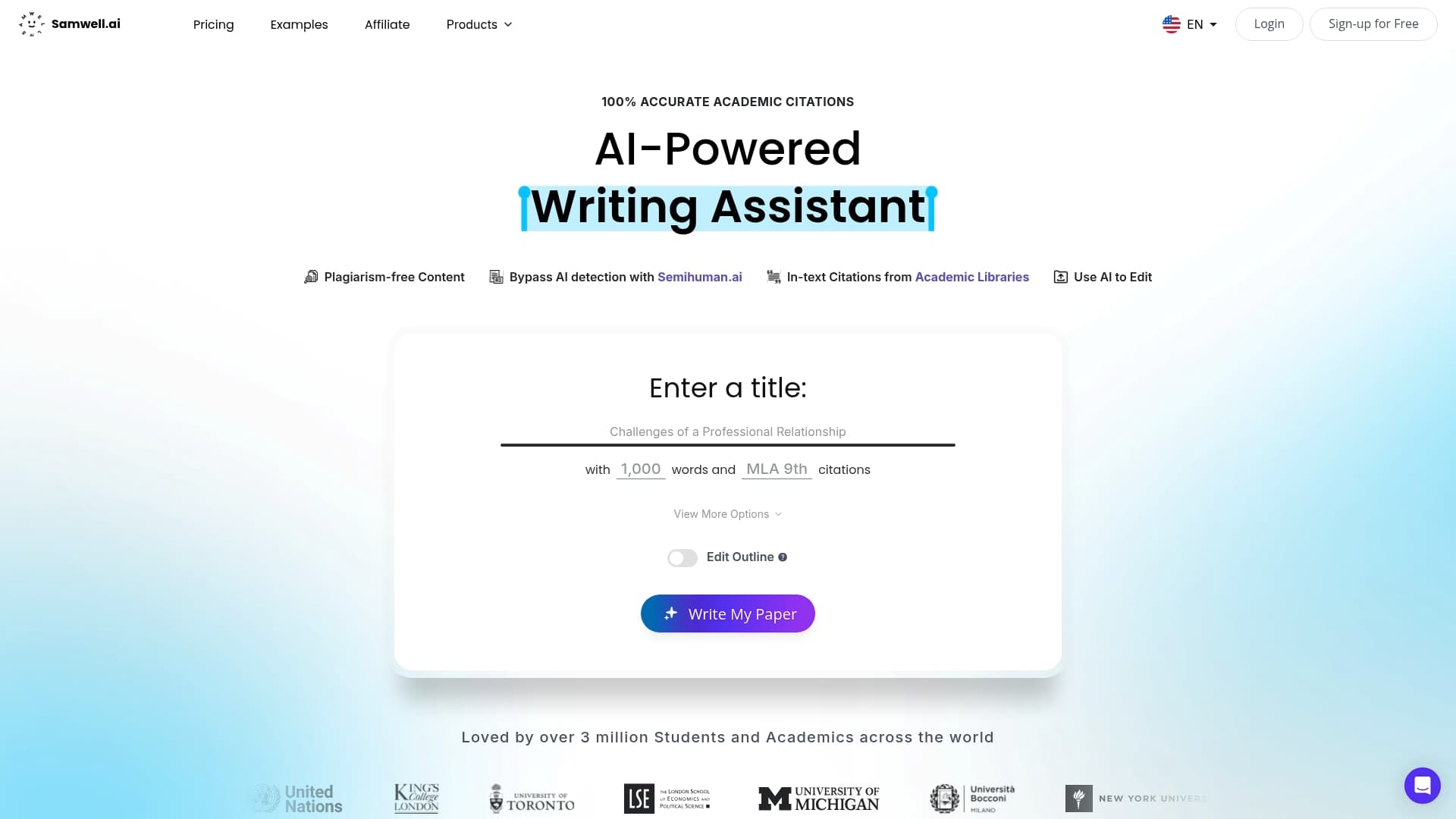
Samwell.ai's feature set covers the full academic writing workflow: MLA and APA citation generation, Semihuman.ai technology that minimizes plagiarism risk, a Power Editor for targeted section-level edits, Guided Essays for structured outlines, and real-time AI-detection checks that keep pace with evolving detection tools. It is the only tool in this roundup where citation integrity is built into the generation process rather than added as an afterthought.
That matters directly for the agentic vs. generative discussion above. Samwell.ai is not a multi-step research agent for systematic reviews, but it is the strongest option for the drafting and citation stage that follows research, which is where most academic integrity issues actually occur.
Try a short academic workflow: upload a draft or topic, generate a citation-formatted outline, and run an originality check. Samwell to see how it fits your specific assignment or research paper.