Loading...

Many students believe passionate language or lengthy explanations make stronger arguments. Research shows that logical clarity boosts persuasion by 40% in academic settings, making concise argument statements the foundation of effective essays. This guide provides examples, debunks myths, and teaches you to craft compelling argument statements that improve essay quality and grades.
| Point | Details |
|---|---|
| Argument statements are concise, debatable claims | They guide persuasive essays with focused, specific positions that readers can challenge or support. |
| They differ from thesis statements | Argument statements focus on one claim while thesis statements preview multiple points and broader scope. |
| Common myths weaken effectiveness | Emotional appeals and longer statements reduce clarity and persuasiveness in academic writing. |
| Strong statements improve essay quality | Clear argument statements align with grading rubrics and can increase scores by up to 20%. |
| Crafting requires systematic steps | Identify topics, take clear stances, hint at evidence, and refine for maximum clarity. |
An argument statement is a concise, debatable claim that presents your position in an academic essay. Unlike broader thesis statements that preview multiple points, argument statements zero in on one specific claim you'll defend with evidence. This distinction matters because strong argumentative statements are concise, usually one to two sentences, to enhance clarity and reader focus.
Effective argument statements share three core characteristics. First, they must be debatable, meaning reasonable people could disagree with your position. Second, they provide why structure matters essays by establishing clear focus from the opening paragraph. Third, they hint at the reasoning you'll develop throughout your essay without revealing every detail.
The ideal length ranges from 20 to 40 words, compressed into one or two sentences. This brevity forces you to eliminate vague language and get straight to your claim. Argument statements must be debatable; statements of fact or universally accepted truths do not qualify as effective argumentative claims.
Key features of strong argument statements include:
These elements work together to create a roadmap for both writer and reader. Your argument statement tells readers exactly what to expect while keeping you focused during the writing process.
Seeing effective argument statements across disciplines helps you recognize patterns and apply them to your own work. Each example below demonstrates how concise language and clear positioning create powerful opening claims.
From humanities: "Shakespeare's portrayal of Lady Macbeth challenges Elizabethan gender norms by depicting female ambition as a catalyst for political change rather than moral corruption." This statement works because it takes a specific stance on a debatable interpretation while hinting at the evidence about gender roles and ambition.

From social sciences: "Mandatory voting laws in Australia have increased political engagement among young adults, suggesting compulsory participation strengthens democratic outcomes." The argumentative essay conclusion example shows how this claim sets up evidence about voter turnout and democratic health.
From sciences: "Reducing antibiotic use in livestock by 30% would significantly decrease antibiotic-resistant bacteria in human populations within five years." This statement combines a specific proposal with measurable outcomes, making it both debatable and testable.
| Discipline | Example Word Count | Effectiveness Factor |
|---|---|---|
| Humanities | 28 words | Challenges established interpretation with specific textual focus |
| Social Sciences | 22 words | Links policy to measurable outcomes with comparative evidence |
| Sciences | 21 words | Proposes quantifiable intervention with timeline for results |
| Business | 25 words | Connects strategy to performance metrics with causal reasoning |
What these argument statement examples share:
Pro Tip: Adapt these examples by identifying your topic's core debate, then crafting a claim that takes one clear side while suggesting your supporting logic.
Three myths consistently weaken student argument statements and undermine essay effectiveness. Understanding these misconceptions helps you avoid common pitfalls that confuse readers and reduce persuasive impact.
First, many students believe emotional language strengthens arguments. Research contradicts this assumption. Misconception: Argument statements must be emotionally charged or subjective to be persuasive. Correction: Effective argument statements rely on clear logic and evidence rather than emotional appeal. Academic readers value reasoned claims over passionate declarations.
Second, longer statements feel more comprehensive but actually reduce clarity. When you pack multiple ideas into one sentence, readers struggle to identify your main claim. Brevity forces precision, making your position impossible to misunderstand. The best argument statements strip away unnecessary words to reveal the core debate.
Third, confusing argument statements with thesis statements creates unfocused essays. While thesis statements can preview multiple points, argument statements concentrate on one debatable claim. This distinction affects how you structure supporting paragraphs and develop evidence. Following final tips for argumentative essays helps maintain this crucial focus.
Top misconceptions corrected:
"Studies in academic writing show that logic-based arguments improve persuasion by 40% compared to emotion-driven claims, demonstrating that clarity trumps passion in scholarly discourse."
Recognizing these myths allows you to write argument statements that meet academic standards and persuade through reasoning rather than rhetoric.
Creating strong argument statements requires a systematic approach that moves from broad topics to precise claims. Follow these steps to build statements that guide your essays and engage readers.
Identify your specific topic within the broader assignment. Narrow from "climate change" to "renewable energy adoption in developing nations" to create manageable scope.
Take a clear, debatable stance on that topic. Avoid neutral observations; commit to a position that reasonable people could challenge with evidence.
Condense your claim into 20 to 40 words maximum. Remove qualifiers like "I think" or "perhaps" that weaken your assertion.
Hint at your supporting evidence without revealing every detail. Signal the type of reasoning you'll develop: empirical data, textual analysis, or comparative examples.
Refine for clarity by reading aloud and eliminating ambiguous terms. Replace vague words like "important" or "interesting" with specific descriptors that preview your argument.
Test against evaluation criteria: debatable claim, clear position, appropriate scope, evidence hint, and relevance to assignment. Revise any element that fails these standards.
Pro Tip: Common mistakes include starting too broad (refine scope earlier), using weak verbs like "relates to" (choose action verbs), and burying your claim in background information (lead with your position).
This process works best when combined with outlining. The argument outline guide 2025 shows how argument statements anchor your entire essay structure. Similarly, understanding writing a counter argument helps you anticipate challenges to your claim during the crafting stage.
Revision is essential. Your first draft rarely captures the precise claim you'll defend. Write multiple versions, comparing them against the criteria above. The strongest statement emerges through iteration, not inspiration. Following argumentative essay final tips ensures your polished statement aligns with your evidence and conclusion.
Assessing your argument statement before writing the full essay saves time and improves quality. Use these criteria to identify weaknesses and refine your claim for maximum impact.
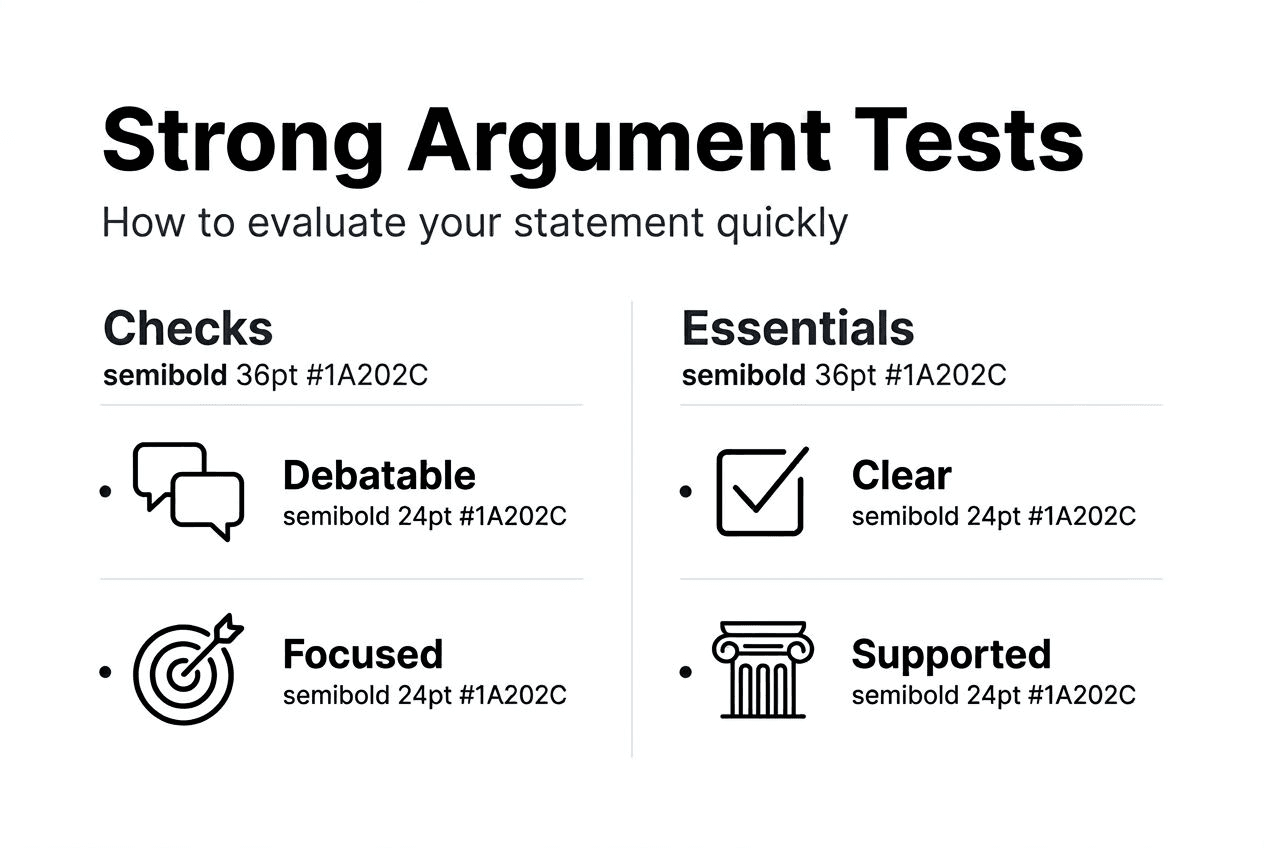
Five key evaluation standards determine statement effectiveness. First, debatable means your claim invites evidence-based disagreement rather than stating facts. Second, concise indicates you've eliminated unnecessary words while preserving meaning. Third, clear ensures readers immediately understand your position without rereading. Fourth, evidence hint signals the type of support you'll provide. Fifth, relevant confirms your claim addresses assignment requirements and academic discourse.
| Criteria | Weak Example | Strong Example |
|---|---|---|
| Debatable | "Pollution harms the environment" (fact) | "Carbon taxes reduce emissions more effectively than voluntary programs" (debatable claim) |
| Concise | "In my personal opinion based on research, social media platforms might potentially have some negative effects on teenagers" (28 words, vague) | "Social media addiction increases anxiety in teenagers by disrupting sleep patterns" (11 words, specific) |
| Clear | "Technology impacts education in various ways" (ambiguous) | "Online learning platforms improve math scores for rural students" (specific outcome) |
| Evidence Hint | "Healthcare is important" (no reasoning preview) | "Universal healthcare reduces emergency room costs by improving preventive care access" (causal logic) |
| Scope | "Shakespeare wrote many plays about power" (too broad) | "Macbeth depicts unchecked ambition as self-destructive through supernatural imagery" (focused) |
Quick self-check questions to improve statement strength:
Iterative revision transforms adequate statements into compelling ones. Read your statement alongside your essay prompt, checking alignment. Remove hedging language like "seems to" or "may suggest" that undercuts your authority. The tips for writing argument essays emphasize this refinement process as essential for academic success.
Clear argument statements directly impact your grades by addressing key rubric elements that instructors prioritize. Understanding these benefits motivates the effort required to craft precise claims.
Grading rubrics consistently reward argument clarity and focus. When instructors assess essays, they look for a defensible position stated early and maintained throughout. Strong argument statements signal you understand the assignment and have organized evidence to support your claim. This alignment with assessment criteria translates to higher scores across evaluation categories.
Reader comprehension improves dramatically with focused argument statements. Students and professors process information more efficiently when they know your exact position from the opening paragraph. This clarity reduces confusion, prevents misinterpretation, and keeps readers engaged as you develop supporting points. Your evidence lands with greater impact when readers understand how each piece connects to your central claim.
Peer review outcomes also improve with strong argument statements. Classmates provide more useful feedback when they can easily identify your position and evaluate whether your evidence supports it. Vague or buried claims lead to comments about organization rather than substantive suggestions about reasoning or evidence quality.
"Academic research demonstrates that essay scores increase by up to 20% when students craft clear, focused argument statements compared to essays with unclear or missing claims, highlighting the strategic importance of this foundational element."
The academic consensus is clear: investing time in argument statement development pays measurable dividends. Professors across disciplines emphasize that strong claims separate good essays from excellent ones. This single sentence shapes your entire writing process, from research decisions to paragraph organization to conclusion strength. Understanding essay structure importance reveals how argument statements anchor every other element of effective academic writing.
Applying these argument statement principles becomes easier with the right tools and support. Samwell.ai helps you craft clear, original argumentative essays while maintaining academic integrity through advanced AI technology.
Our platform combines writing assistance with plagiarism detection, ensuring your argument statements and supporting evidence remain unique. The Semihuman.ai technology generates content that aligns with academic standards while passing AI detection checks. You provide your topic and stance, and our tools help you refine argument statements that meet the criteria covered in this guide.
Time-saving features include the Power Editor for targeted revisions and Guided Essays for structured outlines that build from strong argument statements. These tools help you implement the step-by-step crafting process while maintaining your own voice and ideas. Explore our plagiarism free essays service to see how AI assistance enhances rather than replaces your writing skills.
Ready to strengthen your argumentative writing? Review the argument outline guide 2025 to see how argument statements anchor comprehensive essay structures. Then use Samwell.ai's tools to practice crafting, evaluating, and refining your claims for better grades and clearer communication.
An argument statement is a concise, debatable claim that presents a clear position guiding an academic essay. It differs from a thesis by being more focused and highlighting a single argument rather than previewing multiple points.
Argument statements focus on one debatable claim, while thesis statements may preview main points and broader scope. Thesis statements are often longer, encompassing overall essay direction, whereas argument statements are concise and specific to one position.
Using emotional appeals instead of logical evidence reduces effectiveness in academic writing. Making argument statements too long decreases clarity and reader retention. Confusing argument statements with broader thesis statements weakens focus and undermines essay organization.
Check if the statement is debatable and not a mere fact that everyone accepts. Ensure it is clear and concise, ideally one to two sentences. Verify it hints at evidence and fits the essay scope without exceeding assignment boundaries.