Loading...

Staring at a list of sources but realizing some have no listed author can leave any student second guessing their APA citations. This common challenge affects students whether researching European history, Canadian law, or American social issues. Accurately citing sources without an author is more than a technical step—it protects your academic integrity and makes your work easier to follow. This guide breaks down how to handle missing author information in APA references so you can approach your next assignment with confidence.
| Key Insight | Explanation |
|---|---|
| 1. Identify Source Type | Assess the type of source, as the format affects APA reference structure significantly. |
| 2. Apply APA Rules | Replace missing author information with the title and follow related citation practices. |
| 3. Format Titles Properly | Use correct capitalization and italics based on the source type for clarity and consistency. |
| 4. Arrange Reference List | Organize entries alphabetically, apply hanging indents, and ensure double spacing for professionalism. |
| 5. Verify Reference Accuracy | Cross-check titles, dates, and sources to maintain reliability and credibility in citations. |
Identifying the correct source type is crucial when creating an APA reference for works without an author. Your goal is to understand how different source types impact reference formatting, ensuring accurate and consistent citations. APA citation guidelines provide specific templates for handling various source types.
To identify the source type accurately, examine key characteristics of the document or resource you are referencing. Consider the following factors:
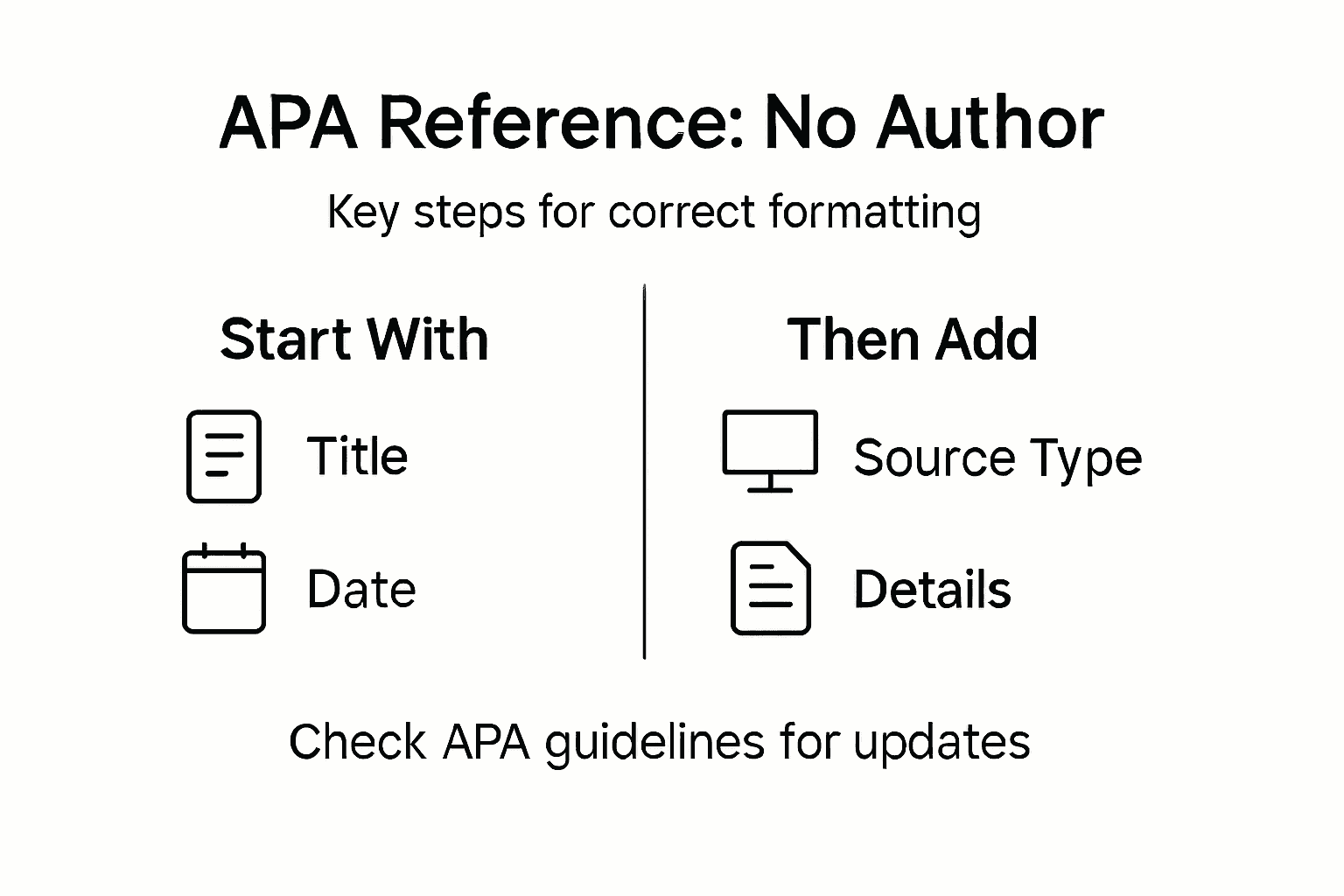
When no author is present, the reference will typically start with the title of the work, followed by the date of publication. Different sources require slightly different approaches:
Here's a quick overview of how APA references differ for common source types without an author:
| Source Type | Reference Start | Formatting Note |
|---|---|---|
| Website | Title in quotation marks | Include URL at end |
| Report | Organization name | Italicize title, add publisher |
| Blog Post | Blog title | Use sentence case, not italicized |
| Social Media Post | Account or username | Direct URL, use post date |
Pro tip: Always prioritize finding the most authoritative version of the source to ensure accurate reference details.
Pro tip: Check multiple sources to confirm the publication details and verify the source type before finalizing your APA reference.
When you encounter a source without a clear author, understanding how to correctly apply APA reference rules becomes critical. APA citation guidelines provide specific instructions for handling sources with missing author information, ensuring your academic writing maintains professional standards.
The primary rule for referencing works without authors is straightforward: replace the author's name with the title of the work. Here are the key steps to apply APA rules correctly:
Depending on the source type, the formatting will vary slightly:
When no author is present, the title becomes your primary identifier in both the reference list and in-text citations.
Pro tip: Always verify the source's credibility and attempt to locate an author before defaulting to a title-based reference.
Properly formatting titles and publication details is crucial for creating accurate APA references when an author is missing. APA reference guidelines provide specific rules for presenting source information with precision and consistency.
When formatting titles in your reference list, follow these critical guidelines:
Here are the key steps for formatting publication details:
This summary highlights APA title formatting rules for references with missing authors:
| Title Type | Capitalization Rule | Italicization |
|---|---|---|
| Book or Report | Sentence case, proper nouns | Italicized |
| Article/Web Page | Sentence case, proper nouns | Not italicized |
| Journal Title | Title case | Italicized |
Consistency in formatting is key to creating professional and credible academic references.
Pro tip: Double-check your reference formatting against the latest APA style guide to ensure complete accuracy.

Successfully arranging your APA reference list requires precision and attention to detail. APA reference list guidelines provide specific instructions for creating a professional and organized bibliography.
When arranging entries in your reference list, follow these essential formatting rules:
Key steps for proper reference list arrangement:
Consistent formatting demonstrates academic rigor and helps readers easily locate sources.
Pro tip: Use a reference management tool to automatically sort and format your entries for maximum accuracy.
Accurately verifying references without an author demands meticulous attention to detail. APA reference guidelines provide critical insights for ensuring your citation meets scholarly standards.
When verifying a reference without an author, focus on these essential elements:
Key verification steps include:
Thorough verification prevents potential academic integrity issues and maintains research credibility.
Pro tip: Always save and screenshot source pages as backup evidence during your verification process.
Struggling with the complexities of formatting APA references without an author? This challenge can slow down your research progress and cause frustration when accuracy matters most. From properly arranging titles to verifying source details, every step demands careful attention. Samwell.ai understands these pain points and offers tailored AI-powered assistance that helps you create flawless APA citations effortlessly. With tools designed to handle missing author scenarios and ensure perfect formatting, you can save time and reduce stress while maintaining academic integrity.
Ready to elevate your academic writing? Visit Samwell.ai now to explore AI-driven solutions that guide you through citation standards including APA and MLA. Use the Power Editor to polish your references or get structured help with Guided Essays that keep your work on track. Don't let citation uncertainty hold your research back. Take control today by leveraging technology that guarantees accuracy and confidence in every reference you create.
To begin an APA reference without an author, use the title of the work instead. Place the title in quotation marks for web sources or write it in italics for reports and books. This ensures proper recognition of the work in your citations.
If the source does not have a publication date, mark it as 'n.d.' for 'no date' in your reference. Make sure to place this designation where you would typically insert the year. This keeps your citation clear and accurate.
For in-text citations without an author, use the title of the work in quotation marks for the initial citation. In subsequent references, you can shorten the title. This method ensures your citations remain identifiable and consistent throughout your document.
When formatting titles in APA references without an author, use sentence case for capitalization and italicize longer works such as reports and books. Remember to also include publication details like the publisher name and the publication date, ensuring accuracy in your reference list.
To verify the accuracy of an APA reference without an author, confirm the title's wording and capitalization, check the publication date, and validate the source's credibility. Use multiple reliable sources to cross-reference these details to maintain academic integrity in your citations.