Loading...

TL;DR:
- In APA 7th edition, in-text citations for works with three or more authors always use the first author's surname followed by et al. from the first mention.
- This rule applies to both parenthetical and narrative citations, with specific punctuation and locator placement rules for direct quotes and multiple sources.
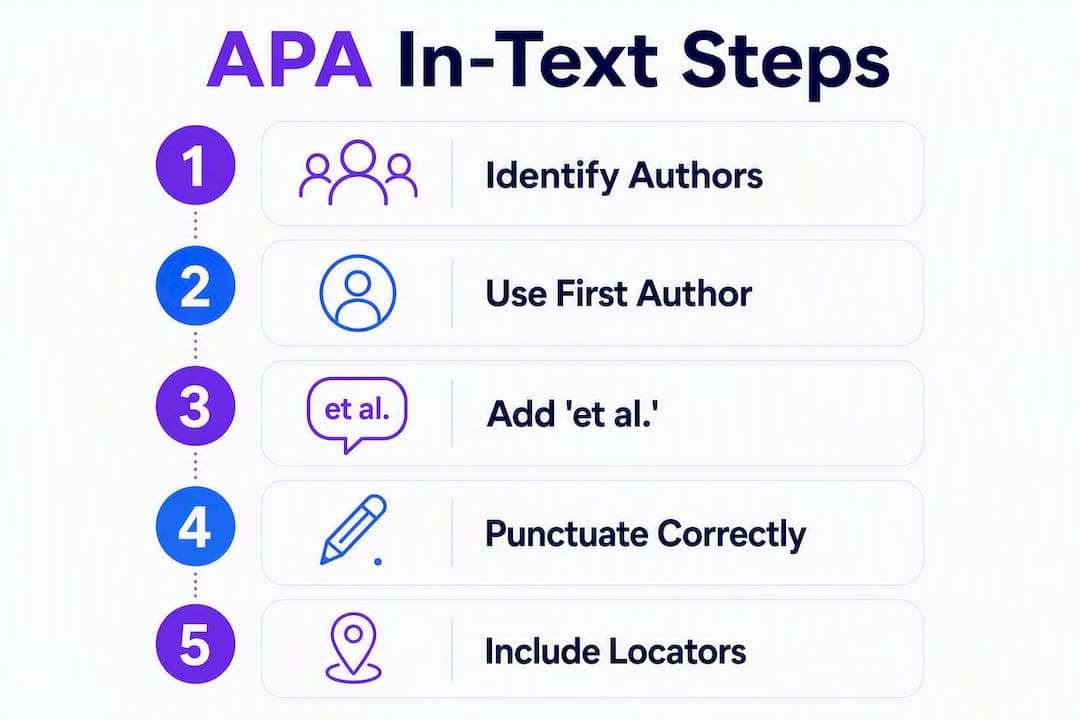
For any work with three or more authors, APA 7th edition requires the first author's surname followed by et al. in every in-text citation, including the very first one. No exceptions, no listing everyone on first mention.
That's the whole rule. Resources like APA Style (apastyle.apa.org), Purdue OWL, and Scribbr all confirm this format. The sections below cover punctuation, direct quotes, ambiguity fixes, and the mistakes that cost students points.
The author–date system is APA's core citation method. For works with three or more authors, you cite only the first author's surname plus et al. every time that source appears, whether in a parenthetical or a narrative citation.
A few punctuation details matter here:
APA 7th intentionally simplified this. Earlier editions required listing all authors on the first mention for works with three to five authors. The 7th edition dropped that entirely, so et al. applies from citation one. The goal is readability: keeping in-text citations concise while the reference list carries complete attribution.
Exceptions worth knowing:
The two formats look similar but place the year differently, and that placement changes the punctuation around it.

| Format | Paraphrase | Direct quote |
|---|---|---|
| Parenthetical | (Martin et al., 2020) | (Martin et al., 2020, p. 45) |
| Narrative | Martin et al. (2020) found that… | Martin et al. (2020) stated "…" (p. 45). |
In a parenthetical citation, everything goes inside the parentheses: author, year, and any locator. In a narrative citation, the author name is part of the sentence and the year follows immediately in its own parentheses. The locator (page number) moves to a separate parenthetical at the end of the quoted passage.
USC LibGuides also note a related rule for two-author works: use an ampersand (&) inside parenthetical citations (Salas & D'Agostino, 2020) but spell out "and" in narrative form (Salas and D'Agostino, 2020). That distinction disappears with three or more authors since you're using et al. either way.
Pro Tip: Write the narrative form when you want to emphasize who conducted the research. Use the parenthetical form when the finding itself is the focus and the authors are secondary.
When you quote directly from a source, you must add a locator immediately after the year, separated by a comma.
The University of Alberta's citation guide confirms this structure: locator comes after the year, always with a comma separating them. A common error is placing the page number outside the parentheses or before the year. Neither is correct.
For sources without page numbers, like websites or ebooks without fixed pagination, use paragraph numbers (para.) or section headings. If neither is available, cite the author and year alone.
Sometimes one sentence draws on several sources at once. APA has a specific format for that.
Example: (Adams et al., 2019; Martin et al., 2020; Wu et al., 2021)
APA Style guidance is explicit: alphabetical order and semicolons help readers parse multiple sources quickly. The most common mistakes here are using commas instead of semicolons and listing sources in the order you found them rather than alphabetically. Both will cost you points on a formatted paper.
Here's where students often get stuck. Two sources can shorten to the exact same form: Cooper et al. (2015) and Cooper et al. (2015). If those are two different papers, your reader has no way to tell them apart.
The fix: add as many subsequent author names as needed to make the citations distinct.
Keep adding names until the two forms no longer match. If adding names still doesn't resolve it (an unlikely but possible scenario), APA allows a shortened title in the parenthetical as a last resort.
Same-surname situations work differently. If two unrelated authors share a surname, add their first initials in every citation: J. Smith et al. (2018) and R. Smith et al. (2018). This applies even when the years differ.
Pro Tip: During proofreading, search your document for every instance of "et al." and check whether any two citations share the same first author surname and year. If they do, expand them. That single search catches most ambiguity errors before submission.
These are formatted and ready to use. Swap in your own author names, years, and page numbers.
Scribbr's APA in-text citation guide includes a reference table covering one, two, and three-or-more author scenarios with worked examples, which is useful for double-checking your own formatting against a clear visual.
Most citation mistakes with et al. fall into a short list of patterns.
Frequent errors:
Proofreading checklist:
Samwell's APA citation checklist can speed up this review, but always verify ambiguity edge cases and identical short forms manually.
Pro Tip: Run a "Find" search for "et al" (without the period) to catch every instance where you forgot the period after al.
For three or more authors, APA 7th requires the first author's surname plus et al. in every in-text citation, with the full author list reserved for the reference entry only.
| Point | Details |
|---|---|
| Core rule | Use first author surname + et al. for three or more authors in every citation, from the first mention onward. |
| Punctuation | Always include a period after al.; never italicize et al.; separate author from year with a comma. |
| Quotes need locators | Add page, paragraph, or timestamp after the year: (Garcia et al., 2021, p. 112). |
| Ambiguity fix | Add subsequent author names until identical short forms are distinct; use shortened titles only as a last resort. |
| Samwell | Samwell's citation-check tools and APA checklist help catch formatting errors before submission. |
The rule itself is simple. What catches students is the gap between knowing the rule and applying it consistently across a 20-page paper with 40 citations.
The most common failure point isn't the format. It's forgetting to check whether any two sources in the paper shorten to the same form. Students add citations throughout the writing process, and by the time the paper is done, two Cooper et al. (2018) entries can be sitting in the text without anyone noticing. A batch search for et al. at the end, cross-referenced against the reference list, catches this in under five minutes.
A second pattern: writers who switch between parenthetical and narrative formats mid-paragraph without adjusting punctuation. The year moves, the comma placement changes, and the page number ends up in the wrong spot. Reading citations aloud, one by one, is a surprisingly effective fix.
Samwell's Power Editor and citation-checking features can flag formatting inconsistencies across a full draft. For ambiguity cases and identical short forms, though, a manual pass is still the most reliable approach. Automated tools don't always catch two sources that look different in the reference list but collapse to the same in-text form.
Writing a research paper means managing dozens of citation decisions at once. Samwell takes the mechanical side off your plate: its citation-management tools check APA formatting, flag missing periods after et al., and verify that in-text citations match their reference list entries.
The Power Editor lets you target specific passages for revision, and Guided Essays give you a structured outline before you write a single sentence. Over 1,000,000 students from leading universities already use Samwell for exactly this kind of support. For ambiguity edge cases and identical short forms, you'll still want a manual check, but the routine formatting work is handled. Start with Samwell and spend your time on the argument, not the punctuation.