Loading...

TL;DR:
- Proper APA formatting ensures clarity and professionalism in academic writing by focusing on consistent structure.
- Attention to details like margins, font choice, heading levels, and reference spacing helps avoid unnecessary points deductions.
A single misplaced period on a heading, a missing hanging indent on your references page, or the wrong font choice can strip points from an otherwise excellent paper. APA formatting is not designed to trip you up, but its rules are precise enough that even strong writers miss details under deadline pressure. This step-by-step checklist covers every major APA 7th edition requirement, from margins and title pages to references and heading levels, so you can submit with real confidence instead of crossing your fingers.
| Point | Details |
|---|---|
| Margins and spacing | Use 1-inch margins and double spacing throughout your paper every time. |
| Consistent font choice | Select one approved font (like Times New Roman 12-pt) and stick with it from start to finish. |
| Proper title page setup | Follow student APA title page guidelines, including correct order and bold formatting. |
| Organized references | Begin your References list on a new page and apply a hanging indent to every entry. |
| Watch out for common errors | Double-check for mistakes like skipped heading levels, inconsistent fonts, and extra spaces. |
With the rationale for a checklist established, let's break down each essential step in formatting your APA paper.
The foundation of any APA paper is its layout. Get these fundamentals right before you type a single word of content, and you will save yourself a frustrating round of reformatting later.
According to the student paper setup guide, APA 7th edition requires 1-inch margins on all sides, double-spacing throughout the entire document, left-aligned text with 0.5-inch paragraph indents, and page numbers in the top right corner starting from page 1 on the title page. No running head is required for student papers unless your instructor specifically asks for one.
Fonts matter more than most students realize. The approved APA typefaces include 12-pt Times New Roman, 11-pt Calibri, 11-pt Arial, 10-pt Lucida Sans Unicode, or 11-pt Georgia. The critical rule is consistency: pick one font and use it everywhere throughout your paper, including headings, body text, references, and figure labels.
Here is a numbered checklist to run through before you write:
Following the APA format step-by-step means treating your document settings as the first draft, not an afterthought.
Pro Tip: Set up a blank APA template in your word processor before you start writing. Getting the margins, font, spacing, and page numbers correct once in a template file means you never have to redo it again for future papers.
Now that the core layout is set, let's explore how to create a flawless title page and understand APA's unique heading structure.
Your title page makes the first impression. For a student paper, every element on page 1 is centered. The student title page includes, in this order: the bold title of your paper (in title case), your full name, your department and university affiliation, the course number and name, the instructor's name, and the assignment due date (formatted like May 2, 2026). There is no page label saying "Title Page." The elements simply appear centered in the upper half of the page.

Here is a quick reference table for all five APA heading levels:
| Heading level | Format | Example |
|---|---|---|
| Level 1 | Centered, bold, title case | Literature Review |
| Level 2 | Flush left, bold, title case | Theoretical Framework |
| Level 3 | Flush left, bold italic, title case | Study Procedures |
| Level 4 | Indented 0.5in, bold, title case, period, text follows | Participant Recruitment. Text begins here. |
| Level 5 | Indented 0.5in, bold italic, title case, period, text follows | Data Collection Methods. Text begins here. |
The APA heading structure requires that you never skip levels. If your paper uses Level 1 and needs subsections, go to Level 2 next. Never jump from Level 1 directly to Level 3. Also, per the APA formatting checklist, you should repeat your paper's bold title as a Level 1 heading at the top of page 2 (where your text begins). You do not need an "Introduction" heading because APA assumes the first paragraphs are always introductory.
Key points for title pages and headings:
For abstracts, the rules are equally specific. The abstract requirements specify a new page after the title page with "Abstract" as a centered bold heading, 150 to 250 words written as a single block paragraph with no indent, and optional keywords listed below. Many undergraduate instructors do not require an abstract, but always check your assignment guidelines. When it is required, the abstract is the second page of your paper, before the body text begins on page 3.
You can see a complete APA essay title page example that walks through each element with real formatting applied.
Expert note: One of the most common heading mistakes is adding a period to Level 1, 2, or 3 headings. Periods only appear in Level 4 and Level 5 headings because those are the only levels where text continues on the same line as the heading. Every other level ends without punctuation.
With your paper's headings in order, let's focus on the other elements that must follow APA style: references, tables, and figures.
Your references page is one of the most scrutinized parts of any paper. The References page must start on a new page after your conclusion, with the word "References" centered and bolded as the heading. Every entry is double-spaced, listed alphabetically by the first author's last name, and formatted with a 0.5-inch hanging indent. That means the first line of each entry is flush left, and every subsequent line is indented. Getting this indent wrong is one of the most common formatting errors submitted to instructors.
For tables and figures, the APA guidelines specify that you should embed them in your text close to where they are first mentioned, or place them all after the references section. Each table and figure is numbered sequentially (Table 1, Table 2, Figure 1, etc.). Table titles appear in italic title case above the table. Figure titles appear the same way, below the figure label. Notes go below in plain text. Use the same font as the rest of your paper and make sure every table or figure is self-contained, meaning a reader could understand it without reading your surrounding text.
Here is a comparison of common mistakes versus correct practices:
| Common mistake | Correct practice |
|---|---|
| Alphabetizing by first name instead of last name | Always sort by the author's last name |
| Forgetting the hanging indent | Use 0.5-inch hanging indent for every reference entry |
| Writing "Figure 1." without italics | Italicize the label and the title |
| Placing a table before it is mentioned in text | Mention the table first, then let it appear close after |
| Using a different font inside a table | Use the same approved font throughout |
| Leaving extra space before "References" heading | Let double-spacing handle all spacing |
Key reminders for references and visuals:
Pro Tip: After finishing your references page, sort your in-text citations and your reference list side by side. Every author name that appears in your text should appear in your references, and every reference entry should be cited at least once in the body of your paper. This two-way check catches orphaned citations fast.
Even following the checklist, subtle errors can creep in. Here are the most frequent mistakes and how to prevent them.
Common APA formatting mistakes include inconsistent fonts across different sections, wrong indentation sizes, skipping heading levels, and adding periods to the wrong heading levels. These are not obvious errors, which is exactly why they appear so often. A paper that looks polished at a glance can still carry several of these hidden problems.
The edge cases outlined by Royal Roads are especially worth knowing: never use a single subsection under a heading (use at least two or remove the subsection entirely), never label your headings with numbers or letters, never add extra blank lines around headings, and always use one space after periods, not two.
Here are the top formatting mistakes to check for before you submit:
Review the APA 7 format guide for a deeper look at how these rules interact when you are working on longer research papers with multiple sections.
Pro Tip: Read your paper backwards section by section when doing a final formatting check. This breaks the flow of content and forces you to see structure instead of meaning. You will spot alignment issues, rogue fonts, and missing indents much faster this way.
Here is the perspective most formatting guides skip: APA is not bureaucratic busywork. It is a shared language that signals you take accuracy seriously.
When your paper is consistently formatted, instructors and peer reviewers focus entirely on your ideas rather than being distracted by structural inconsistencies. A correctly formatted reference list tells your reader that you verified your sources, checked every detail, and respect the scholarship you are citing. That is not a small thing. It shapes how your work is received before a single argument is evaluated.
There is also a long-term advantage that rarely gets mentioned. Students who internalize APA early find the transition into graduate research, academic publishing, and professional reports significantly smoother. Journals, grant applications, and conference submissions all have strict formatting requirements. Building the habit now means you spend less mental energy on mechanics later and more on the ideas themselves.
The citation checklist insights make a strong case for thinking of citation styles not as style constraints but as quality signals. A paper with flawless citations and formatting broadcasts credibility in the same way that a polished resume signals professionalism to an employer.
Treat your formatting checklist as the last act of intellectual honesty before submission. Not as a chore, but as your signature on the work.
Ready to turn these steps into stress-free action? Managing every element of a checklist manually works, but it takes significant time and still leaves room for human error.
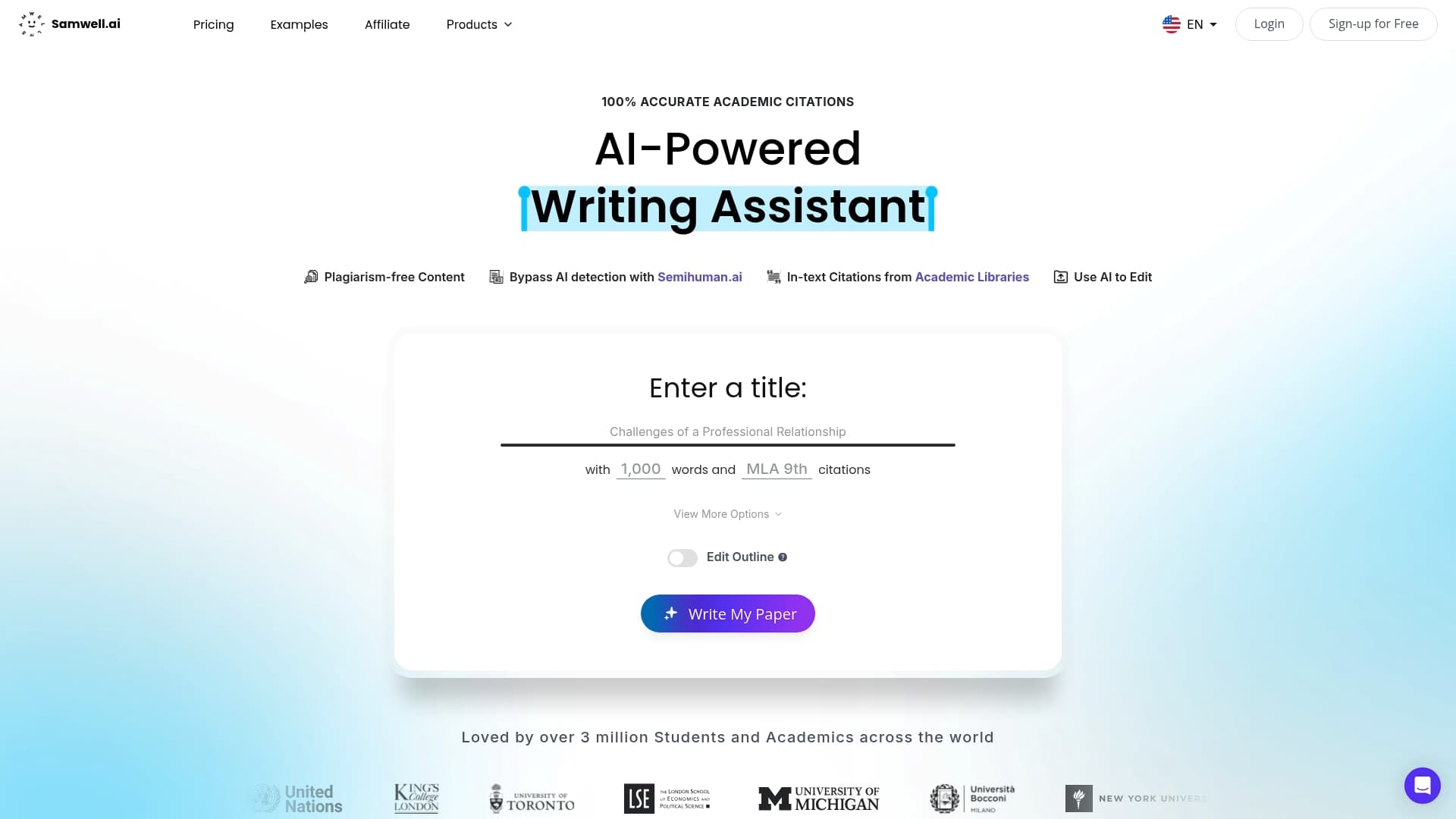
Samwell.ai is built specifically for students and academic professionals who want to produce well-structured, properly formatted research papers without spending hours checking every rule manually. The platform handles APA citation formatting, references, and structure in real time, while its Power Editor lets you refine and expand individual sections with precision. Guided Essays keep your paper's outline logical and properly leveled from the first draft. With over 1,000,000 students already using it, Samwell.ai brings together AI efficiency and academic integrity so you can focus on your ideas while the formatting takes care of itself.
APA 7th edition accepts several fonts: 12-pt Times New Roman, 11-pt Calibri, Arial, Georgia, and 10-pt Lucida Sans Unicode, with consistent use of your chosen font throughout the entire paper.
A running head is not required for student papers; it is only needed when your instructor specifically requests one in the assignment guidelines.
Start the References page on a new page with "References" centered and bolded as the heading, then list all entries alphabetically with a 0.5-inch hanging indent and double-spacing throughout.
APA style does not use numbers or letters for headings; format each heading according to its prescribed Level 1 through Level 5 structure based on its place in your paper's hierarchy.
Only one space follows a period at the end of any sentence in APA format; use your word processor's find-and-replace tool to catch any double spaces before submitting.