Loading...

For any source with two authors, name both authors every time you cite it. In narrative citations, use "and" between the names. In parenthetical citations, use "&." The reference list inverts both names and also uses "&."
Here are the two formats at a glance:
The page number goes inside the parenthetical at the end of the sentence for direct quotes. For paraphrases, no page number is required, though you may include one.
The core rule from APA's author–date citation system: always include both authors' names, and switch between "and" and "&" depending on where the citation sits in your sentence.

Why the distinction? APA deliberately uses "&" inside parentheses and "and" in narrative citations so readers can instantly tell whether the citation is woven into the sentence or appended as a parenthetical note. It is a small typographic signal with a real function.
Paraphrase, narrative:
Smith and Jones (2020) found that adolescents who slept fewer than seven hours showed measurable declines in working memory.
Paraphrase, parenthetical:
Adolescents who slept fewer than seven hours showed measurable declines in working memory (Smith & Jones, 2020).
Direct quote, narrative:
Smith and Jones (2020) noted that "working memory capacity dropped by a third in sleep-restricted adolescents" (p. 47).
Direct quote, parenthetical:
"Working memory capacity dropped by a third in sleep-restricted adolescents" (Smith & Jones, 2020, p. 47).
For direct quotes, the page number follows a comma after the year inside the closing parenthesis. The period ending the sentence goes after the closing parenthesis, not before it.
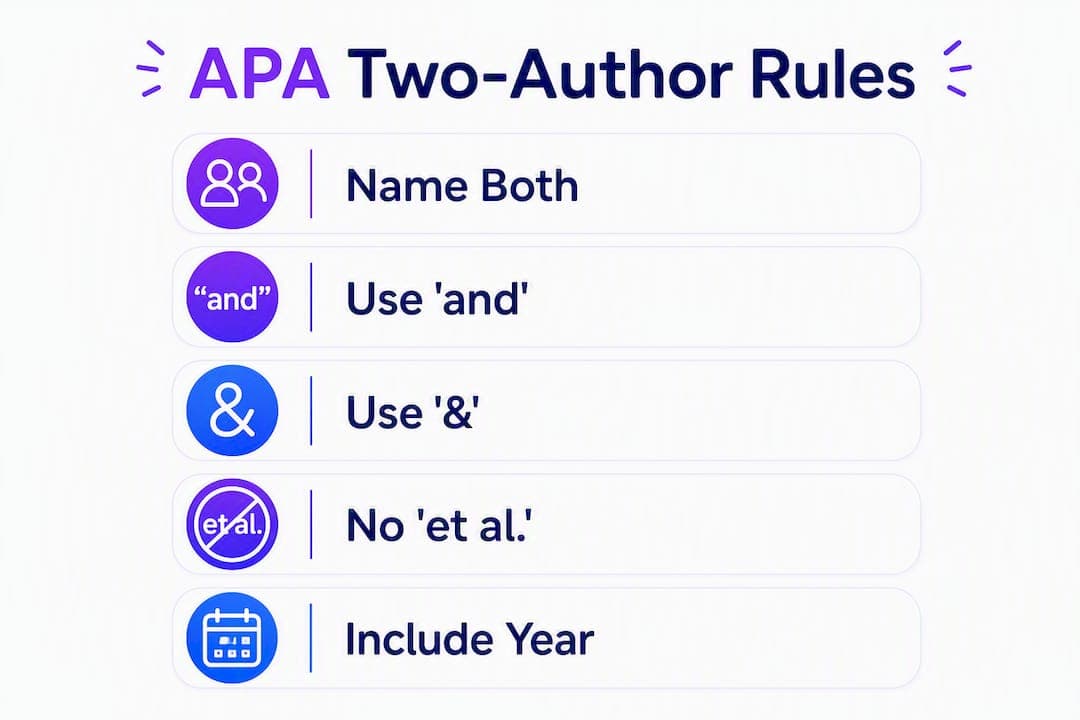
APA 7th edition is explicit: never use "et al." for a source with only two authors. That shorthand starts at three or more authors. Every citation of a two-author work names both people, every single time, no exceptions. Purdue OWL reinforces this with side-by-side examples that make the contrast clear.
Pro Tip: If an author has a long hyphenated surname (e.g., García-Martínez), reproduce it exactly as published — hyphen included — in every in-text citation. Shortening or dropping the hyphen creates an attribution mismatch with your reference list.
The canonical template from APA Style inverts both names, uses initials, separates elements with commas, and places an ampersand before the second author's inverted name.
Template: Author, A. A., & Author, B. B. (Year). Title of work. Publisher/Source.
The three examples below are ready to adapt:
| Source type | Example reference entry |
|---|---|
| Book | Patel, R. K., & Nguyen, L. M. (2019). Cognitive load and learning design. Routledge. |
| Journal article (with DOI) | Harris, C. D., & Cook, S. F. (2021). Sleep architecture in adolescents. Journal of Sleep Research, 30. https://doi.org/ |
| Webpage (with URL) | Rivera, T. A., & Osei, K. B. How screen time affects teen sleep. Sleep Foundation. https://www.sleepfoundation.org/example |
A few formatting details that trip people up:
The APA reference guide PDF collects the most commonly used templates in one place and is worth bookmarking for quick checks on book chapters, reports, and other source types.
When an edited book has two editors in the author position, add "(Eds.)" after the second name. Format the names identically to how you would for two authors.
Example: Okafor, J. T., & Brennan, M. S. (Eds.). (2022). Handbook of developmental psychology. Springer.
In an in-text citation for a chapter within that book, you cite the chapter's authors, not the editors.
If two different works you are citing happen to share an author surname, APA requires you to include initials in every in-text citation for those works, even when the first names differ.
Example: (J. M. Smith & Torres, 2018) vs. (R. L. Smith & Park, 2021)
Always include the year. If the same two authors published in 2019 and 2022, the year is the only thing distinguishing the citations in your text. Dropping it creates ambiguity that your reader cannot resolve.
APA guidance is straightforward here: reproduce names exactly as they appear on the published work. If the cover reads "García-Martínez," that hyphen stays in every citation and reference entry. Altering it can cause indexing errors in databases.
Run through this list before you hand in any paper with two-author sources:
Pro Tip: Check your reference list at the end of the writing process, not just the beginning. Authors get added, dropped, or reordered during drafting, and a reference entry that was correct in your outline may no longer match the in-text citation in your final draft.
For a broader look at APA in-text citation rules across source types, that guide covers the full range of scenarios beyond two-author works.
For a two-author APA citation, name both authors every time, use "and" in narrative citations, "&" in parenthetical citations, and "&" in the reference list between inverted names.
| Point | Details |
|---|---|
| Always name both authors | Never use "et al." for two-author works; both names appear in every in-text citation. |
| "And" vs. "&" placement | Use "and" in narrative citations; use "&" in parenthetical citations and in the reference list. |
| Reference list format | Invert both names, use initials, separate with commas, and place "&" before the second author. |
| Special cases | Add initials to disambiguate shared surnames; reproduce hyphenated names exactly as published. |
| Samwell for citation checks | Samwell's Power Editor and citation tools help catch formatting errors before submission. |
Most citation errors in academic papers are not random. They cluster around a handful of predictable spots: the "and" vs. "&" switch, the et al. temptation for short author lists, and the reference list where "and" sneaks in where "&" belongs. These are not obscure edge cases. They show up in papers from undergraduates and graduate students alike, and they matter because a citation that does not match its reference entry is, technically, an unverifiable source.
The deeper issue is that citation consistency signals something about the writer's attention to detail. A reviewer who spots three "and" errors in parenthetical citations will wonder what else was skimmed. That is not a fair judgment, but it is a real one.
The two-author rule is actually one of the simpler ones in APA. There is no et al. calculation, no threshold to remember after the first citation. You name both people, every time, and you flip the conjunction based on where the citation sits. Getting that right consistently, across a 30-page paper, is a proofreading discipline more than a knowledge problem. Check your in-text citations and reference entries together, not separately.
Formatting two-author citations correctly across a full paper takes focus, and it is easy to let a stray "and" slip into a parenthetical citation on page 18. Samwell's Power Editor flags exactly these kinds of mechanical errors in real time, so you catch them during writing rather than during a last-minute proofread.
The Guided Essays feature structures your paper with properly formatted citation placeholders from the start, which means your reference list builds alongside your draft instead of getting reconstructed from memory at the end. For students who want to spend less time on formatting mechanics and more time on argument, that shift is concrete.
If you want citation checks built into your writing workflow, try Samwell and see how much faster a clean reference list comes together.
The rules in this article come directly from official APA guidance and established university writing centers. For edge cases or source types not covered here, these are the resources worth consulting:
| Resource | What it covers |
|---|---|
| APA Style: Author–date citation system | In-text rules for narrative vs. parenthetical citations, et al. thresholds, and disambiguation |
| APA Style: Elements of reference list entries | Reference list formatting, name inversion, initials, and ampersand placement |
| APA Reference Guide PDF | Quick templates for books, journal articles, and edited book chapters |
| Purdue OWL: In-Text Citations | Accessible examples for multiple author configurations, including two-author works |
For anything beyond these resources, the Publication Manual of the American Psychological Association (7th ed.) is the definitive authority. It covers complex cases like group authors, anonymous works, and translated sources that shorter guides do not address in full.