Loading...

TL;DR:
- Small errors like missing commas or incorrect DOIs can undermine credibility and cause points loss.
- The APA Style Checklist guides proper formatting, citation accuracy, and ethical language use.
- Mastery requires understanding principles beyond checklists, including reviewing updates and complex citation scenarios.
One missed comma in a reference entry. A forgotten DOI. An in-text citation that doesn't match the reference list. These small errors add up fast, and in academic writing, they can cost you points, trigger plagiarism flags, or undermine the credibility of your entire paper. The APA Style Checklist covers everything from preparation and title page setup to citations, grammar, punctuation, and references, including specific mechanics like page numbering, inclusive language, one space after periods, and using surnames only in citations. This guide gives you a practical, item-by-item checklist to catch every error before you submit.
| Point | Details |
|---|---|
| APA basics matter | Getting formatting details right prevents academic penalties and boosts credibility. |
| Checklist for accuracy | Walk through each checklist item to catch overlooked citation and reference errors. |
| Examples prevent mistakes | Double-check official examples for common source types and tricky references. |
| Stay ethical | Citing all sources and using inclusive language upholds academic integrity. |
| Understand updates | Regularly review APA updates so you don’t get caught using outdated rules. |
Before you start checking individual citations, it helps to understand the full landscape of what APA style actually requires. Most students focus only on the reference list and miss the formatting mechanics that reviewers and professors notice immediately.
The student paper setup checklist specifies 1-inch margins on all sides, double-spacing throughout, and approved fonts like Times New Roman at 12pt. Your title page must include the paper title, your name, institutional affiliation, course name, instructor name, and due date. Page numbers go in the top-right header starting at page 1. These aren't optional style preferences. They're required formatting standards.
Beyond layout, APA citation success depends on four core areas:
Refer to the student paper format guide for a full breakdown of layout requirements, or browse an APA 7th essay example to see how these elements look in a real paper.
Pro Tip: Print your paper and check formatting manually at least once. Screen reading causes you to skip over spacing and indent errors that jump out on paper.
With the framework in mind, here's a step-by-step checklist to ensure your paper meets every APA expectation. Work through these in order before submitting any academic paper.
As the APA Style Checklist notes, specific mechanics like page numbering, inclusive language, one space after periods, and surnames in citations are all required, not suggestions.
"The reference list is one of the most error-prone sections of any academic paper. A single mismatch between an in-text citation and its reference entry can raise questions about source accuracy and academic integrity."
For source-specific formatting, the official reference examples from APA are your most reliable resource. Also check the APA references guide for 2025 and 2026 updates.
Pro Tip: Use the official APA Style website's reference examples when formatting unusual sources like dissertations, social media posts, or translated works. Don't guess.
Having your checklist is key, but seeing real-world reference examples ensures you catch subtle differences. The table below shows how APA 7th edition formats the most common source types, based on official APA reference examples.

| Source type | APA 7th format example | Key notes |
|---|---|---|
| Journal article | Author, A. A., & Author, B. B. (Year). Title of article. Journal Name, Volume(Issue), pages. https://doi.org/xxxxx | DOI as full URL; no "doi:" prefix |
| Book | Author, A. A. (Year). Title of work: Capital letter also for subtitle. Publisher. | No publisher location in APA 7th |
| Webpage | Author, A. A. (Year, Month Day). Title of page. Site Name. URL | Include retrieval date only if content changes |
| Dataset | Author, A. A. (Year). Title of dataset (Version) [Dataset]. Repository. https://doi.org/xxxxx | Label dataset type in brackets |
A few patterns stand out immediately. APA 7th dropped the publisher location requirement that APA 6th included. That's one of the most common holdover mistakes. DOIs must now appear as full hyperlinks, not the old "doi:" shorthand. Author names always use initials, never full first names.
Quick reference tips:
These distinctions are subtle but graded. A professor reviewing 30 papers will notice inconsistencies immediately.
Even the best checklists only work when you know what to avoid. Here's how to stay error-free.
The most frequent APA errors fall into predictable categories. Knowing them in advance puts you ahead of most students:
Academic integrity goes beyond formatting. Using inclusive, bias-free language is required by APA guidelines. Plagiarism, even unintentional, can result from missing citations on paraphrased content. Always document your sources as you write, not after.
For fixing specific issues, the guide on fixing reference errors covers edge cases. You can also review the citation styles checklist for a broader view, or work through common pitfalls using the guide to master APA citation mistakes.
Pro Tip: After completing your reference list, read it out loud entry by entry while comparing each one to its in-text citation. This slow, deliberate check catches mismatches that a quick scan misses entirely.
Here's something most citation guides won't tell you: a checklist is a floor, not a ceiling. It catches the obvious errors. It doesn't teach you judgment.
Seasoned academics know that the hardest APA problems aren't covered by any checklist. What do you do when a source has no date? When an author publishes two papers in the same year? When you're citing a translated work with both an original and a translation date? These edge cases require you to understand why APA rules exist, not just what they say.
APA formatting is built around one core goal: giving readers enough information to locate and verify your sources. When you internalize that principle, edge cases become manageable. You ask yourself, "Does this entry give a reader everything they need?" rather than "Does this match the template?"
Revisiting APA updates regularly also matters. APA releases guidance updates and clarifications that don't always make it into third-party guides. Bookmarking the official APA Style website and checking it when you encounter unusual sources is a habit that separates careful writers from careless ones.
For deeper strategy, the advanced citation list strategies guide covers nuanced scenarios that go well beyond the basics. Real mastery comes from repeated practice, not one-time checklist use.
You now have a complete APA citation checklist, a comparison table for common source types, and a clear picture of where errors hide. The next step is making sure you never have to catch these mistakes alone.
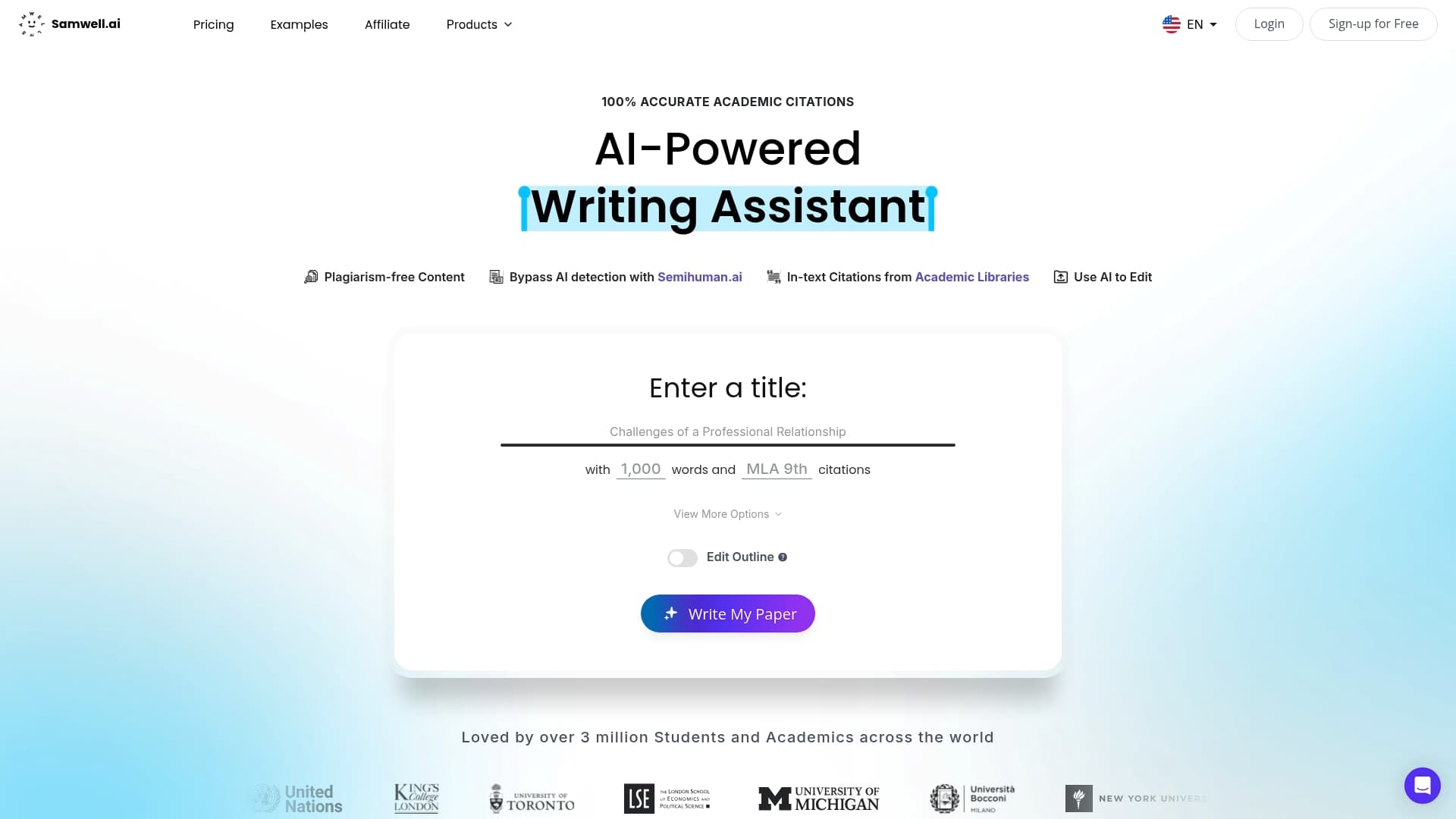
Samwell.ai is built for exactly this. Over 1,000,000 students and academic professionals use the platform to generate and refine research papers with built-in citation compliance for APA, MLA, and more. The AI checks for citation accuracy, flags formatting issues, and helps you produce papers that meet academic integrity standards from the first draft. Whether you need AI-powered research paper help or want to use the research paper generator to build a fully cited paper from scratch, Samwell.ai gives you the tools to write with confidence and submit without second-guessing every reference.
Students most often miss verifying that in-text citations match the reference list exactly, especially with et al. usage and DOI formatting. A mismatch between the two is one of the highest-risk errors in academic papers.
Yes, APA 7th remains current in 2026 and is the standard for academic formatting and citation. Avoid using APA 6th edition rules, which include outdated requirements like publisher locations and the "doi:" prefix.
No. While tools help identify common issues, manual verification is essential for nuanced or edge-case APA citation situations that automated systems often miss.
When no author is listed, move the title to the author position and alphabetize the entry by the first significant word of the title on your reference page.
Yes. APA guidelines require the use of inclusive and bias-free language throughout all academic papers, as outlined in APA Ethical Standard 8.11.