
Loading...

An effective claim for an argumentative essay is a specific, contestable statement you can actually prove with evidence, not a fact or a feeling. It usually lands at the end of your introduction, where it sets up everything that follows. If you remember nothing else, remember three words: contestable, specific, provable.
TL;DR:
- A strong claim must be contestable, specific, manageable, and include a roadmap to guide the essay's structure.
- Refining claims is an iterative process that requires narrowing the scope, clarifying language, and aligning with evidence found during research.
- Effective claims acknowledge counterarguments through concession clauses to demonstrate consideration of opposing views and strengthen credibility.
- Evidence should be linked to the claim with explicit reasoning called warrants, which clarify how the proof supports the argument.
- Revising the claim after drafting is crucial, as new evidence and insights often reshape the initial statement into a sharper, more defendable position.
A claim, sometimes called a thesis, is the sentence that takes a side. It's the one line a reasonable, informed person could push back on. That's the test most writing centers use, and it's the fastest way to tell a real claim from a fact dressed up as one. "Social media use has increased since 2010" isn't a claim. Nobody argues with it. "Social media platforms have made political polarization worse by rewarding outrage over accuracy" is a claim, because someone could disagree and mean it.
The Harvard College Writing Center frames this as an arguable assertion that's specific, focused, and backed by evidence. Three characteristics separate the claims that work from the ones that collapse under a reader's first question:
Skip any one of these and the essay wobbles. Skip contestability and you're writing a report. Skip specificity and you're writing three vague pages that go nowhere in particular.
A weak claim doesn't just weaken your opening paragraph. It weakens every paragraph after it. Without a focused central claim, essays drift into summary and description, because there's no argument pulling the evidence into a shape. The UW–Madison Writing Center makes this point directly: the claim organizes your subclaims, and each topic sentence should trace back to it like a spoke to a hub.
Think of your claim as the spine of the essay. Every topic sentence attaches to it. Every piece of evidence has to answer to it. When the claim is vague, paragraphs start floating free of each other. You get evidence with no clear job, transitions that feel forced, and a conclusion that restates the intro instead of resolving anything. A precise claim prevents that drift before it starts.
Seeing the edit matters more than hearing the rule. Here are three claims revised from vague to workable, with the reasoning behind each change.
Weak: "Homework is bad for students." Strong: "Assigning more than one hour of homework per night in middle school harms student well-being more than it improves academic performance." The revision names an actor (middle schoolers), a threshold (one hour), and a comparison (harm versus benefit), which gives it something to prove.
Weak: "Climate change is a problem." Strong: "Local governments, not just national policy, should lead climate adaptation because they respond faster to region-specific flooding and heat risks." This version picks a side on a real disagreement (who should lead) instead of restating something everyone already accepts.
Weak: "The novel is about isolation." Strong: "In Frankenstein, Victor's isolation is self-imposed and drives the novel's tragedy more than the creature's rejection by society." Swapping description for interpretation turns a plot summary into an argument someone could contest.
A good claim takes a stand, gives the reader a reason to keep reading, and stays narrow enough that you can actually back it up in the pages you have.
For a standard five-paragraph assignment, a model claim might read: "School start times should shift later because sleep research shows teenagers' academic performance and mental health both suffer under early schedules." That's one idea, one clear position, and three visible subclaims (sleep science, academics, mental health) waiting to become body paragraphs.
Building a claim is rarely a one-shot process. It's closer to sculpting: you start with a rough block and cut away the vague parts.
The Indiana University Writing Tutorial Services recommend testing reasonableness, specificity, and significance before you write a single body paragraph, since fixing the claim early saves you from rewriting three pages later.
Pro Tip: Write your claim, then delete every word that a classmate couldn't argue against. Whatever survives is your actual argument.
Evidence doesn't speak for itself. A quote or statistic sitting next to your claim proves nothing until you explain the connection. That explanation is called a warrant, and skipping it is the single most common reason strong evidence still earns a weak grade. As one guide on argument structure puts it, a claim becomes provable only through explicit reasoning that links the evidence back to the assertion rather than leaving the connection implied.
A workable pattern looks like this:
Strengthen this further by addressing counterevidence directly. Acknowledging a study that found no effect, then explaining why your case differs, makes the claim look researched rather than one-sided.
Most weak claims fail in one of three predictable ways. Here's how to spot each one and fix it fast.
Purdue OWL suggests revisiting your claim after drafting the body, since the essay you actually wrote often argues something sharper than the sentence you started with.
Refining a claim benefits from feedback, not just a checklist. A guided essay tool can help students outline a claim and its subclaims before drafting begins, while an editor can help tighten wording once a draft exists. Built-in originality checks and citation support for MLA and APA formatting handle the mechanical side, so revision time goes toward sharpening the argument itself. For more on structuring claims, see this guide to strong thesis statements. This piece was edited by Tilen, who covers academic writing strategy for Samwell. Treat any AI-assisted draft the way you'd treat a peer review: useful for spotting weak spots, but the final claim still needs to match your instructor's specific assignment.
The same topic produces different claims depending on who's reading and why. A claim written for a professor grading against a rubric needs to signal academic rigor. It should name the specific mechanism you're arguing (causal, comparative, evaluative) rather than gesture at a general opinion. A claim aimed at a general public audience, say for a op-ed style assignment, can lean more on stakes and consequences than on technical framing, since the goal is persuasion rather than demonstrating command of a discipline's methods.
Purpose matters as much as audience. If the assignment asks you to evaluate, your claim needs a judgment word in it ("is more effective," "fails to address"). If it asks you to compare, your claim needs to name both sides of the comparison explicitly rather than favoring one and mentioning the other in passing. Ask yourself who's grading this and what they're checking for before you lock in your wording. A claim that impresses a literature professor by leaning on close textual interpretation might read as unsupported opinion in a policy class that expects data. Match your vocabulary and evidence type to the discipline the assignment sits in, and the claim will feel like it belongs in that conversation rather than borrowed from a different one.
These two get confused constantly, and the difference shapes how you write the claim itself. A persuasive essay claim is allowed to lean on emotional appeal and personal conviction. It can say "we should" or "you should" and rest partly on values. An argumentative essay claim carries a heavier evidentiary burden. It needs to acknowledge the other side exists and hold up against logical scrutiny, not just emotional appeal.
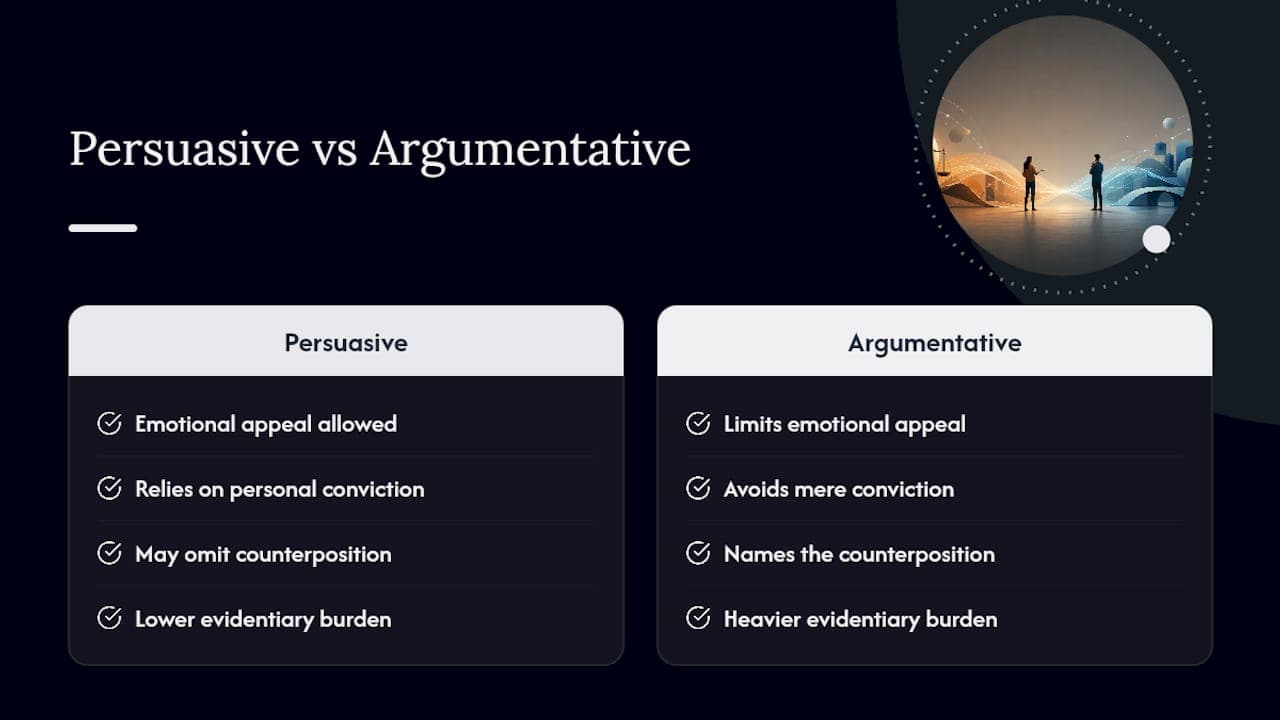
Practically, that means an argumentative claim tends to be more hedged and more precise. Where a persuasive claim might say "banning phones in schools is the right call," an argumentative claim says "banning phones during instructional hours reduces measurable classroom distraction more effectively than voluntary policies, based on district-level attendance and grade data." The second version anticipates that someone will ask for proof and builds the answer into the sentence.
Argumentative claims also tend to name the counterposition somewhere nearby, even if only in the next sentence, because the genre assumes a skeptical reader. Persuasive writing can address a friendlier one. If your assignment says "argumentative," treat every clause of your claim as something you'll need to defend with a citation, not just a conviction.
The strongest claims don't ignore opposition. They anticipate it. One way to do this directly in the claim sentence is to use a concession clause: "While some argue X, the evidence more strongly supports Y because Z." That structure does two things at once. It shows you've considered the other position, and it tells the reader exactly why your side wins the comparison.
This matters more than it sounds. A claim that never acknowledges disagreement often reads as naive, even when the argument itself is sound, because the reader assumes you haven't tested it against the obvious objection. Academic claims work best when they acknowledge complexity rather than presenting a clean win or lose position, since most real arguments live in that messier space.
You don't have to cram the entire counterargument into the claim sentence itself. Sometimes it's enough to signal that you know it exists, then handle it fully in a dedicated paragraph later. What you can't do is pretend the opposition doesn't exist, because your reader almost certainly already knows it does.
Scope mismatches sink more essays than bad ideas do. A claim built for a 20 page research paper collapses inside a five paragraph essay, because there's no room to support it. The fix is almost mechanical: add a qualifier that shrinks the claim to fit the space.
"Social media harms teenagers" is a book. "Instagram's algorithm-driven feed increases anxiety in teenage girls more than time spent on messaging apps" is an essay. The Indiana University Writing Tutorial Services recommend narrowing scope as one of the most effective revision moves available, specifically because it's the fastest way to make an unwieldy claim provable within a fixed page count.
Broadening works in reverse, and it's needed less often but does come up when a claim is too narrow to fill the required length. If your claim only supports two paragraphs of evidence, widen the actor or add a second dimension: shift from "my school's start time" to "public middle schools' start times" to give yourself more evidence to draw from. Either direction, the adjustment happens through the claim's specific nouns and qualifiers, not through padding the body paragraphs with repetition.
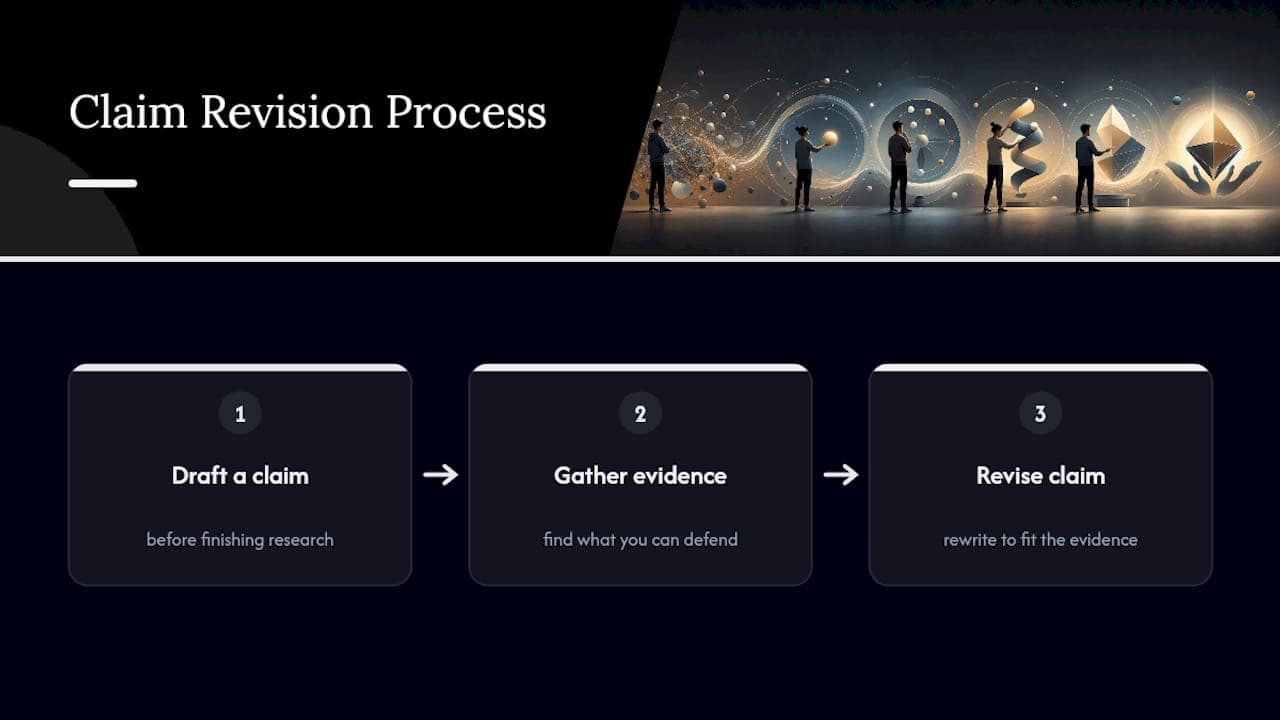
Most guidance on claim writing treats it as a one-time task: draft a sentence, move on to body paragraphs. That's backwards. The strongest claims in student writing almost always look different in the final draft than they did in the outline, because the evidence you find while writing reshapes what you can actually defend.
The conventional advice oversimplifies scope, too. Students are told to "be specific," but rarely shown what specific looks like next to vague, side by side, in their own subject area. That's why the annotated examples above matter more than another rule. Seeing "technology affects education" become a claim about a named tool, a named age group, and a named outcome does more work than any abstract instruction.
If there's one thing to prioritize above the rest, it's this: draft your claim before you finish researching, then rewrite it once your evidence is in front of you. A claim written in isolation from the evidence almost never survives contact with it intact, and that's fine. Treating the thesis as a living idea that evolves with your draft, rather than a fixed sentence you write once, is the difference between an essay that argues something and one that just describes a topic in five paragraphs.
— Tilen
There are tools available that provide a faster way to pressure-test a claim than staring at a blank outline. Instead of guessing whether your thesis is specific enough, you can draft it inside guided essay software, see how it maps to subclaims and structure, then run it through an editor to tighten vague wording into concrete arguments.

The platform's originality checks and citation support for MLA and APA formatting handle the parts that eat up revision time, so you can spend more of it on whether your argument actually holds up. More than a million students and academics have used Samwell to move from a rough idea to a defensible, well-supported essay, and a free tier lets you test the workflow before committing to a paid plan. Start with your working claim, run it through a draft, and see what the tool surfaces about your argument's structure before your next deadline.



