Loading...

TL;DR:
- An AI research assistant automates mechanical research tasks while allowing human control over critical decisions. Samwell.ai is recommended for citation-backed drafting, real-time AI detection, and plagiarism minimization, supporting a structured, human-in-the-loop workflow. Verification of source links and human approval at each stage ensures academic integrity and reduces risks of hallucinations or errors.
An AI research assistant is software that automates mechanical research tasks — literature search, data extraction, citation management, and draft generation — while keeping you in control of every substantive decision. For academic work, the recommended starting point is Samwell.ai, which pairs citation-backed drafting with real-time AI detection and plagiarism-minimization technology built specifically for students and researchers.
Why Samwell first:
Use it to organize literature, extract evidence, draft sections, and verify citations with human oversight at each step.
The short answer: it handles the mechanical layers of research so you can focus on interpretation and argument. Modern tools like Elicit search 125M+ papers and return sentence-level citations for each extracted claim. Web of Science Research Assistant pairs trusted Core Collection data with task-based guidance for literature review workflows. Agentic systems like Gemini Deep Research go further, using a million-token context window to plan multi-stage research runs across dozens of sources.
| Feature category | What the tool does | Output you receive |
|---|---|---|
| Discovery & search | Queries indexed databases by keyword, topic, or DOI | Ranked paper lists with metadata |
| Literature organization | Tags, clusters, and deduplicates sources | Annotated reference library |
| Data extraction & synthesis | Pulls key findings, statistics, and quotes per paper | Structured extraction tables |
| Draft generation | Writes sections with inline citations | Editable draft with source links |
| Citation management | Formats references in MLA, APA, or Chicago | Export-ready bibliography |
| Editing & revision | Flags weak arguments, passive voice, and gaps | Tracked-change suggestions |
The shift worth noting: the market is moving from single-turn chatbots to agentic assistants that decompose a research task into ordered sub-tasks — search, extraction, synthesis, draft — and maintain session memory across all of them. That architecture produces more reproducible outputs, but it requires more upfront configuration than a simple chat interface.
AI handles execution well. It does not handle judgment. The distinction is what separates a credible paper from a liability.

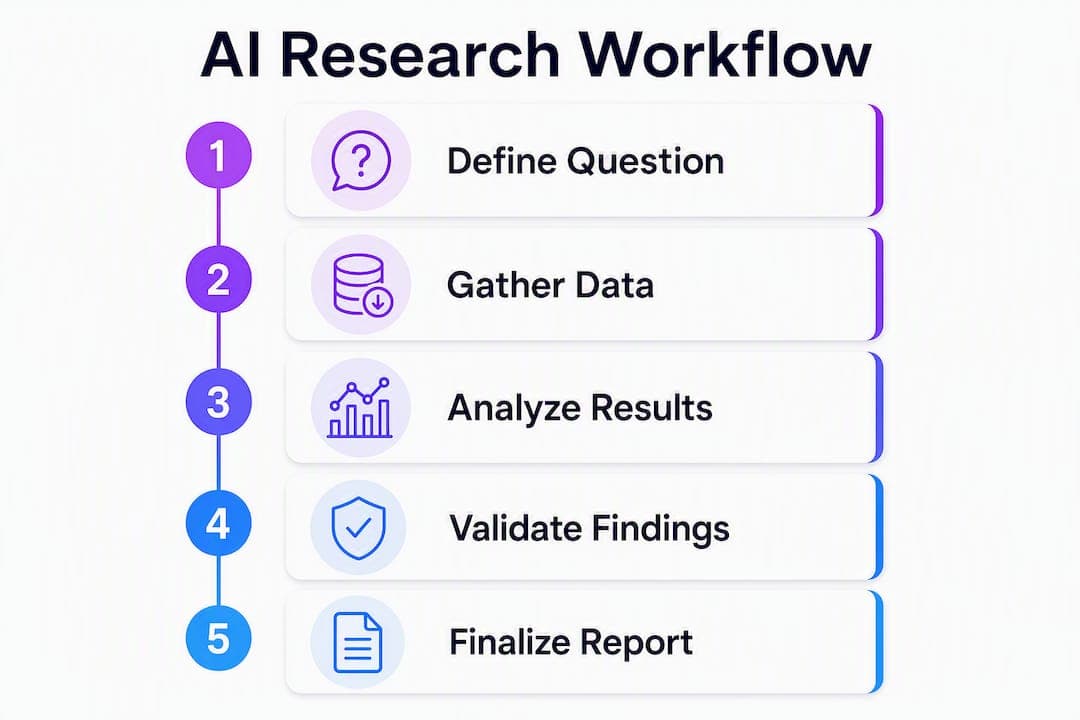
AutoR's 9-stage workflow makes this concrete: AI runs each stage, but a human must approve the output before the next stage begins. Every approved output becomes an artifact stored on disk, making the entire run auditable. That is the standard academic work should hold any AI assistant to.
Pro Tip: Configure your assistant for narrow, auditable runs. Require an artifact export — a saved file of prompts, extracted data, and approved summaries — after each stage. If you cannot export it, you cannot defend it in a thesis review.
A practical workflow with human checkpoints looks like this: intake and scope definition (you set the research question and inclusion criteria) → curated database search (AI proposes, you approve the filter set) → screening and extraction (AI screens titles and abstracts, you verify the top sources manually) → synthesis (AI drafts a summary table, you check every extracted statistic) → draft generation (AI writes with inline citations, you review claim by claim) → verification and edit (you open each cited source) → plagiarism and AI-detection checks → final submission packaging.
Industry guidance is consistent: humans retain final approval at every stage while AI handles the mechanical tasks. Skipping a checkpoint does not save time — it transfers risk to you.
The role of AI in academic writing is to accelerate steps 2–5. Steps 1, 6, 7, and 8 stay with you, always.
Accuracy in academic AI tools comes down to one thing: whether every claim links to a verifiable source passage. Fluent prose with no citation trail is the primary hallmark of an unreliable output.
A practical verification protocol for a single generated claim: open the linked source → use Ctrl+F to locate the cited passage → compare the assistant's language to the original → check that the statistic matches the original table or figure, not a rounded or paraphrased version → note any discrepancy in your artifact log.
Red flags that signal probable hallucination: a citation with a plausible-sounding DOI that returns a 404, bibliographic metadata where the author list or journal name does not match the paper, page numbers that do not exist in the PDF, and statistics that differ from the original by more than rounding. AI citation generators vary significantly in how reliably they handle these edge cases — test any tool against a paper you already know well before trusting it on new literature.
Samwell is built around the workflow described above. Its Guided Essays feature handles intake and structured outlining. The Power Editor covers targeted editing and content expansion at the draft stage. Citation management outputs MLA- and APA-compliant references, and the platform's Semihuman.ai technology actively minimizes plagiarism risk throughout generation, not just at the end.
| Samwell feature | Workflow stage it covers |
|---|---|
| Guided Essays | Intake, scope, and structured outline |
| AI-assisted drafting | Draft generation with sentence-level source citations |
| Power Editor | Human editing, expansion, and claim verification |
| Citation management | MLA/APA formatting and bibliography export |
| Real-time AI detection | Pre-submission integrity check |
| Semihuman.ai technology | Plagiarism-risk minimization during generation |
Trust signals worth noting: Samwell serves over 1,000,000 students and academic professionals, including users from leading universities. The platform's AI detection integration aligns with current institutional policy requirements. Pricing details and institutional licensing options are available directly on the Samwell site — worth checking before committing to a semester-long workflow.
Lead with three non-negotiable criteria: sentence-level citation export, evidence of trusted database indexing, and a clear data retention and deletion policy. Everything else is secondary.
Decision checklist for a free trial:
Questions to ask in a vendor demo: Where does your literature index come from? Do you provide sentence-level citations with source snippets? How do you handle document uploads — are they stored, and can I delete them?
Red flags: no citation links on generated claims, vague source descriptions ("the internet" or "recent studies"), inability to export citation metadata in standard formats, and no stated data deletion policy. Citation management is a non-starter without export capability.
The tools worth knowing break into two categories: source-grounded academic assistants and general agentic research systems.
On the academic side, Elicit is purpose-built for systematic reviews, searching indexed literature and returning structured extraction tables with sentence-level citations. Web of Science Research Assistant layers agentic AI over the Core Collection, which gives it a significant advantage for peer-reviewed source quality. Samwell focuses specifically on essay and research paper generation with built-in plagiarism minimization and AI detection.
General agentic systems like Gemini Deep Research handle broader, web-sourced research with large context windows and multi-stage planning. They are powerful for exploratory work but require more manual verification because their source pools are less controlled than curated academic databases. Feynman, an open-source research agent, supports inline citations and audit trails from the terminal, which appeals to technically comfortable researchers who want full transparency over every run.
The practical split: use a purpose-built academic tool for any work that will be submitted for a grade or publication. Reserve general agentic systems for background reading, brainstorming, and preliminary scoping.
Every document you upload to an AI research assistant is potentially stored on a third-party server. That matters for unpublished research, proprietary data, and anything covered by an IRB protocol or NDA.
Before uploading anything sensitive, check three things: whether the platform's privacy policy covers research data explicitly, whether you can delete uploaded files and when deletion takes effect on their servers, and whether the platform is FERPA-compliant if you are a student at a U.S. institution. Many general-purpose AI tools are not designed with FERPA in mind.
A practical rule: treat any AI platform like a shared computer in a public library. Do not upload raw participant data, unpublished manuscripts under embargo, or proprietary datasets unless the platform's terms explicitly cover confidential research use. For sensitive projects, run the tool locally or use a platform with a documented enterprise privacy tier.
The most effective approach to using an AI research assistant for academic work is to combine source-grounded, sentence-level citations with human sign-off at every major workflow stage.
| Point | Details |
|---|---|
| Require sentence-level citations | Every AI-generated claim must link to a verifiable source passage — no floating assertions. |
| Keep human sign-off at key stages | Approve search filters, extracted data, and final draft before moving to the next step. |
| Run integrity checks before submission | Use both plagiarism detection and AI-detection tools; check your university's policy first. |
| Audit your tool's privacy policy | Confirm data retention terms before uploading any unpublished or sensitive research. |
| Samwell for academic-first workflows | Samwell's Semihuman.ai technology, MLA/APA compliance, and real-time AI detection cover the full workflow from outline to submission. |
The strongest argument for human-in-the-loop AI research assistance is not caution — it is quality. An AI assistant that returns a fluent, well-structured draft with no verifiable citations is actively dangerous for academic work. It creates the appearance of rigor without the substance. The tools that enforce artifact exports, stage approvals, and sentence-level source links produce work that can actually survive peer review or a professor's scrutiny.
The adoption tip that works in practice: run a one-week pilot on a narrow, low-stakes project. Pick a topic with a bounded literature, set strict inclusion criteria, and require an artifact export after each stage. Compare the AI-assisted output against what you would have produced manually in the same time. That comparison will tell you exactly where the tool earns its keep and where your judgment is still irreplaceable. Most students find the tool handles search and extraction well; interpretation and argument remain firmly human territory. That is the right division of labor, and critical thinking in academic writing is what separates a good paper from a great one.
If sentence-level citations, real-time AI detection, and plagiarism-minimization technology are on your checklist, Samwell is built for exactly that. Its Guided Essays feature handles your outline and intake; the Power Editor covers targeted revision; and Semihuman.ai works throughout generation to reduce plagiarism risk before you ever run a final check.
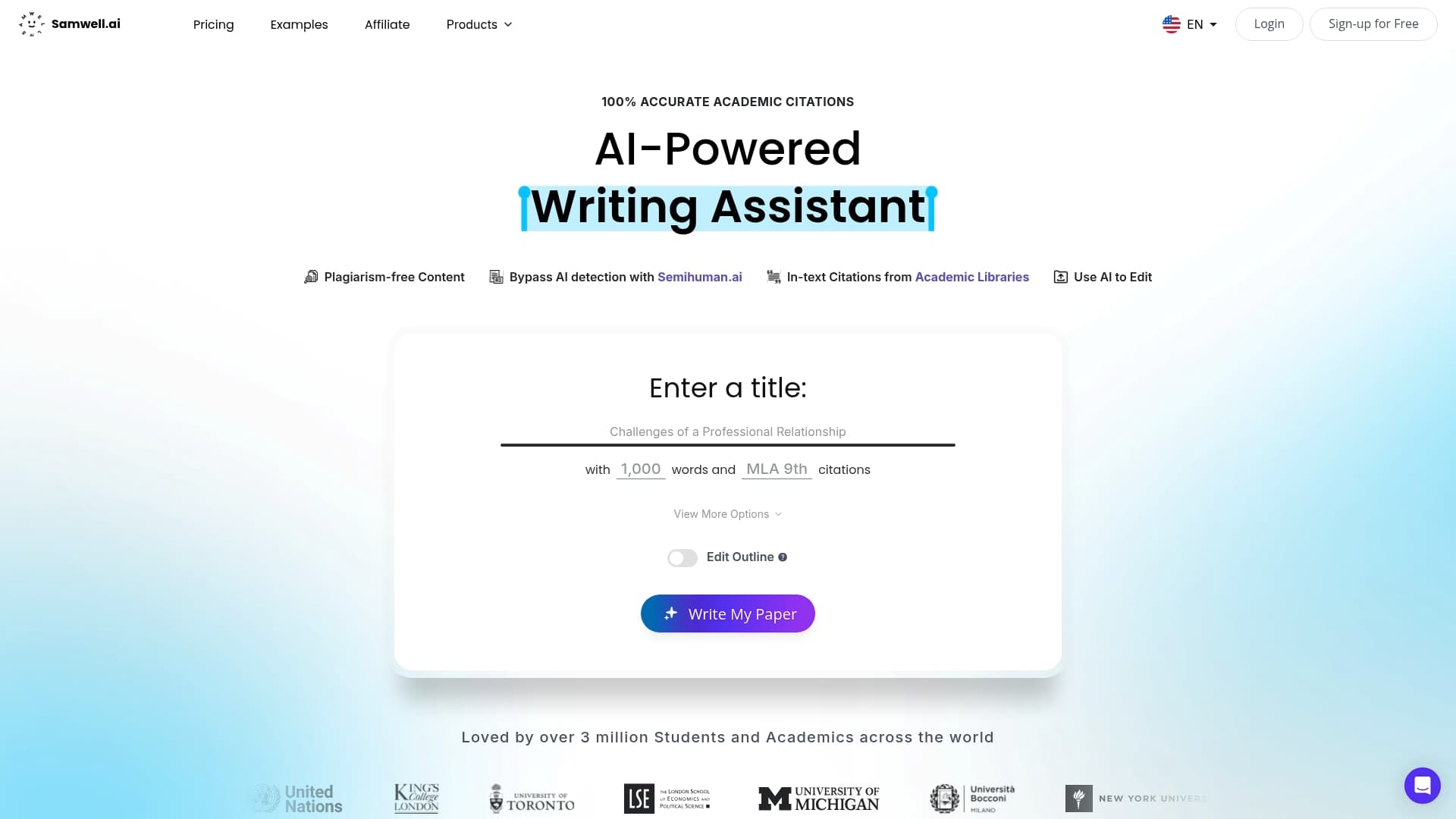
Over 1,000,000 students and academic professionals already use Samwell for research papers and essays that meet institutional standards. The platform supports MLA and APA citation compliance out of the box, so your bibliography is submission-ready without manual reformatting. Try Samwell's research paper assistant and run your first guided essay with full citation tracking today.
Before submitting any AI-assisted work, check your university's current AI use policy and citation rules — institutional standards vary and are updated frequently.