Loading...

TL;DR:
- AI tools significantly increase writing efficiency by assisting with tasks like outlining, grammar, and summarization.
- They excel at mechanical tasks but have limitations in producing original analysis and meaningful insights.
- Responsible use involves verifying citations, personalizing content, and maintaining critical thinking skills.
Strong ideas alone don't guarantee a great essay. The way you structure arguments, catch grammar errors, and synthesize sources matters just as much as your original thinking. AI-powered academic writing tools have quietly become one of the most powerful forces reshaping how students and researchers produce work. Over one million students and academics already use platforms like Samwell.ai to write faster and smarter. This guide breaks down exactly what these tools do, how the technology works, what the research says about their impact, and how to use them without compromising your integrity or your grade.
| Point | Details |
|---|---|
| AI tools boost efficiency | Academic writing tools can make essay and research tasks up to 70% faster without lowering basic quality. |
| Use tools strategically | Let AI handle structure and mechanics, but keep your unique ideas and analysis at the center. |
| Address ethical risks | Avoid plagiarism, citation errors, and skill loss by verifying, personalizing, and properly citing all tool-generated work. |
| Blend AI and human strengths | The most effective academic writing combines the speed of AI with your critical thinking and academic rigor. |
Academic writing has always been labor-intensive. You brainstorm, outline, draft, revise, proofread, and then do it all again. AI tools now handle significant portions of that cycle, and the efficiency gains are real.
According to an ERIC study, AI academic writing tools assist in idea generation, outlining, grammar checking, paraphrasing, editing, proofreading, literature summarization, and providing feedback, speeding up writing by 70% while maintaining comparable quality. That's not a minor convenience. That's a fundamental shift in how academic work gets done.
Here's what these tools actually cover on a practical level:
The role of AI in academic writing extends beyond simple grammar fixes. These tools act as a first-pass editor, a research assistant, and a structural advisor all at once. For students managing multiple deadlines, that combination is transformative.
| Writing task | Average time without AI | Efficiency gain with AI |
|---|---|---|
| Brainstorming | 45 minutes | Up to 60% faster |
| Outlining | 30 minutes | Up to 55% faster |
| Grammar/proofreading | 60 minutes | Up to 75% faster |
| Literature summarization | 90 minutes | Up to 70% faster |
| Paraphrasing sources | 40 minutes | Up to 65% faster |
The data is clear. If you want to boost efficiency with AI, the entry point is understanding which tasks benefit most. Mechanical and repetitive tasks see the biggest gains. Higher-order thinking, like original analysis, still needs you.
Understanding what AI writing means in an academic context is the first step. It's not about replacing your voice. It's about removing the friction that slows you down before you even get to your best ideas.
Understanding these functions, it's critical to look beneath the hood at the technology powering these popular tools.
Most AI writing tools are built on two foundational technologies: natural language processing (NLP) and machine learning (ML). NLP allows a system to understand and generate human language with grammatical accuracy and contextual awareness. ML allows the system to improve over time by learning patterns from massive datasets.
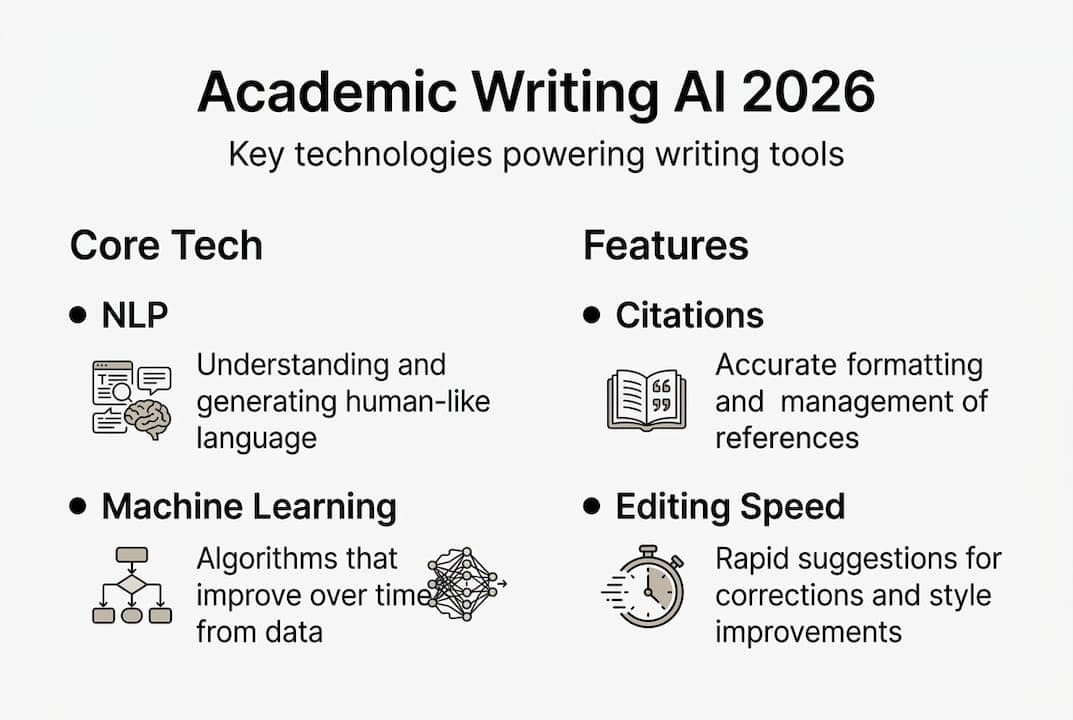
For academic writing specifically, NLP and machine learning power grammar and style corrections, real-time suggestions, and generative capabilities for drafting based on prompts, with models trained on academic texts for context-aware outputs. That last point matters. A tool trained on general internet text will write differently than one trained on peer-reviewed journals and university-level essays.
Here are the main AI-driven features you'll find in top-tier platforms:
These content creation AI tools are not simple autocomplete systems. They reason about context, recognize citation formats, and adjust tone based on the type of paper you're writing.
| Editing type | Human editor | AI tool |
|---|---|---|
| Speed | Slow (hours to days) | Instant |
| Consistency | Variable | High |
| Grammar accuracy | High | Very high |
| Context sensitivity | Very high | Moderate to high |
| Original insight | Very high | Low |
The best academic AI tools combine these capabilities in one platform, reducing the need to switch between multiple apps.
Pro Tip: Use AI for mechanics and structure first. Then read your draft out loud and revise for true academic tone. The places where something sounds off are exactly where your own analysis needs to show up.
Now that we understand the technology, let's look at the actual impact these tools have on academic writing quality and their limits.
"Empirical studies show AI feedback improves essay quality significantly and enhances student engagement and motivation. However, benchmarks reveal that LLMs like ChatGPT and Claude excel in structure and mechanics but lag in depth and novelty compared to human writers."
That finding captures the central tension. AI tools genuinely help students produce cleaner, better-organized work. Students report higher motivation when they get fast, specific feedback rather than waiting days for instructor comments. But the gains are concentrated in surface-level quality.

Here's where AI tools shine versus where they fall short:
Strengths:
Weaknesses:
The latest AI writing trends show that students who use AI tools strategically, meaning for editing and structure rather than full generation, perform better than those who either avoid tools entirely or rely on them completely.
The challenges of AI tools become most visible in upper-level courses where instructors expect original argument development. A tool can help you organize a literature review, but it cannot replicate the insight you develop after reading 30 papers in your field. That gap is real and growing.
For students using essay writing software, the practical lesson is this: measure success by whether your thinking got sharper, not just whether the paper got longer.
Fast, smart writing tools aren't without risks. Here's what every academic needs to know about using them wisely.
The risks are well-documented. Challenges include plagiarism risks, AI detection, over-reliance eroding critical thinking and originality, citation fabrication, biases, hallucinations, and reduced readability in generated text. Citation fabrication is particularly dangerous. Some AI systems generate plausible-looking references that don't actually exist. Submitting a paper with fake citations is an academic integrity violation, regardless of intent.
Ethical concerns go beyond plagiarism. Over-dependence on AI can quietly erode the skills you're supposed to be developing. If a tool always structures your arguments, you never learn to do it yourself. That matters when you're in an exam, a job interview, or a graduate seminar with no AI access.
Here are five best practices to avoid the most common pitfalls:
You can boost efficiency and originality at the same time, but only if you stay in the driver's seat. Tools that include built-in detection checks, like those designed to ensure originality with research engines, help reduce risk before submission.
Pro Tip: Before submitting any AI-assisted paper, run it through your institution's preferred detection tool and read every paragraph as if you're the grader. If a sentence doesn't sound like you, rewrite it.
Here's the honest take that most articles skip: the debate isn't human versus AI. It never was. The real question is whether you're using AI as a tool or letting it use you.
AI is best for mechanical tasks like grammar, formatting, and structure, where the risk of harm is low. It performs poorly on deep analysis and original arguments, and it requires verification, context, and strategic use to be genuinely helpful. Institutions are still developing policies for ethical integration.
The common misconception is that AI will replace critical thinking. The contrarian view, backed by evidence, is that it can actually sharpen your thinking if you use it right. When AI handles the mechanical load, you have more mental space to focus on argument quality, source evaluation, and original insight. That's a genuine cognitive upgrade, not a shortcut.
The practical hybrid workflow looks like this: draft your core argument yourself, use AI to refine structure and mechanics, then revise with your own analysis and verify every claim. Treat AI as an assistant with strong grammar skills but no real understanding of your field. That framing keeps you in control.
Platforms built to boost writing quality with AI work best when you bring the ideas and let the tool handle the polish. That's not a compromise. That's the most effective academic writing strategy available right now.
If this guide has clarified how to use AI tools responsibly and effectively, the next step is finding a platform that actually delivers on those principles.
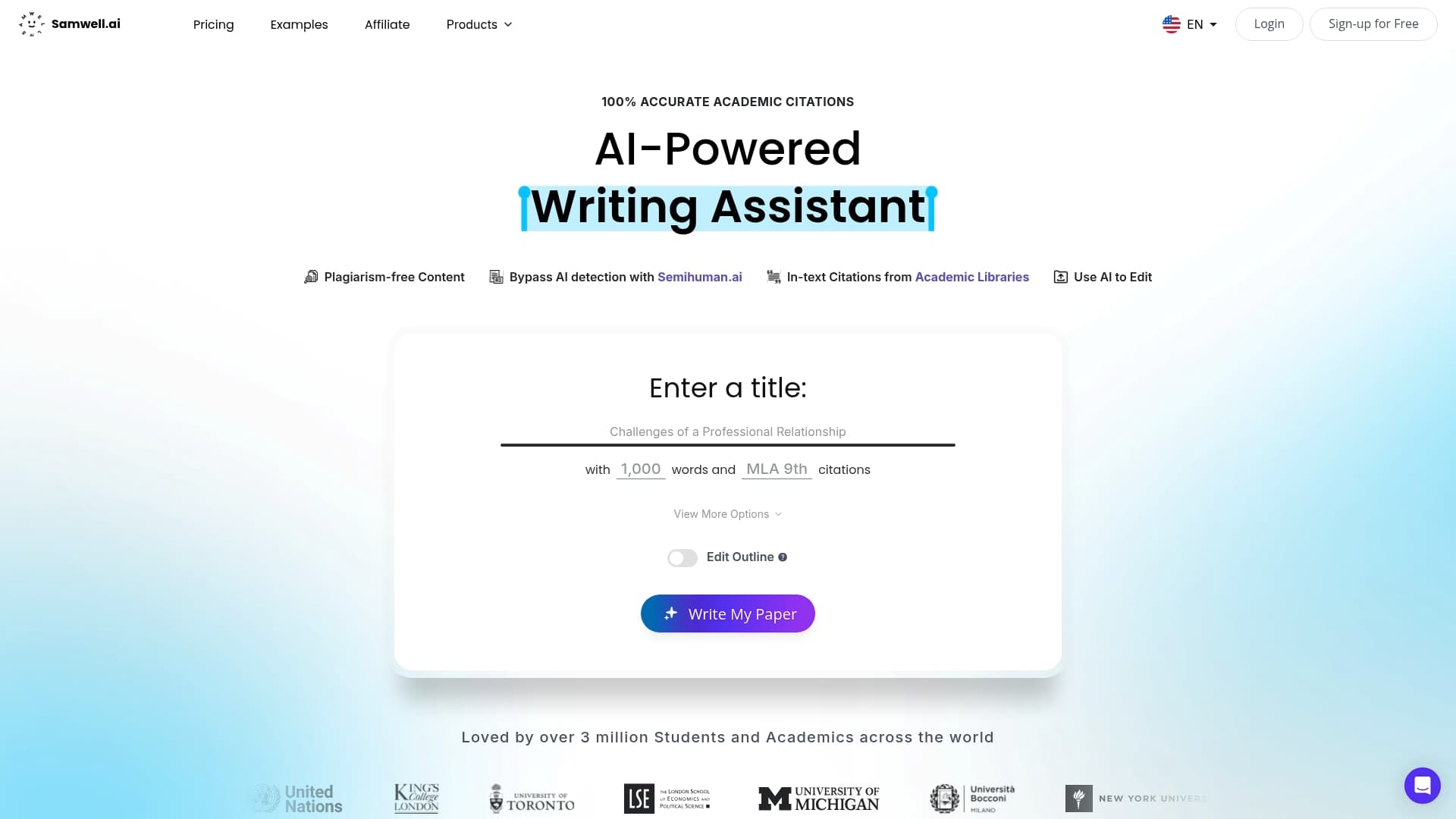
Samwell.ai is built specifically for students and academics who want faster, cleaner, and more original writing without sacrificing integrity. The platform covers the full writing cycle, from structured outlines and guided drafts to real-time AI detection checks and proper citation formatting in MLA and APA. Over one million students from leading universities already use it. If you want to compare top AI writing tools before committing, Samwell.ai's blog breaks down exactly how it stacks up. The tools are ready. Your next paper is waiting.
Using AI tools isn't plagiarism if you verify outputs, personalize the content, and cite sources properly. Submitting AI-generated text as entirely your own work can be detected and penalized by most institutions.
Empirical studies confirm that AI tools improve mechanics and structure significantly, but deeper analysis and original argumentation still require your direct input and judgment.
Most institutions now use detection tools that flag AI-generated patterns, so revising drafts thoroughly with your own voice and analysis is essential before submission.
The primary risks include citation fabrication, loss of original voice, and weakened critical thinking skills. Always verify AI outputs and add your own perspective before submitting.