Loading...

TL;DR:
- Academic style involves clear expression of complex ideas, evidence-based arguments, and discipline-specific conventions. Mastering tone, objectivity, precision, and clarity ensures credible, publishable-level work across various disciplines and assignments. Style guides shape formatting and citation rules but are part of a broader communication system that emphasizes purpose, evidence, and contextual appropriateness.
Most students spend hours agonizing over whether their APA citations are formatted correctly, only to lose points for writing that feels too casual, too vague, or structurally weak. That's because academic style is the writing style used in university and scholarly contexts, aiming to express complex ideas clearly, build arguments from evidence, and contribute to expert discussion. Citations are just one small piece of a much larger puzzle. Mastering academic style means understanding how formal tone, precise vocabulary, evidence-driven reasoning, and discipline-specific conventions all work together to produce credible, publishable-quality work.
| Point | Details |
|---|---|
| Academic style is multi-faceted | It combines formal language, objectivity, and evidence with discipline-specific mechanics and conventions. |
| Style manuals are not the whole story | APA, MLA, and Chicago dictate mechanics, but effective academic style involves clear logic and precise expression. |
| Discipline and context matter | Academic style expectations vary by field, assignment type, and even course guidelines. |
| Check the rubric for clarity | Your rubric often outlines expectations for style, tone, and mechanics—don’t assume one-size-fits-all. |
| Master the toolbox, not just the rules | Being adaptable and intentional with style conventions leads to stronger academic writing and engagement. |
Academic style is frequently misunderstood as a simple checklist: double-space your paper, use Times New Roman, add a reference list. In reality, it represents a complete system of communication with its own logic and purpose. Understanding this system is what separates a passing paper from an exceptional one.
At its core, academic writing style asks you to express complex ideas clearly, build arguments from evidence, and contribute meaningfully to an ongoing expert conversation. Every sentence you write should serve one of these three functions. If a sentence doesn't clarify, support an argument, or add knowledge, it probably doesn't belong.
The core conventions of academic style can be grouped into four pillars:
These four pillars apply across virtually every type of academic writing, from lab reports and literature reviews to argumentative essays and case studies. The specific weight placed on each pillar may shift depending on your discipline or assignment, but none of them ever disappears entirely.
"Academic style is the writing style used in university and scholarly contexts, aiming to express complex ideas clearly, build arguments from evidence, and contribute to expert discussion." — University of Wollongong Academic Skills
One of the biggest misconceptions is that academic style is about restriction, about what you can't do. A more accurate framing is that it's about precision and purpose. Every convention exists because it makes scholarly communication more reliable, transparent, and trustworthy for other researchers and readers in the field.
Once you understand the broad definition, the real work begins in the details. Tone, voice, and word choice are where many students struggle most, partly because these elements are harder to quantify than citation formatting.
Academic writing features a formal, objective tone; precise word choice and clarity; and usually third-person presentation rather than addressing the reader directly or relying on personal judgment, except in certain tasks like personal reflections.
Let's break that down into practical terms:
There is an important nuance here. First-person voice in academic writing is not always forbidden. Personal reflections, some qualitative research methods sections, and certain humanities disciplines actually expect or even require "I" statements. The key is knowing your context and following the conventions of your specific assignment.
Building clear, evidence-driven arguments is one of the most consistent expectations across all academic disciplines, regardless of how other stylistic choices vary.

When structuring an argument, your claim should come first, followed by evidence, followed by your analysis of how that evidence supports the claim. This pattern, sometimes called the CER model (Claim, Evidence, Reasoning), keeps your writing focused and prevents the common habit of listing facts without explaining their significance.
Pro Tip: After drafting a paragraph, read it aloud and ask yourself: "Does this sound like something I'd say in a casual conversation?" If yes, revise it. Strong academic writing reads fluently but formally, like a well-reasoned professional report rather than a chat with a friend.
Style guides are the formal rulebooks of academic writing. They specify everything from how you format a title page to how you punctuate an in-text citation. But their role in shaping academic style goes deeper than mechanics.
Academic style/05%3A_Applying_Style_in_Academic_Writing/5.02%3A_Style_in_Academic_Writing) is not only about citations and formatting styles like APA, MLA, or Chicago. It also concerns rhetorical and stylistic choices, and academic discourse varies significantly across contexts. A style guide tells you how to cite, but academic style tells you why precision and evidence matter in the first place.
The APA Publication Manual is a comprehensive source for scholarly communication style, including mechanics such as punctuation, italics, capitalization, abbreviations, and numbers. It doesn't just format your references. It shapes how you write sentences, how you use numbers, and even how you refer to research participants.
Here's a practical comparison of how the three major style guides differ in focus and application:
| Feature | APA | MLA | Chicago |
|---|---|---|---|
| Primary discipline | Social sciences, education, psychology | Humanities, literature, language | History, arts, some humanities |
| Citation format | Author-date in text | Author-page in text | Footnotes or author-date |
| Reference list title | References | Works Cited | Bibliography or Reference List |
| Tone emphasis | Objective, passive or active | Interpretive, analytical | Narrative, contextual |
| Heading structure | Five levels, strictly defined | Flexible | Flexible |
| Grammar guidance | Extensive (bias-free language, numbers, etc.) | Moderate | Moderate |
Understanding which style guide your assignment requires is only the first step. You also need to internalize that guide's underlying assumptions about how knowledge should be presented. APA emphasizes recency and empirical rigor because its disciplines value up-to-date data. MLA prioritizes textual evidence and interpretation because its disciplines value close reading and analysis.
Explore the key APA and MLA differences to understand not just the formatting distinctions but the philosophical ones that shape your entire approach to evidence and argumentation.
For students working in history or the arts, Chicago citation examples and conventions reveal a writing culture that values narrative context and nuanced sourcing over concise, data-first presentation. If you're new to Chicago style, the MLA manual guide can serve as a useful comparative reference. And if you're still getting comfortable with how formatting choices shape the overall reading experience, start with this academic formatting guide for a solid foundation.
No single version of academic style works for every course, department, or institution. Context shapes expectations in ways that even experienced students sometimes underestimate.
Academic writing conventions vary by discipline, methodological approach, and audience. For social sciences, accepted forms can differ depending on the methodological approach used to gather data and the intended audience for that research.
A psychology paper written for an empirical methods course will look very different from a philosophy paper exploring an ethical argument, even though both belong to the broad category of academic writing. The psychology paper will likely use passive voice in its methods section, report statistical results in precise numerical format, and avoid figurative language entirely. The philosophy paper may use analogies, thought experiments, and rhetorical questions to build a case.
Here is a step-by-step approach for analyzing your assignment prompt to determine what academic style is expected:
Across all these styles of academic writing, one constant remains: your writing should be purposeful, evidence-grounded, and adapted to the expectations of your specific reader.
Pro Tip: Ask your instructor for three to five published journal articles in your field that represent the kind of writing they expect. Read them with your rubric in hand, and annotate choices the authors make about tone, structure, and evidence. You'll learn more about disciplinary style from one hour of active reading than from most style guides.
Here's an uncomfortable truth that most academic writing guides won't say directly: rigid adherence to rules, without understanding why those rules exist, produces mediocre writing. The students who genuinely excel at academic writing treat its conventions as tools they choose deliberately, not constraints they suffer through.
This framing changes everything. Instead of asking "Am I allowed to use first person here?" you ask "Does using first person serve my argument and meet my audience's expectations in this context?" That's a question a skilled academic writer asks. It's also the question your most experienced professors are already asking, even if they've never articulated it that way.
Treat academic style as a combination of three distinct but connected elements: discipline-appropriate rhetorical aims like clear argument and evidence, discourse conventions like formal and precise and objective language, and the required mechanics of the assigned style manual for formatting, citations, and grammar rules.
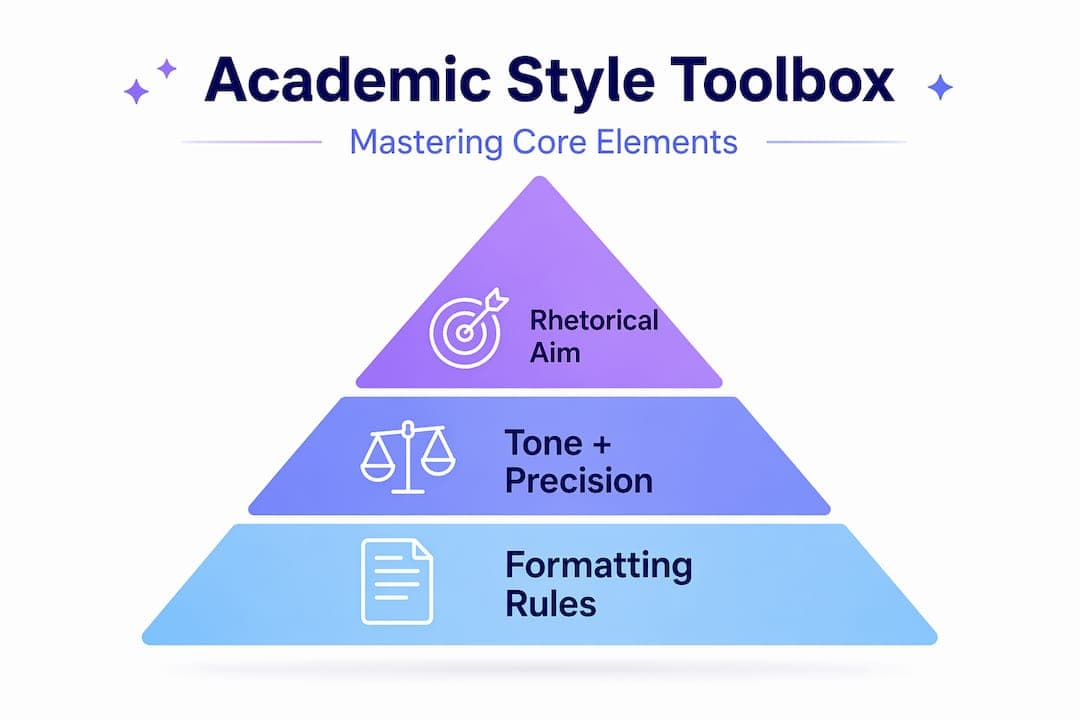
Think of it this way. A carpenter doesn't use every tool on every project. But knowing when to reach for a chisel versus a router, and why, is what separates a craftsperson from someone just following a YouTube tutorial. Academic style works the same way.
Why formatting matters becomes clearer when you understand it as part of a larger communication system, not a bureaucratic requirement. Consistent formatting signals that you understand the conventions of your scholarly community. Precise language shows you can think in that community's terms. Evidence-driven arguments demonstrate you can contribute to its conversations.
The best way to develop this kind of fluency is to read widely in your field. Notice when published authors use first person and when they don't. Notice how they introduce evidence and how they signal uncertainty (using hedging language like "suggests" rather than "proves"). Notice how they structure a paragraph to move from claim to evidence to analysis. Then practice replicating those patterns deliberately in your own writing.
Real mastery of academic style is knowing which tool fits the task, and using it with confidence.
Putting all of this knowledge into practice takes time, and even the most careful writers benefit from a second set of eyes. Modern AI-powered tools can support every stage of your academic writing process, from generating a structured outline to checking whether your tone stays consistent throughout a 5,000-word research paper.

Samwell.ai's AI essay generator is built specifically for academic contexts, helping you structure arguments, maintain formal tone, and stay aligned with the style guide your assignment requires. The platform's Power Editor lets you refine specific sections, tighten your vocabulary, and expand thin arguments with evidence-grounded content. If you're tackling a longer project, the research paper generator guides you through disciplinary conventions from the first outline to the final reference list. With over 1,000,000 students and academic professionals already using Samwell.ai, it's built to meet the real demands of university-level writing while keeping your work original and credible.
No. Academic style/05%3A_Applying_Style_in_Academic_Writing/5.02%3A_Style_in_Academic_Writing) encompasses rhetorical choices, tone, precision, and argumentation that exist independently of any specific citation format. Style guides are one component of academic style, not the whole picture.
First-person voice is generally permitted in reflective assignments, certain qualitative methods sections, and some humanities disciplines. For most other academic tasks, third person is preferred because it emphasizes evidence over personal opinion.
Beyond citations, instructors assess tone, clarity, and objectivity alongside how well your writing demonstrates precision, use of evidence, and adherence to the discourse conventions of your discipline. A rubric referencing "academic style" typically covers all of these dimensions together.
Yes. Postgraduate writing generally demands greater disciplinary fluency, higher originality of argument, and more sophisticated integration of sources. Expectations for complexity, critical depth, and independent scholarly voice all increase as you advance through academic levels.