Loading...

TL;DR:
- Academic paper structures vary greatly by discipline, with IMRaD common in sciences and argument-based in humanities.
- Outlining before writing ensures clarity, efficiency, and adherence to discipline-specific norms.
- Proper structure enhances credibility, makes ideas more accessible, and simplifies peer review and citation.
Most students assume every academic paper follows the same rigid template. That assumption causes real problems. The truth is that structure varies significantly by discipline, paper type, and publication context. The standard structure for empirical scientific papers is IMRaD (Introduction, Methods, Results, Discussion), but humanities papers often rely on argument-driven or thematic frameworks instead. Choosing the wrong structure can undermine your credibility before a reader even reaches your argument. This guide breaks down the core frameworks, explains when each applies, and gives you practical tools to write with greater efficiency and confidence.
| Point | Details |
|---|---|
| IMRaD is foundational | The Introduction, Methods, Results, and Discussion format is the cornerstone for most scientific papers, promoting clarity and reproducibility. |
| Discipline drives structure | Paper organization varies by academic field, so always check your discipline’s preferred approach. |
| Structure boosts efficiency | Organizing your paper with a clear framework reduces writing stress and improves your impact and credibility. |
| Adapt for your assignment | Consult guidelines and adapt your headings or sections accordingly to meet your specific requirements. |
Academic paper structure is the organizational blueprint that determines how ideas, evidence, and arguments are arranged on the page. It exists for a practical reason: readers (especially reviewers and professors) need to locate information quickly and assess the logic of your work without getting lost. Structure is not about following arbitrary rules. It is about communicating clearly.
The IMRaD format mirrors the scientific method and became dominant in STEM and social sciences during the 20th century as journals needed a consistent way to present experimental research. Before IMRaD, scientific writing was far more narrative and inconsistent, making it difficult to compare studies or reproduce results. IMRaD solved that by giving every reader a predictable map.
But not all disciplines adopted IMRaD. Humanities, law, and many social science fields still favor structures built around argument development, thematic analysis, or narrative progression. Understanding the academic writing overview for your field is the first step toward choosing the right framework.
Here is a quick comparison of the two dominant structural families:
| Feature | IMRaD (empirical) | Humanities/argument-driven |
|---|---|---|
| Primary goal | Report findings | Develop and defend a claim |
| Section order | Fixed | Flexible |
| Common in | Sciences, medicine, psychology | Literature, history, philosophy |
| Literature review | Embedded in Introduction | Often standalone |
| Tone | Objective, passive voice common | Analytical, first-person allowed |
The main components of each structural type include:
"The adoption of IMRaD as a global standard transformed scientific communication by making research universally readable and reproducible across disciplines and languages."
Knowing which family your paper belongs to is the single most important structural decision you will make.
With the foundation set, let's move into the specific nuts and bolts of the IMRaD structure many papers now use.
IMRaD increases reproducibility and clarity by reflecting the actual process of scientific discovery. Each section has a distinct job, and understanding that job helps you write more efficiently and cite more accurately.
Here is how each section functions:
A simple outline for a 3,000-word empirical paper might look like this: Introduction (400 words), Methods (600 words), Results (700 words), Discussion (900 words), References.
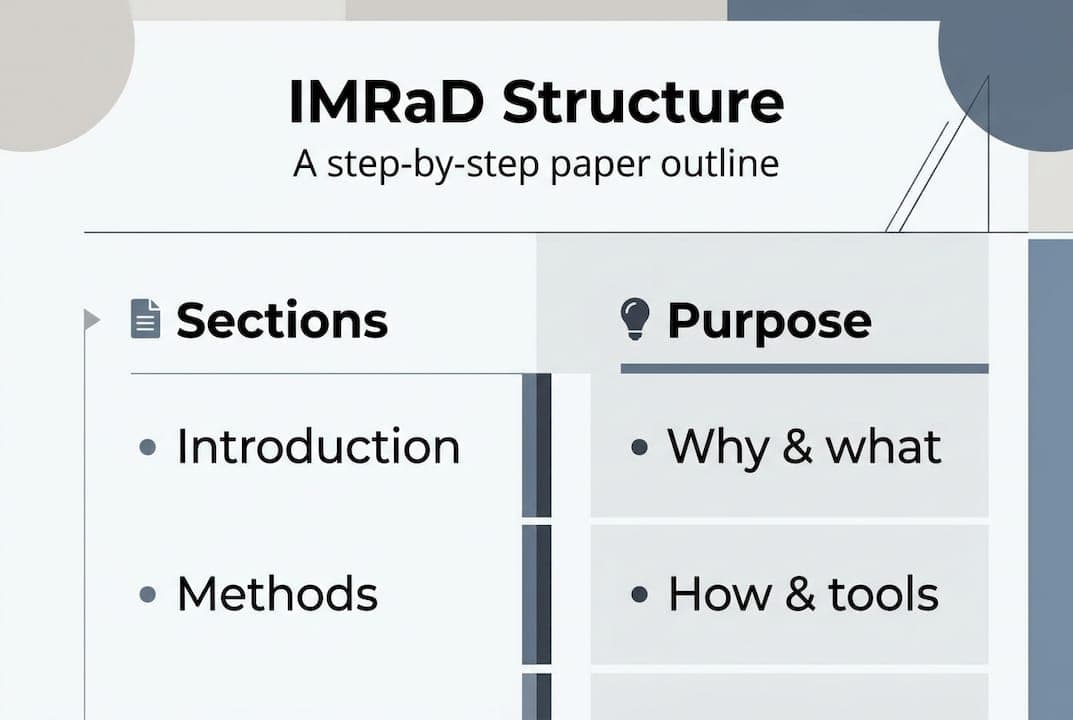
This table shows the core question each section answers:
| Section | Core question answered |
|---|---|
| Introduction | Why did we study this? |
| Methods | How did we study it? |
| Results | What did we find? |
| Discussion | What does it mean? |
For citation practices, IMRaD is particularly useful. The USC guide on academic writing notes that citations cluster naturally in the Introduction (supporting the gap claim) and Discussion (connecting findings to prior work), making it easier to manage references systematically.
Pro Tip: When you draft your IMRaD paper, write the Methods section first. It is the most concrete and easiest to complete, and it anchors everything else you write afterward.
But one size does not fit all. Here is how academic paper structure shifts depending on your discipline or level.
Different disciplines combine or split sections in ways that reflect their unique research traditions. Computer science papers, for instance, often merge Results and Discussion into a single section. Qualitative social science papers frequently add a standalone Literature Review before the Methods. Humanities papers may skip Methods entirely and organize body sections around themes or arguments.
Here are some common field-specific structural differences:
This table compares three common paper outlines across disciplines:
| Section | Natural science | Social science | Humanities |
|---|---|---|---|
| Opening | Abstract + Introduction | Abstract + Introduction | Introduction with thesis |
| Background | Brief lit review in Intro | Standalone Literature Review | Extended context section |
| Core content | Methods, Results | Methodology, Findings | Thematic argument sections |
| Closing | Discussion, Conclusion | Discussion, Conclusion | Conclusion |
For papers that require a literature review, understanding how to approach organizing literature reviews and presenting lit reviews effectively will save you significant revision time. The way you adapt IMRaD sections to your field signals to reviewers that you understand disciplinary norms.
Pro Tip: Before you write a single word, locate the style guide or submission guidelines for your target journal or your professor's assignment brief. The required structure is almost always specified there, and ignoring it is the fastest way to lose credibility.
Adapting the right structure is just the start. Here is how you can use structure to your advantage in practice.

The most effective way to master structure is to outline before you write. This sounds obvious, but most students skip it and pay for it in revision time. A solid outline forces you to decide where every argument, piece of evidence, and citation belongs before you commit to prose.
Here is a reliable outlining process:
Common pitfalls to avoid include skipping required sections (especially the Abstract or Discussion), using inconsistent heading levels, mixing citation styles within a single paper, and writing a Results section that includes interpretation (that belongs in Discussion).
IMRaD reduces cognitive load for both writers and readers, which directly boosts writing efficiency. When you know exactly what goes where, you stop second-guessing every paragraph.
"Structured writing is not a constraint on thinking. It is the architecture that makes complex thinking visible and persuasive to others."
For papers that include literature reviews, knowing how to approach introducing a literature review and concluding literature reviews correctly keeps your structure tight. If your paper uses APA, reviewing APA format examples before you finalize your draft will help you catch formatting errors early. The academic writing guide from USC is also a reliable free resource for checking structural and citation conventions.
Pro Tip: After completing a first draft, read only your section headings and the first sentence of each paragraph. If those alone tell a coherent story, your structure is working. If they do not, reorganize before polishing prose.
Most writing advice frames structure as a limitation, a cage that keeps your ideas from running free. That framing is backwards. Structure is actually what gives your ideas room to breathe and be heard.
Think of structure as scaffolding on a building under construction. The scaffolding does not determine what the building looks like. It holds everything in place while the real work happens. Without it, the whole thing collapses before anyone can appreciate the design.
The academics who struggle most with peer review are often those who prioritize creative expression over structural clarity. Reviewers are busy. If they cannot find your hypothesis in the Introduction or your limitations in the Discussion, they question the quality of your thinking, not their own reading. Your ideas get dismissed not because they are weak, but because they are hard to locate.
Learning to write scientific papers or argument-driven essays within a clear structure actually forces you to think more precisely. You cannot hide vague reasoning in a well-structured paper. Every section demands a clear purpose, and that pressure makes your argument stronger. Structure does not suppress creativity. It makes your contribution impossible to ignore.
If you want to make mastering academic paper structure easier, here is how Samwell.ai can help.
Samwell.ai is built specifically for students and academics who need to produce well-structured, properly cited papers efficiently. The platform's Guided Essays feature walks you through selecting the right structure for your paper type, whether that is IMRaD for a lab report or a thematic outline for a humanities essay.

The Power Editor lets you expand or refine individual sections without disrupting the overall structure, and real-time citation checks ensure your references stay consistent with APA, MLA, or other required formats. Over 1,000,000 students from leading universities already use it to cut revision time and improve submission quality. Explore the complete writing guide to see how structured writing and AI assistance work together.
The IMRaD format is the norm for scientific research, covering Introduction, Methods, Results, and Discussion. Humanities papers typically use argument-driven or thematic structures instead.
Use a standalone literature review when field guidelines require it, or when writing a thesis, dissertation, or comprehensive academic paper where the scope of prior research needs its own dedicated space.
Yes. A standard structure like IMRaD reserves sections for references, which makes it easier to place citations accurately and consistently throughout your paper.
Review your assignment brief and check field-specific guidelines from your professor or target publication. Consistency with disciplinary norms improves both readability and credibility.
Yes, as long as it aligns with your discipline's expectations. For example, combining Results and Discussion is common in computer science and some engineering fields.