Loading...

An essay about love works best when it opens with a claim, not a question. Here is a thesis template you can paste and adapt right now:
"Love, as I have lived it, is less a feeling than a decision — one I made [specific moment] and have been making ever since."
That single sentence does three things at once: it stakes a position (love as choice, not chemistry), it signals voice (first person, reflective), and it promises a story. Those three elements — voice, stake, and a hint of evidence — are what every strong opening needs.
Three quick elements every opening should show:
As scholars note, treating love as a single fixed biological fact is the most common error in thinking about it. The best essays treat love as a fluid construct shaped by biography and story — which means your lived experience is your primary source.
A strong about love essay opens with a specific claim grounded in lived experience, develops it through concrete anecdote and analysis, and cites any outside ideas with proper MLA or APA attribution.
| Point | Details |
|---|---|
| Lead with a thesis, not a definition | Open with a claim about love drawn from your own experience, not a dictionary entry. |
| Match structure to word count | Use 3–4 paragraphs for 200 words, 5–6 for 500, and 4–5 for 800–1,000 words. |
| Choose one focused angle | Pick a single theme (romantic, familial, philosophical) and develop it fully rather than surveying all types of love. |
| Cite every borrowed idea | Use MLA or APA inline citations for quotes and paraphrases; run a similarity check before submission. |
| Samwell for structure and polish | Use Samwell's Guided Essays and Power Editor to scaffold your outline and expand thin paragraphs, then verify citations automatically. |
Use this length for short-response assignments, personal statements, or warm-up drafts. Economy is everything here. Think of it the way short spoken essays work on radio: one image, one turn, one landing.
Sample (200 words):
My grandmother kept a jar of buttons on her windowsill. Every Sunday she sorted them — not because they needed sorting, but because my grandfather had given her the jar on their first anniversary. He died before I was born. She sorted those buttons for forty years after.
That is what love looks like to me: not the grand gesture, but the repeated small one. Philosophers debate whether love is an emotion, a commitment, or a biological drive. My grandmother never read those debates. She just sorted buttons.
I think the most honest essays about love start here — in the specific, the ordinary, the almost embarrassing in its smallness. Love resists the abstract. Every time a writer tries to define it from the outside, it slips away. Every time a writer shows it from the inside — a jar, a Sunday, a habit — it holds.
This essay is my attempt to hold it.
Notes: One central image carries the whole piece. No definition, no survey of theories. The thesis arrives in the final line as a restatement of purpose.
At 500 words you have room for a brief introduction, two developed body paragraphs, and a conclusion. The micro-outline looks like this:
Keep each paragraph to a single idea. The most common 500-word mistake is cramming three arguments into one paragraph and developing none of them.
At this length, add a third body paragraph that introduces a counterpoint or complication. Does love always look the way your opening claimed? A brief acknowledgment of complexity makes the essay more credible, not weaker.
Suggested paragraph word ranges for 1,000 words:
Pro tip on pacing: If you are over the word limit, cut adjectives and adverbs before cutting ideas. If you are under, add one more specific sensory detail to your central anecdote — not another argument.
A three-act outline fits both short and long assignments.
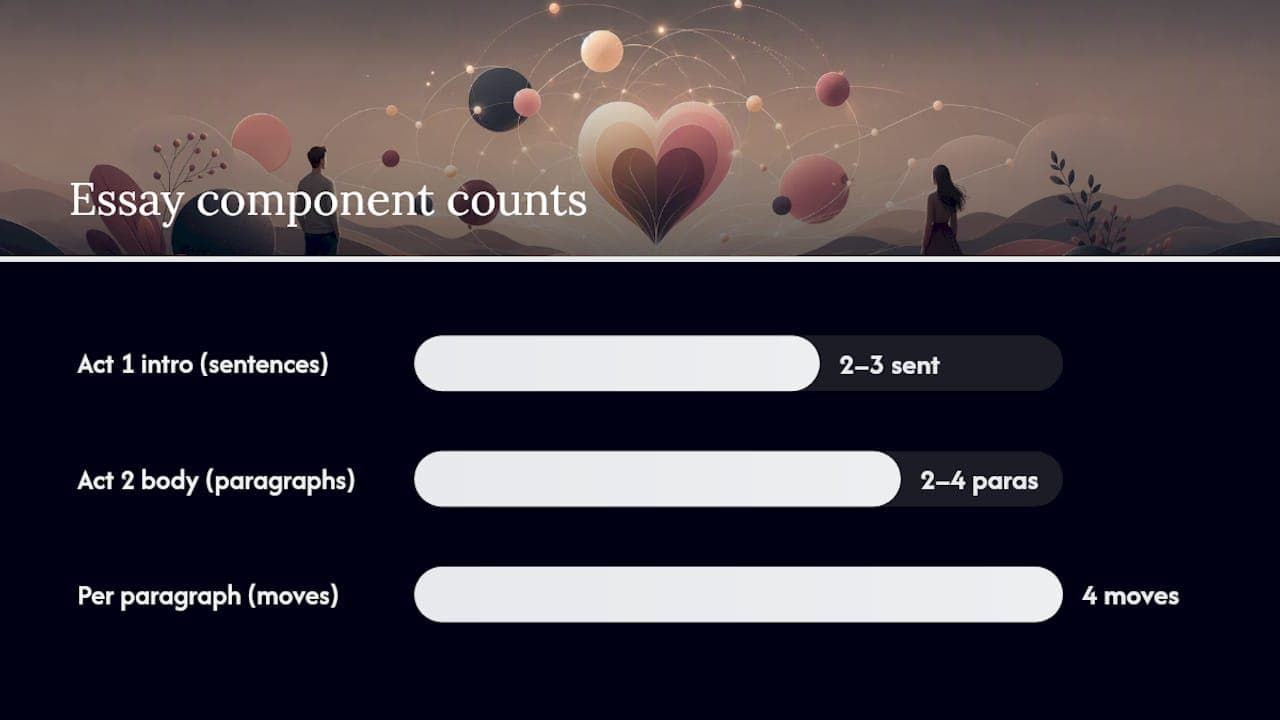
Act 1 — Introduction: Open with a scene or image (two to three sentences), then state your thesis. Avoid starting with a dictionary definition of love; it signals to the reader that you have nothing original to say.
Act 2 — Body paragraphs (2–4): Each paragraph should show before it tells. The sequence that works: (1) present a specific anecdote or example, (2) interpret what it reveals, (3) connect it to your thesis, (4) reflect on what you now understand that you did not before.
Act 3 — Conclusion: Return to the opening image with new meaning. Do not summarize — transform. The reader should feel the essay has moved somewhere.
Transition examples:
When inserting a quote or literary reference, place it inside a body paragraph after your own sentence, not at the start. Emerson's essay "Love" models this perfectly: he opens with personal observation, then expands outward to cultural and philosophical reflection. Follow that sequence, not the reverse.
Vague essays about love fail because they try to cover everything. Pick one angle and go deep. Here are eight distinct approaches:
Choose the angle that connects to something you have actually experienced. Borrowed themes produce borrowed prose.
Do's and don'ts:
Robert Louis Stevenson argued that convincing writing on love is grounded in the writer's lived experience rather than detached theorizing. That is still the best single piece of craft advice for this genre.
Pro Tip: Place your most vulnerable sentence in the middle of a paragraph, not at the end. Ending on vulnerability reads as a plea for sympathy. Burying it mid-paragraph and then analyzing it reads as courage — and that is what earns the reader's trust.
Editing checklist:
For more sentence-level revision strategies, the writing advice guide at Samwell covers practical craft tips worth bookmarking.
Reading strong models is the fastest way to improve your own essay. Here is a short annotated list:
When you read these, do not copy content. Copy technique: notice where the writer places the thesis, how they handle transitions, and when they choose to go abstract versus concrete.
A responsible workflow looks like this:
Tasks you can responsibly outsource: proofreading, citation formatting, grammar checks. Tasks that must stay yours: the argument, the analysis, the interpretation of your own experience.
For guidance on turning personal anecdotes into analytic paragraphs, the reflective essay guide at Samwell walks through each step. If you want to see how other writers handle sensitive personal material, the writing about intimacy considerations resource covers responsible disclosure.
The essays about love that stay with readers are not the ones with the most elegant sentences. They are the ones where the writer clearly told the truth about something specific. Vulnerability in an essay is not weakness — it is the mechanism by which a private experience becomes a shared one. The boundary worth keeping is not between what is emotional and what is analytical, but between what is genuinely yours and what you borrowed because it sounded right. Avoid sharing details that could harm you or someone else; a pseudonym or a slight change of context protects real people without sacrificing honesty. The goal is not confession. It is clarity.
Writing a strong personal essay about love is hard. Getting the structure right, expanding thin paragraphs, and formatting citations correctly are the parts that eat time without adding meaning.
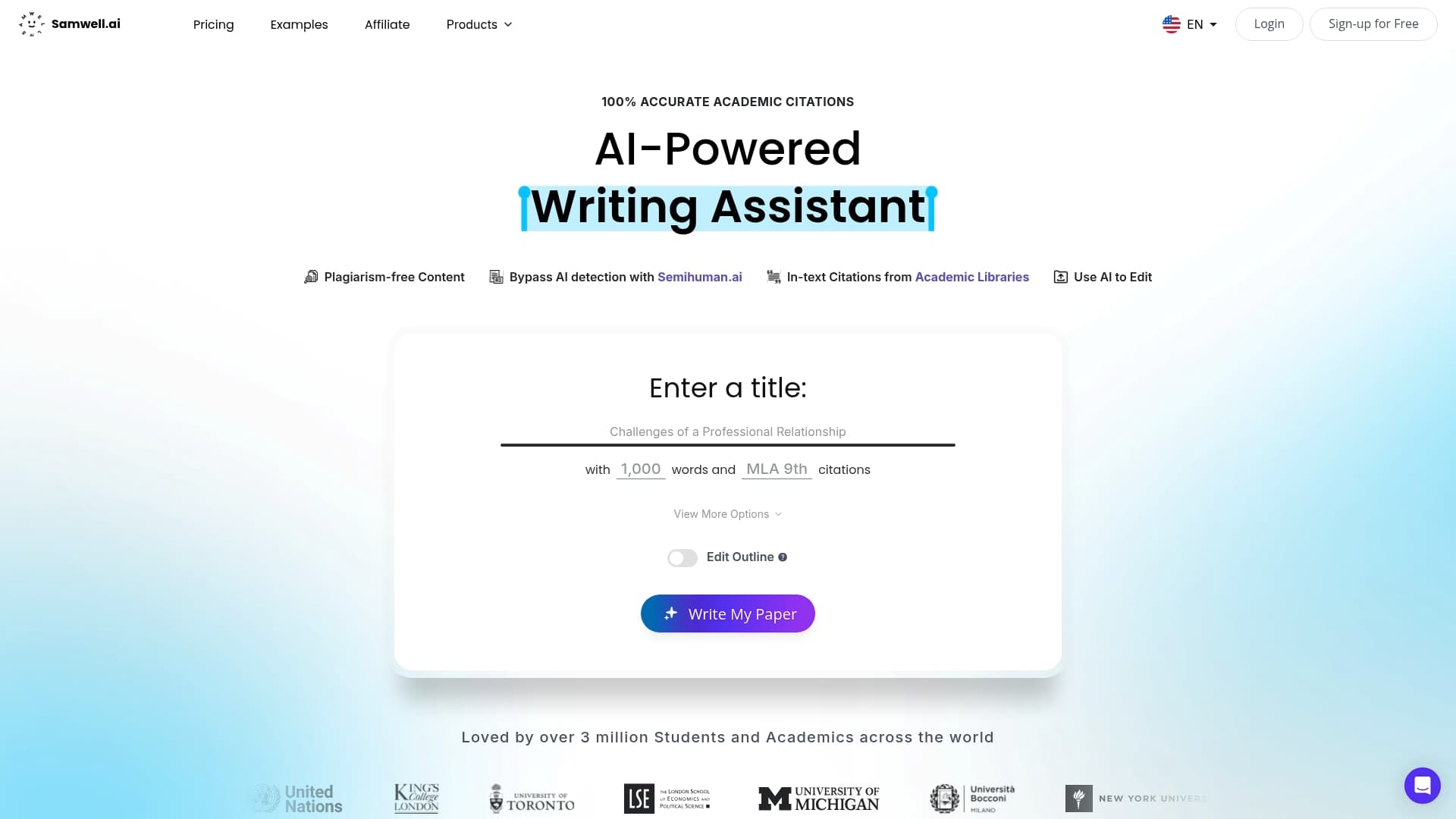
Samwell's Guided Essays feature gives you a structured outline built around your thesis — so you start with a skeleton, not a blank page. The Power Editor expands underdeveloped paragraphs at the sentence level, which is exactly what 500-word essays need when a body paragraph runs thin. Citation helpers format MLA and APA references automatically, cutting the formatting work to minutes. Over 1,000,000 students have used Samwell to draft, expand, and check their academic writing.
One practical workflow: enter your thesis into Samwell's guided outline tool, draft each section yourself using the outline as a scaffold, then use the sentence expansion tool to develop any paragraph that feels underdeveloped. Run the similarity check before submitting. Always check your instructor's AI disclosure policy first — Samwell is a tool for polishing and structuring, not a replacement for your own analysis.