Loading...

A writer should revise an argumentative essay for ideas and organization before touching a single comma. That means testing your thesis, confirming each paragraph earns its place, and pressure-testing your evidence against real counterarguments. Grammar comes last. Do the structural work first and you often find whole paragraphs need to move, merge, or disappear entirely.
TL;DR:
- The thesis must be debatable, scope-appropriate, and explain how or why, with revisions based on insights from the draft rather than initial assumptions.
- Paragraphs should clearly serve the thesis, summarized with a single claim, structured with PEEL, and flagged if they lack a connection or contain redundant points.
- Evidence should be relevant, authoritative, recent, sufficient, and accurately represented, while counterarguments must be honestly acknowledged and rebutted with strong support.
- Sentence-level clarity requires active voice, direct verbs, consistent subjects, and removal of unnecessary modifiers, with reading aloud to identify unclear or awkward phrasing.
- Revision is most effective when spaced, starting with structural review, then evidence, followed by style, with external feedback focused on weak points and dissonance detection.
Your thesis is the one sentence every paragraph has to answer to, so start there. If it fails, everything built on it wobbles too. Run it through three quick tests before you touch anything else.
Drafting often teaches you things your outline couldn't predict. Maybe your evidence points to a narrower claim, or a stronger one you hadn't considered. That's normal. Revision at George Mason University's writing center describes exactly this: re-evaluating the thesis is core to seeing the draft again, not a sign you did something wrong the first time.
Pro Tip: Rewrite your thesis so the second half previews your reasoning, not just your conclusion. "Social media harms teen mental health" states a position. "Social media harms teen mental health because algorithmic feeds reward outrage over accuracy" previews the argument you still have to prove.
Once the thesis holds up, check whether your paragraphs actually serve it. The fastest diagnostic is a post-draft outline: go paragraph by paragraph and write, in one line, what each one argues. Nothing else. This takes about five minutes and exposes gaps that are invisible when you're reading straight through.
The reverse-outline usually reveals two or three paragraphs that don't belong where they are, sometimes not at all.
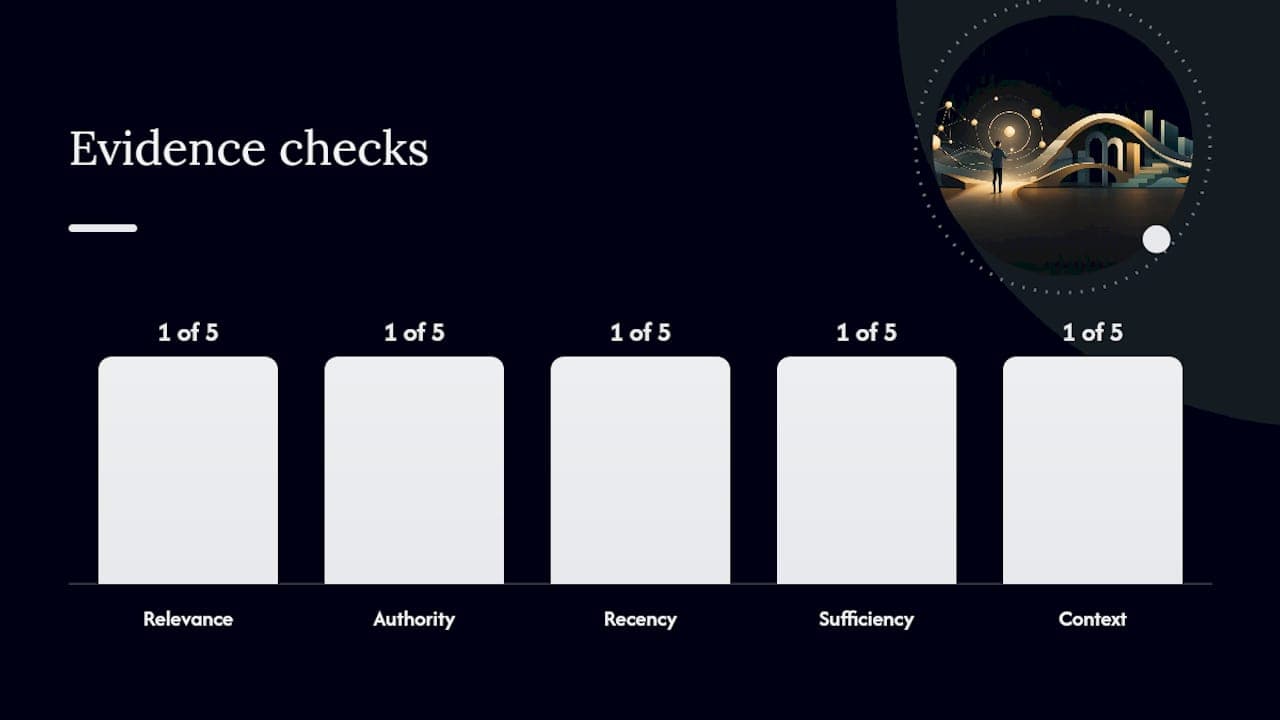
Weak evidence sinks a strong thesis faster than almost anything else. For every source you cite, run it through five checks:
Then address the other side. State the strongest counterargument honestly, in a sentence or two, before you rebut it with a specific piece of evidence rather than a vague dismissal. UW-Madison's Writing Center notes that this kind of dissonance-reading, where you actively look for what a skeptical reader would object to, surfaces gaps a straight read-through misses entirely.
Pro Tip: Pick your single weakest source right now and replace it with either a stronger one or a second source that corroborates it. That one swap often does more for credibility than three new paragraphs.
Ideas can be sound and still get lost in bad sentences. Once structure and evidence hold up, work sentence by sentence:
Read your draft aloud. Places where you stumble, run out of breath, or lose your own thread usually mark spots where the thinking underneath the sentence isn't fully worked out yet, not just awkward phrasing. LibreTexts's guide to revising for clarity makes the same point: sentence-level clarity affects how an argument is received, not just how it reads. Keep technical terms when the audience expects them; simplify everywhere else. For more on this, see this guide on improving academic writing.
Revising immediately after finishing a draft rarely works well. You're too close to the choices you made to see them clearly. Give it at least a day if your deadline allows, longer if possible, before starting a major pass.
Before submitting, run a short last-pass check: does the introduction still match the thesis you ended up with? Does the conclusion echo your strongest point rather than introducing a new one? Are citations formatted consistently? This academic writing checklist covers the mechanical items worth confirming at this stage.
Ask someone who's likely to disagree with your position, not just a friend who'll say it's fine. Give them three specific questions: Where does the argument feel weakest? What would you push back on? Where did you get confused? Vague feedback like "looks good" tells you nothing.
Turn every piece of feedback into a specific task: not "fix paragraph 3" but "add a source for the claim in paragraph 3."
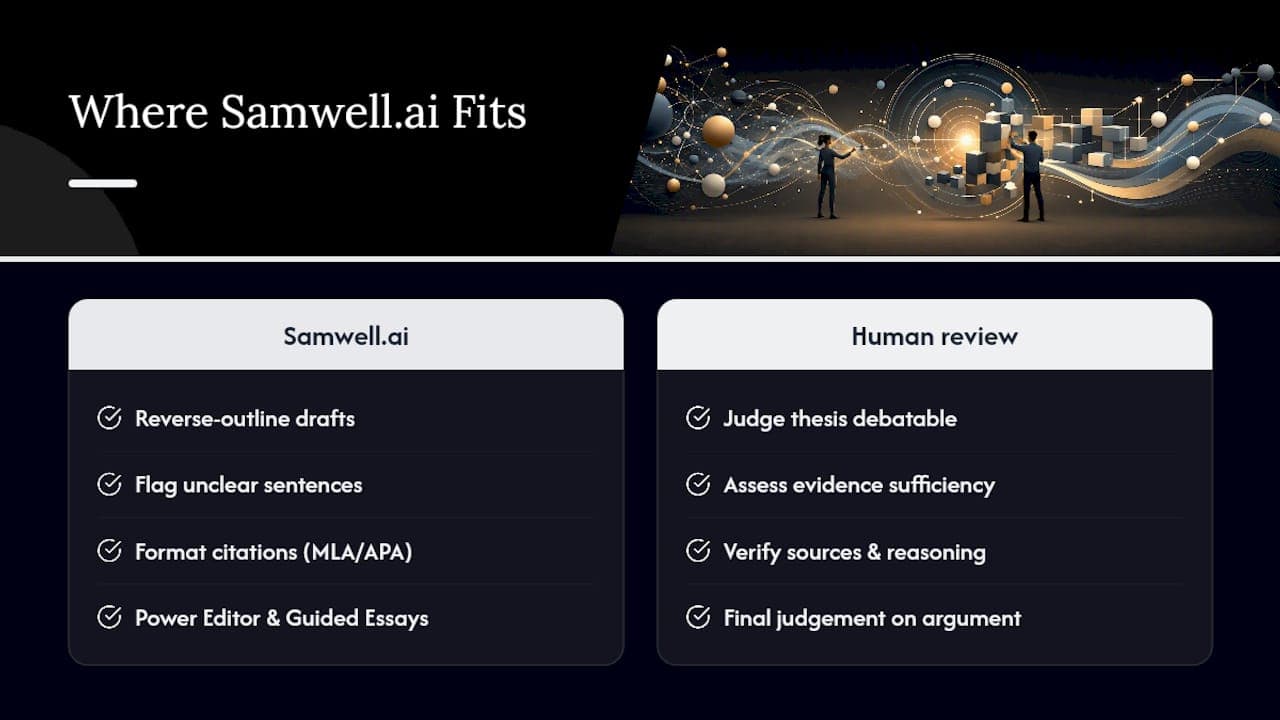
Samwell.ai handles the mechanical parts well: reverse-outlining a draft, flagging unclear sentences, and formatting citations in MLA or APA. The Power Editor and Guided Essays tools map directly to those tasks. What it can't do is judge whether your thesis is debatable or your evidence sufficient. Use it to speed up structure and clarity checks, then verify sources and reasoning yourself.
Test the thesis before anything else. Make every claim earn its evidence. Seek out disagreement, not approval. Right now, spend ten minutes reverse-outlining your current draft. You'll see the problem before you finish the list.
— Tilen
You've done the hard part: testing your thesis, checking paragraph logic, weighing evidence. The tedious part, reformatting citations, catching passive constructions, restructuring a clunky paragraph, doesn't need to eat another hour of your night.
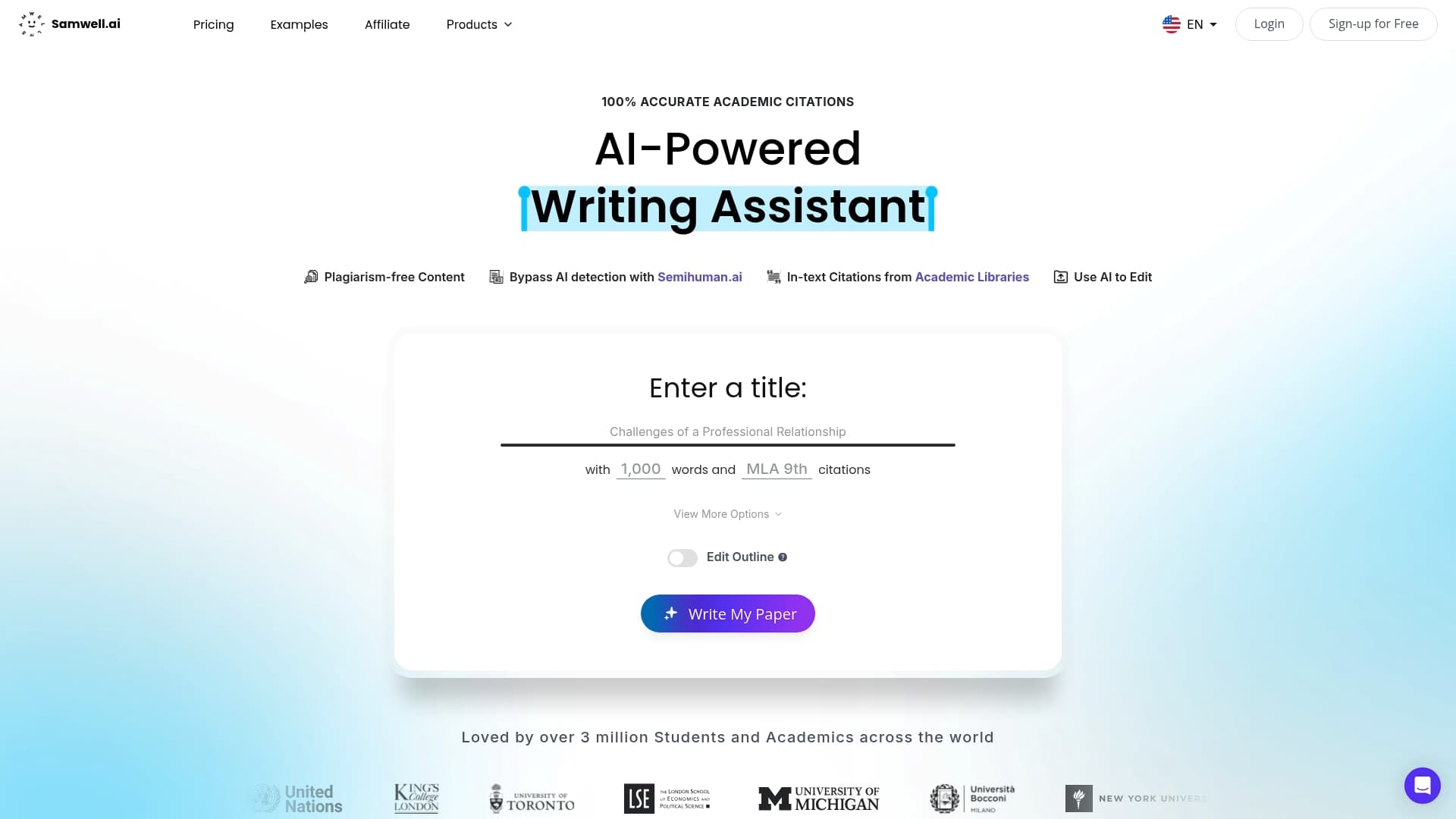
Samwell.ai's Power Editor generates a reverse-outline of your draft, flags unclear sentences, and checks citation formatting against MLA and APA standards, so the mechanical revision work gets done in minutes instead of a full evening. It's built for students juggling multiple drafts and deadlines who still want the argument judgment to be theirs, not the software's. If you've already run the checks in this guide and want help tightening what's left, try the enhanced essay creator and see what it catches in your current draft.