Loading...

500 words is typically about one page single-spaced or two pages double-spaced using the standard academic setup of 12-point Times New Roman and 1-inch margins. That's the number Grammarly and most style guides land on, and it holds up as a reliable default for essays, cover letters, and short assignments.
Change the font or spacing, though, and that number shifts. Switch to 12-point Arial single-spaced and you're looking at roughly 1.1 pages; double-spaced, that climbs closer to 1.8 pages. The safest move is always to check your specific document rather than trust a generic rule.
500 words fills about 1 page single-spaced or 2 pages double-spaced at 12-point Times New Roman, but font, size, and margins can shift that by nearly a full page.
| Point | Details |
|---|---|
| Standard conversion | 500 words equals roughly 1 page single-spaced or 2 pages double-spaced at 12pt Times New Roman. |
| Font choice shifts totals | Arial and Calibri run wider or narrower than Times New Roman, changing page count by a fraction of a page. |
| Handwriting varies widely | Handwritten 500 words often runs close to 2 typed-page equivalents, but personal handwriting size changes this. |
| Verify with your own tools | Word, Google Docs, or a words-to-pages calculator give the exact count for your specific formatting. |
| Editing tools help hit the mark | Samwell's Guided Essays and Power Editor help structure and trim a 500-word essay to fit exact requirements. |
Academic formatting settled on 12-point Times New Roman with 1-inch margins for a reason: it's dense enough to fit real content per page, legible enough to grade quickly, and standardized enough that professors and admissions readers can eyeball length without measuring anything. It's the baseline nearly every conversion table, including CalculatorHero's, builds from.
Font choice moves the needle more than most writers expect. Times New Roman is a narrow, efficient serif font, which is exactly why it became the default. Swap it for Arial, a wider sans-serif font, and the same 500 words spreads across more visual space, pushing you a fraction of a page longer. Calibri, Microsoft's default font since Office 2007, sits somewhere in between: slightly more compact than Arial but still looser than Times New Roman.
Font size does something similar, just more aggressively. Here's roughly how 500 words behaves at common sizes, double-spaced:
Margins and paragraph breaks matter too, though they're easy to overlook. Standard 1-inch margins on all sides leave the most usable space per page; widen them to 1.5 inches and you'll burn through a page faster. Heavy paragraphing (short paragraphs with frequent breaks) also eats space, since each new paragraph leaves a partial line of white space behind it.
Quick reference: A commonly cited baseline puts double-spaced academic writing at roughly 250 words per page, which is exactly how 500 words becomes "about 2 pages" under standard settings, a figure that lines up with CalculatorHero's conversion guidance.
Handwriting throws the typed-page math out the window. A reasonable rule of thumb is that 500 handwritten words often stretches to roughly 2 typed-page equivalents, but that varies enormously depending on how large someone writes, how wide their line spacing runs, and whether they're using wide-ruled or college-ruled paper.
Estimates get you close. A live word processor gets you exact. Both Microsoft Word and Google Docs track word count in real time, and checking it takes seconds.
Pro Tip: Paste one full page of your intended formatting into a brand-new document, then run word count on just that page. Whatever number comes back is your real, personal words-per-page figure, more reliable than any generic table because it accounts for your actual font, margins, and paragraph habits.
| Formatting Setup | Approximate Pages for 500 Words |
|---|---|
| 12pt Times New Roman, single-spaced | about 1 page |
| 12pt Times New Roman, double-spaced | about 2 pages |
| 12pt Arial, single-spaced | about a little over 1 page |
| 12pt Arial, double-spaced | about close to 2 pages |
| 11pt Calibri, single-spaced | slightly under 1 page |
| 11pt Calibri, double-spaced | about 1.5 pages |
| Handwritten (average size) | about 2 pages |
These figures track with conversion data from Wordcountr and Word Counter, though your word processor will always give you the exact count for your document.
Samwell.ai works with a platform built specifically around academic writing at scale, supporting more than a million students and academics who need essays that hit precise length and formatting targets. Features like citation management for MLA and APA, plus the Semihuman.ai approach to reducing plagiarism risk, exist because short-form academic writing has zero room for padding.
For help structuring the piece itself, Samwell's guide on organizing a 500-word essay breaks down paragraph counts and flow.
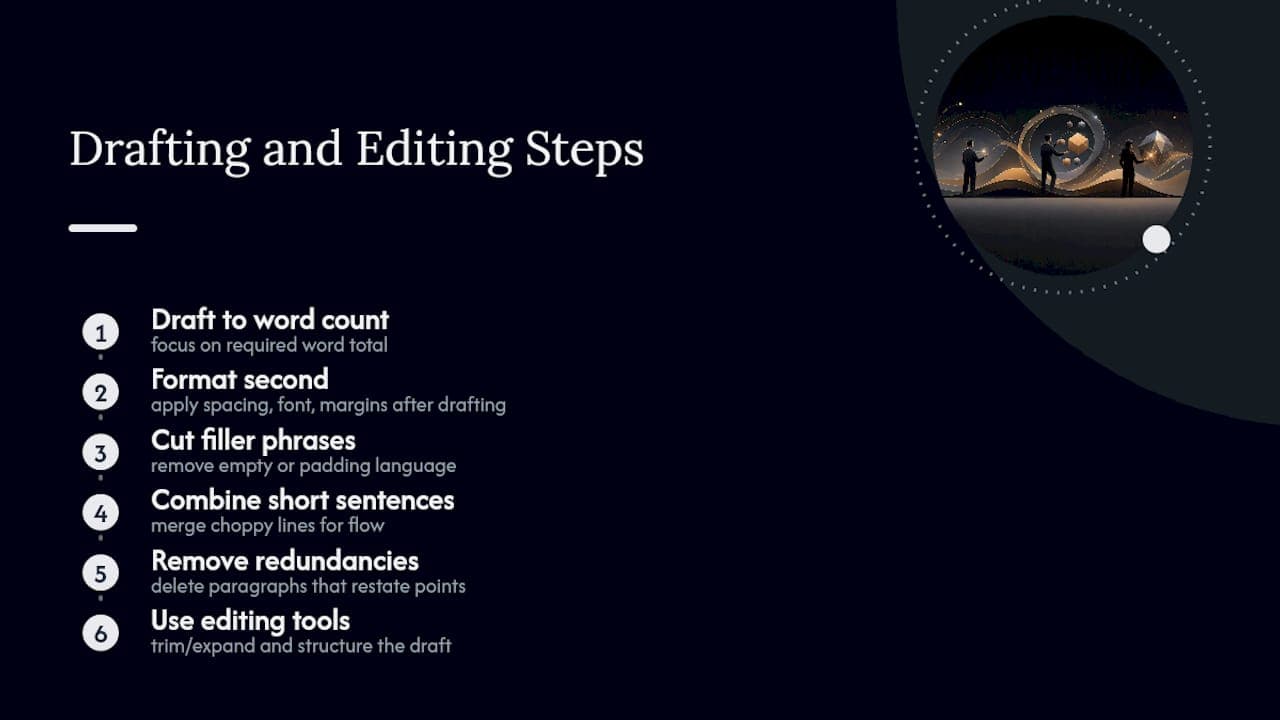
Draft to the word count first. Format second. Trying to hit "two pages" while writing tends to produce padded sentences and repeated points just to fill space, when the actual target, whether it's an admissions portal or a professor's rubric, is almost always a word count.
Once the draft is written, editing is where length gets fixed. Cut filler phrases, combine short choppy sentences, and remove any paragraph that restates a point already made. Tools like Samwell's Power Editor are built for exactly this kind of trimming and expanding, and Guided Essays can help structure the draft correctly the first time so there's less to cut later.
— Tilen
Getting the word count right is only half the job. The other half is making every one of those 500 words count, and that's where most drafts fall apart under a tight limit. Samwell's Guided Essays feature builds a structured outline before you write a single sentence, so paragraphs land in the right order without wasted space. Once a draft exists, the Power Editor targets specific sections to trim bloated phrasing or expand a thin paragraph, without you rewriting the whole piece by hand.
Students working on admissions essays, scholarship applications, or short assignments get the most out of this combination, since those formats reward precision over volume. If your draft is running long, short, or just needs a tighter final pass, enhance your essay with Samwell.ai and see exactly what's worth keeping.