Loading...

Aim for a concise introduction, substantial evidence-driven body content split across multiple sections, and a brief conclusion. Draft your methods, results, or core evidence first, write your introduction and abstract last, and use a tool like Samwell to keep citations organized as you go. That's the whole plan. Everything below just fills in the details.
TL;DR:
- Draft your strongest arguments first and write the introduction and abstract after completing the core content to ensure alignment.
- Limit body paragraphs to roughly 175-260 words and ensure each one advances the argument with a clear topic, evidence, interpretation, and mini-conclusion.
- Include citations during drafting to prevent source misplacement, as in-text citations count toward the 2,500-word limit, but the bibliography usually does not.
- Spell out "two thousand five hundred" in formal writing, with style-dependent conventions for hyphenation and the use of "and" in number phrasing.
- Use structured outlines and specialized tools to plan and tighten your 2,500-word paper efficiently, especially when facing strict deadlines.
The math is simpler than it looks. A medium-length academic paper breaks down into three functional zones with typical word targets for introduction, body, and conclusion sections.
That body chunk is where most students get it wrong. Cramming everything into three or four bloated paragraphs makes each one do too much work, while stretching to 15 short paragraphs leaves every point underdeveloped. A word count guide from TextPulses notes that essays crossing the 2,500-word mark need actual sectioning and deeper argument, not just longer paragraphs stacked on top of each other. Eight to twelve body paragraphs, averaging 175 to 260 words apiece, tends to hit that sweet spot.
In page terms, 2,500 words runs about 9 to 10 pages double-spaced in 12-point Times New Roman, or roughly 5 pages single-spaced. That estimate shifts with font, margins, and heading frequency, so treat it as a rough guide rather than gospel.
Before you draft a single sentence, confirm one thing with your instructor or style guide: does the bibliography count toward the limit? Most don't, but some assignments fold in footnotes or appendices, and guessing wrong here costs you either padding time or a frantic last-minute cut. Samwell's guide on paragraph structuring for academic papers walks through how paragraph counts scale with target length if you want a deeper reference point.
Writing in the order the final paper will read is one of the most common ways students waste time. A CASRAI guide on research writing recommends drafting Methods first, Results second, then Introduction and Discussion, and saving the Title and Abstract for last. Why? Because you can't accurately summarize a paper you haven't finished writing yet, and drafting the frame before the content invites mismatch between what you promised and what you delivered.
The same logic applies to argumentative essays: draft your strongest evidence and analysis sections first, then build the introduction around what you actually argued, not what you planned to argue three days ago.
Two schedule templates:
Pro Tip: Attach each citation to its claim the moment you write the sentence, not after. A Scribbr guide to research papers points out that citing during drafting, rather than reconstructing sources during revision, is what actually prevents lost references and accidental misattribution.
A paragraph that doesn't advance the argument is dead weight, no matter how well it's written. The reliable anatomy for an academic paragraph runs four beats: a topic sentence that states the claim, evidence that backs it, interpretation that explains why the evidence matters, and a mini-conclusion that ties back to your thesis.

Skip the interpretation step and you get a paragraph that's just a citation dump. Skip the mini-conclusion and the reader has to do the connecting work themselves, which is exactly the job you're supposed to be doing for them.
A few rules of thumb that hold up across most assignments:
Word-count rules vary by institution, which is exactly why this trips up so many students. The near-universal default: in-text citations count toward your total, while the bibliography or reference list usually does not. "Usually" is doing real work in that sentence, though, so confirm it with your instructor or the assignment brief before you finalize anything.
Footnotes and endnotes are murkier territory. Short citation footnotes typically don't count, but substantive discursive footnotes (the kind where you're smuggling in an extra paragraph of analysis) sometimes do, depending on the department's style guide.
A quick checklist worth running before submission:
Samwell's guide to citing research papers covers the formatting mechanics in more depth if your assignment mixes styles or requires footnote citations.
Most students blow past 2,500 words by repeating the same claim in three different sentences, not by having too much to say. Editing tools that flag repeated phrasing, like Samwell, catch this faster than a fresh read-through usually does, since repetition is easy to miss in your own writing.
A trimming sequence that works in most cases:
If you're under the limit instead, resist the urge to pad. Add a counterargument and rebuttal, bring in a second piece of supporting evidence, or work in a brief concrete example that illustrates your abstract point. All three add real analytical weight instead of filler.
Pro Tip: Run a targeted edit rather than a full rewrite when you're close to your target. Samwell's Power Editor is built for exactly this: expanding a thin paragraph or tightening a bloated one without touching the rest of the draft.
Spelled out in full, 2,500 is written as "two thousand five hundred." That's the standard form for formal writing, checks, and legal documents, and it's the version most style guides default to when a number needs to appear in text rather than digits.
You'll also see it written as "twenty-five hundred," which is common in spoken American English and casual writing but less standard in formal academic or legal contexts. Both refer to the same number; the difference is register, not accuracy.
A few formatting notes that matter more than they seem:
That last point trips people up constantly: a sentence should never start with a numeral, so "2,500 students were surveyed" needs to become "Two thousand five hundred students were surveyed" or, more naturally, restructured entirely.
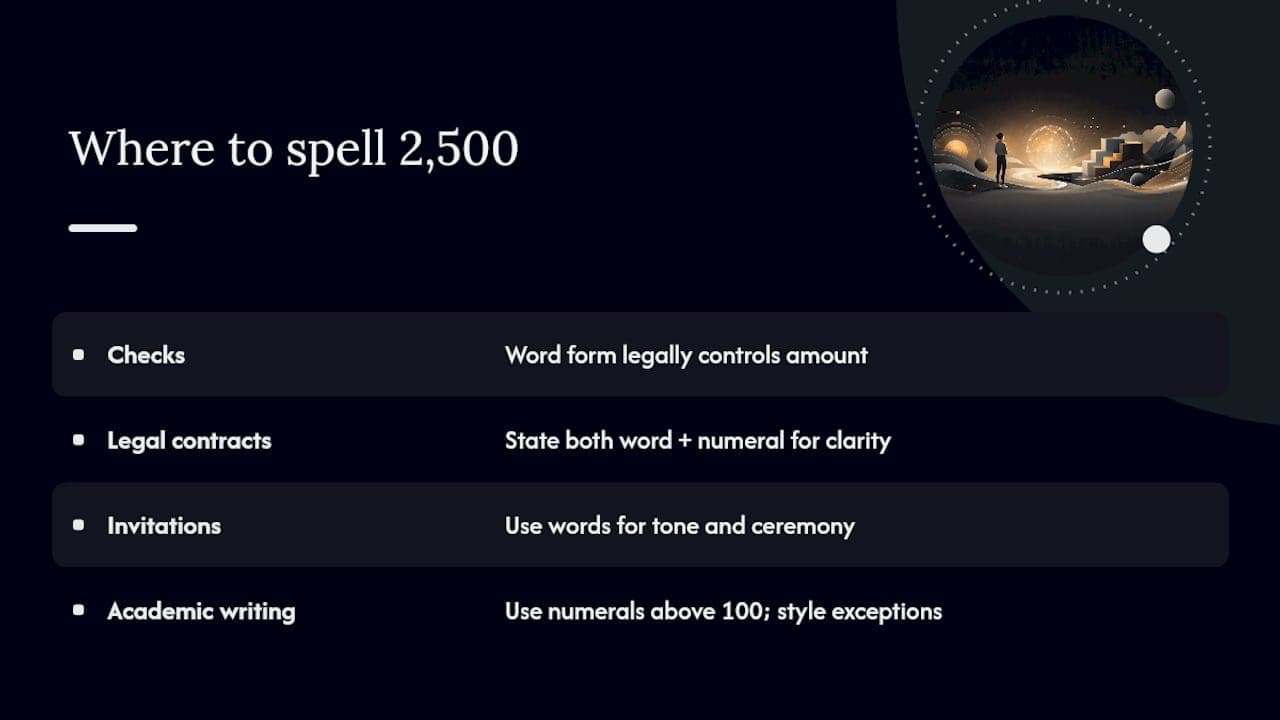
Spelling out numbers isn't just an academic quirk. It shows up anywhere precision and fraud prevention matter more than brevity.
Checks are the clearest example. When you write a check for $2,500, the numeral goes in the small box, but the word form, "Two thousand five hundred and 00/100," goes on the line below it. That's not stylistic preference. It's a legal safeguard: if the numeral and the written amount ever disagree, banks are instructed to honor the written words, since digits are far easier to alter than a spelled-out phrase.
Legal contracts follow the same logic. A lease specifying a $2,500 security deposit will often state "two thousand five hundred dollars ($2,500.00)," pairing both formats so there's no ambiguity if the document is ever contested in court.
Formal invitations and certificates use the word form for tone rather than security. "Two thousand five hundred attendees" reads as more deliberate and ceremonial than "2,500 attendees" in a printed program or commemorative plaque.
Academic and journalistic writing sits in between. Numbers under 100 typically get spelled out, and numbers above that threshold, including 2,500, are usually left as numerals unless the sentence begins with the number or the publication's specific style guide says otherwise.
Understanding which context you're in matters more than memorizing a single rule. A check and a research paper follow completely different conventions for the exact same number, and getting it backward, numerals on a check's written line, or a word-form number buried mid-sentence in a report, reads as a mistake even when the math is correct.
The core difference between American and British English number-writing comes down to one small word: "and."
In American English, 2,500 spelled out is "two thousand five hundred," full stop. British English inserts "and" between the hundreds and the rest: "two thousand five hundred," but for a number like 2,525, British style renders it "two thousand five hundred and twenty-five," while American style drops the "and" entirely, giving "two thousand five hundred twenty-five."
This isn't a trivial stylistic tic. It shows up consistently enough that editors treat it as a dialect marker, similar to spelling differences like "color" versus "colour." If you're writing for a British academic journal or a UK-based publication, dropping the "and" reads as distinctly American, and inserting it in American academic writing will look like an error to a US-based instructor or copyeditor.
Currency conventions diverge too. British English sometimes uses "two thousand five hundred pounds" where American English defaults to "twenty-five hundred dollars" in informal contexts, though formal financial and legal writing in both dialects tends to favor the fuller, more explicit "two thousand five hundred" construction.
For students writing internationally, or submitting to journals with a specific house style, checking which convention the publication follows takes thirty seconds and prevents a copyeditor from flagging what looks like a numeracy error but is really just a dialect mismatch.
Three mistakes show up constantly across 2,500-word essays and research papers, and none of them are about writing ability.
The first is starting with the introduction. Students draft an opening paragraph that promises an argument they haven't fully worked out yet, then spend the rest of the paper trying to match it. Draft your evidence and analysis first, as CASRAI's guide recommends for research papers, and write the introduction once you know what you actually argued.
The second is uneven paragraph development. One paragraph gets 400 words of attention because it's the writer's favorite point; another gets 60 words because time ran out. Samwell's Guided Essays feature builds a section-by-section outline before drafting starts, which keeps that imbalance from happening in the first place.
The third is losing track of sources during revision. Citations get shuffled or dropped entirely when paragraphs move during editing. Samwell's citation tools track sources as the draft changes, and the Power Editor handles the trimming and expansion work covered earlier without requiring a full rewrite.
— Tilen
Samwell turns the workflow in this guide into an actual product: outline first, draft with structure locked in, then edit and check citations without starting over each time. For a 2,500-word paper specifically, that means less time staring at an empty document and more time on the argument itself.
Getting started takes three steps. Sign up for an account, run a Guided Essay to generate a section-by-section outline matched to your word count, then export the draft and use the citation checker and Power Editor to tighten anything that runs long or thin. The research paper generator is built specifically for assignments like this one, where structure and word-count precision both matter as much as the argument.
If your next assignment has a hard 2,500-word ceiling and a deadline that's closer than you'd like, that's exactly the situation this tool is built to handle. Start with an outline instead of a blank page.
For deeper guidance beyond this guide, CASRAI's research paper how-to covers manuscript drafting order in more technical detail, while Scribbr's research paper guidance walks through outlining for beginners.
Samwell's own research paper outline examples and academic paper structure guide both offer templates you can adapt directly to a 2,500-word assignment.